
Red-cockaded woodpeckers successfully transplanted at Wildlife Management Area
Endangered red-cockaded woodpeckers are introduced to Chickasawhatchee Wildlife Management Area.
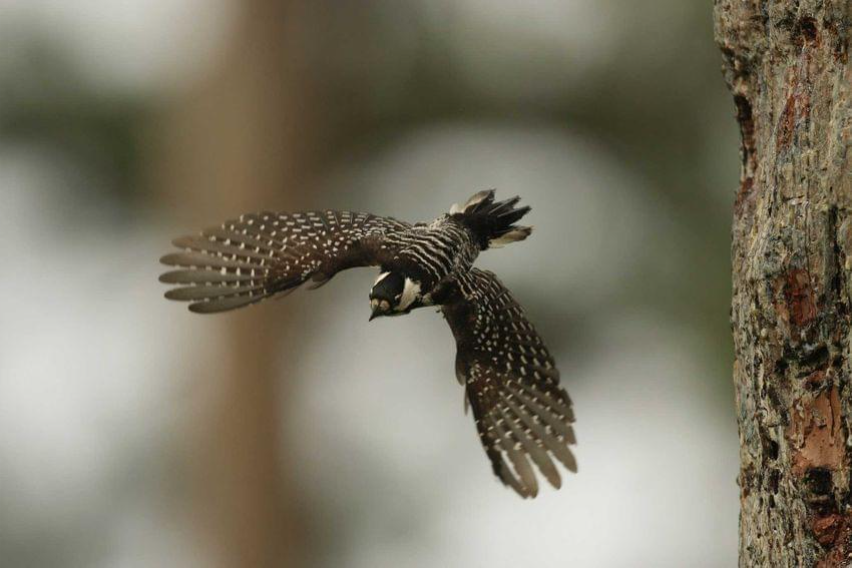
Seven pairs of red-cockaded woodpeckers were released within the Chickasawhatchee Wildlife Management Area recently.
By Tom Seegmueller
DAWSON ‒ An hour before sunrise on Dec. 18, pickup trucks began arriving at a secluded dirt road intersection deep within the Chickasawhatchee Wildlife Management Area. The jovial greetings and sarcastic comments exchanged with each new arrival hinted that this was a gathering of well-acquainted and kindred spirits.
There was also an undercurrent of anticipation as those assembled in the darkness of the intersection waited to receive their final instructions for the landmark release of the federally listed endangered red-cockaded woodpeckers in the WMA.
The bird was listed in the Endangered Species Act of 1973 due to habitat loss and degradation. The species was downlisted from endangered to threatened in October 2024. The downlisting is largely attributed to decades of translocation efforts across the region that involve cooperation across federal and state agencies as well as public-private partnerships.
The successful completion of this translocation was no different and was a collaborative effort between DNR, the Department of Defense (Fort Stewart Army Base), the Jones Center at Ichauway, Tall Timbers, the USDA Forest Service, the Longleaf Alliance, Casto Environmental Services, Quail Forever, and the U.S. Fish and Wildlife Service.
Before a release of this type, parties first have to catch the animal. Coordinated by DNR Senior Wildlife Biologist Joe Burnam, five pairs of birds were captured and transported to the WMA from Fort Stewart in southeast Georgia. Fort Stewart is home to one of the largest populations of red-cockaded woodpeckers in the Southeast and has contributed to translocation efforts since the late 1990s.
Zach Henshaw, a forestry and wildlife biologist from the Jones Center at Ichauway and his team captured another two pairs, increasing the total number of birds being translocated to Chickasawhatchee to seven pairs. The contribution of the two pairs was a fitting tribute to the efforts to restore the woodpecker population at the Jones Center.
On the ride to one of the release sites, Henshaw explained that this was a full-circle moment for the center’s red-cockaded woodpecker program. In just over 25 years, the population there has grown from a single, male bird in 1999 to 57 potential breeding groups (an estimate of 180 birds) in 2025.
This population of stable clusters allowed officials to contribute to this translocation effort. The red-cockaded woodpecker population recovery at the Jones Center was made possible by numerous translocations between 1999-2015. Donor locations include the Apalachicola National Forest, Fort Stewart, Fort Benning Army Base, Eglin Air Force Base, Francis Marion National Forest, Piedmont National Wildlife Refuge, and eight private properties in the Red Hills region.
Before the assembled participants in the recent release left the intersection, Burnham explained that the birds captured less than 12 hours earlier had been transported in specially designed catch boxes to Chickasawhatchee. Upon their arrival each pair was inserted into an individual man-made nest cavity. Screens were then placed over the boxes’ circular openings and stapled in place so the pair of “kidnapped” red-cockaded woodpeckers would remain inside until dawn.
A rope attached to each screen hung down to the ground so that the screens could be removed from the cavity entrance hole without startling the transplanted pair upon their release
Burnham divided those gathered for the release into seven crews, providing each with the GPS coordinates of an overnight nest site. Participants were cautioned to remain quiet so that the early-morning activity of the red-cockaded woodpeckers in the nest could be detected. Once activity was detected the rope to the screens would be yanked and those gathered at the base of the tree were to monitor actions of the freed birds.
As the groups returned to the intersection to report on their release the gathering quickly began to resemble the members of an extended family gathered in a delivery waiting room. With the news of each successful release, the mood became more festive. When the final crew delivered the news that their release had been successful, the magnitude of the moment was palpable.
Each crew reported on the actions of their pair upon leaving the nest, actions that provided visual clues to their physical condition following the translocation as well as the likelihood that they might remain near their release site.
Some of those gathered for the event had put more than two decades of effort into making the translocation possible. Wildlife Resource Division Supervisor for Region 5 Brian Vickery recalled when the Nature Conservancy partnered with DNR to begin purchasing Chickasawhatchee from the St. Joe Paper Company in the early 2000s.
The purchases allowed the Wildlife Resources Division to begin long-range management plans that were not feasible on leased property. Today DNR owns and manages 19,700 acres at the WMA.
Vickery recognized some of those gathered at the intersection for their efforts over the decades in conducting the habitat management operations. Actions including prescribed fire and timber thinning have enhanced conditions at Chickasawhatchee for a variety of wildlife that benefit from open pinelands, including northern bobwhites and gopher tortoises to red-cockaded woodpeckers and white-tailed deer.
The more recent partnership with Quail Forever has accelerated some of the management success leading to the release of red-cockaded woodpeckers in Chickasawhatchee.
“Quail management and woodpecker management go hand-in-hand,” Vickery said. “The deer population is also doing well – it’s an ecosystem approach.”
While heading to the relocation sites that morning, Burnham said that when they began discussing the possibility of releasing woodpeckers in Chickasawhatchee, several of those involved with the early restoration efforts scoffed at the idea.
“There aren’t any trees big enough on ‘Chick’ for woodpeckers,” doubters mistakenly stated.
“They haven’t been to Chick in years”, Burnham explained. “You could blindfold them and drop them in the middle of Chick today, and they would think they were on privately managed property.”
Others in the group remembered when the property was nothing but thousands of young pines and wax myrtle thickets that seemed impenetrable. Today the maturing longleaf pines and wiregrass understory at Chickasawhatchee are perfect habitat for wildlife. The red-cockaded woodpecker is the only woodpecker that builds its nest in living trees.
Henshaw explained that the birds were a very sociable species living in scattered clusters of paired birds. To replicate this, increase the chances of the released birds’ survival and ensure the establishment of successful colonies of red-cockaded woodpeckers at the WMA, the biologists created faux clusters by fashioning a number of man-made nests in close proximity to the nest from which the pairs were released.
According to Burnham and Henshaw, this increases the probability that the birds will return to a suitable nest following their release.
The biologists not only bored nest holes for the transplants, they roughed up the bark surrounding the nest’s entry hole and painted the tree trunk around the hole to resemble the resin scrapes the birds create on their nests as a defense against predators. Every step to make the faux nests attractive and acceptable to the newly arrived transplants was taken.
The biologists also are relying heavily upon the red-cockaded woodpeckers’ penchant for social interaction to make up for the rude awakening they had on the 18th when they flew out of the strange nest where they spent the night of their abduction into a world they had never seen, explaining that they might split up or join with released birds from the other sites from which they were initially collected.
As one of the crew on hand said, ‘We’ve just started.”
Now the work of monitoring the birds begins. There’s no doubt that that will be a team effort as well. Regardless of the decals on the pickup truck doors, it was obvious that the collaborative effort leading up to the release would continue.
“We are honored to play a role in the ongoing recovery of the species and to demonstrate excellence in natural resource management through the introduction of red-cockaded woodpeckers’ on Chickasawhatchee WMA,” Conservation Coordinator Brandon Rutledge and Henshaw of the Jones Center remarked. “This represents what conservation should be all about: people working together across boundaries as positive stewards of natural resources.”
However, another indicator of a bright future for the red-cockaded woodpeckers at Chickasawhatchee might be exemplified by a newly printed T-shirt that proclaimed, “Make Chickasawhatchee Great Again.”
Author

Related Articles

Snakebites among pet owners’ worst nightmares
Pet owners need to learn the dos and don’ts of allowing pets to run free outside where snakes might be lurking.
Georgia Rivers hosts paddle event in Lee County
A group of paddlers makes its way up the Muckalee and Kinchafoonee creeks.
When scoring potentially record-breaking deer, size matters
Strict standards are used when measuring potentially record-breaking deer.
