
Poverty in Albany metro area inches up
J.D. Sumner
ALBANY, Ga. — Compared to 2010, the 2011 Albany Metro Poverty rate ticked upward more than 0.7 percent, but that figure is lower than some had expected.
According to new estimates released by the U.S. Census Bureau through the 2011 American Community Survey, the number of people living at or below the federal poverty line grew to 28.4 percent. That figure is up from 27.7 percent in 2010.
That statistic covers people who lived in Dougherty, Lee, Terrell, Worth and Baker counties in 2011.
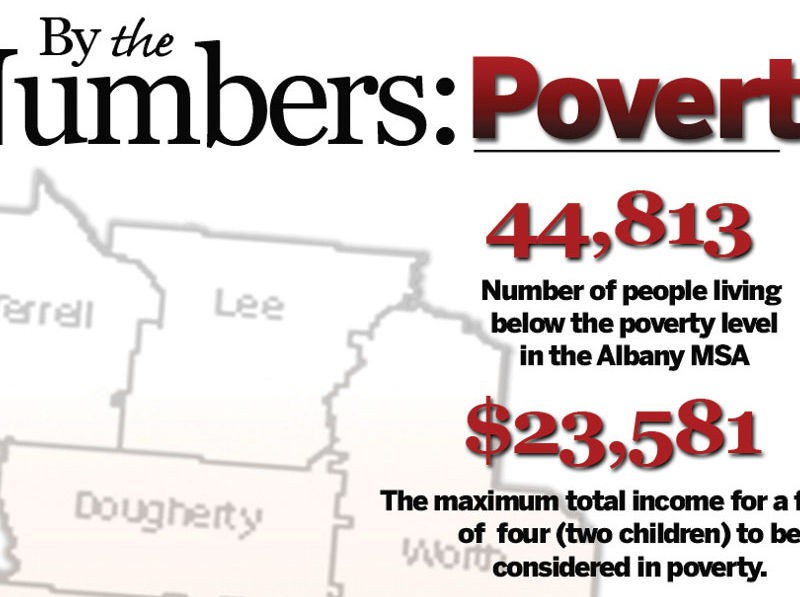
According to statistics used by the Census Bureau, the poverty line is defined as a family of four — two adults and two children — whose maximum income did not excede $23,581 in 2011.
That poverty threshold changes based on the number of children and the number of adults living in a home.
Aaron Johnson, an economics professor at Darton College and a member of the Albany-Dougherty Economic Development Commission, said that while the uptick in the poverty numbers was far from positive, faster-than-expected growth in some industrial sectors in the region likely negated worse statistics.
“Albany continues to have very high poverty rates, which can be explained by socioeconomic challenges dealing with family structure and educational attainment,” Johnson said. “However, the rate of increase in Albany was slower than for the rest of Georgia, so that’s a good sign I speculate that our job growth rates which were the highest in Georgia is the reason for the improvement.”
Breaking down the numbers supports some of Johnson’s conclusions.
According to the same ACS survey, in the city of Albany alone, 42 percent of people who didn’t graduate highschool live below the poverty line while 31 percent of those with a high school diploma or equivalency are living in poverty.
Those figures contrast with the 10.3 percent of those who have a bachelor’s degree or higher but still live in poverty.
The data supports Johnson’s theory that much of Albany’s systemic poverty is linked to low educational attainment.
For the metro area, the data also yield some interesting facts.
Roughly 44,000 people in the metro area lived at or below the poverty line during 2011.
The highest gender subset of that were women between the ages of 25 and 34, 4,410 of whom lived in poverty.
The stats suggest that 16.1 percent of women in the metro area live in poverty compared to 12.2 percent of men.
Johnson said that if there is a silver lining to be found in the numbers, it’s likely to be that the Albany Metro area’s poverty number increase was less than the state of Georgia’s.
“I show the rate of increase in poverty going up 0.7 percentage points, which is much better than the 1.2 percentage point increase for Georgia and almost better than the U.S. rate of 0.60 percentage points,” Johnson said.
He said the Athens MSA currently has a poverty rate of 29.9 percent, which is higher than metro Albany’s. The Valdosta MSA saw a large increase in poverty — 4.6 percent — and and is now approaching to Albany’s at 27.6 percent.
w/graphic
Related Articles

Albany Herald – June 20, 2026
City Albany faces shortfall for police… Women’s Anchorage tentatively set to… Commissioner, school leaders clash over…

Classifieds – June 20, 2026
ALBANY HERALD CLASSIFIEDS JUNE 20, 2026

Public safety drives Leesburg’s $4.2 million Fiscal Year ’27 budget
The adopted spending plan reflects modest growth in city revenues and continued emphasis on maintaining core municipal services, particularly public safety and sanitation, which together account for a significant share of general fund expenditures.
