
Red light violations will bring citations at a dozen Albany intersections
“That was always the goal of the school zone cameras, to change the behavior. It’s the same with the red lights, we want to change the behavior. When you see a yellow light, you need to slow down and prepare to stop.”
ALBANY – School zone speed cameras have drawn a significant amount of criticism in Albany and elsewhere around the state, particularly from drivers who have tickets arrive in the mail, as well as a number of state legislators who have tried to put the kibosh on the cameras.
But for advocates of the devices, there is one idea that is hard to negate. They work, at least when “work” is defined as causing a change in behavior among motorists traveling near schools where those cameras are in place.
Now, the city of Albany is going to try the same strategy at a dozen traffic lights that have been identified at intersections where drivers have a tendency to ignore the concept that “red means stop.”
The Albany City Commission has approved a request from Albany police to allow placement of those devices at the 12 intersections in the city that were identified as high-risk sites.
Police officials plan to meet with RedSpeed Georgia, the company that operates the speed zone cameras at nine city school campuses, to work out the details of placement and rolling out the program.
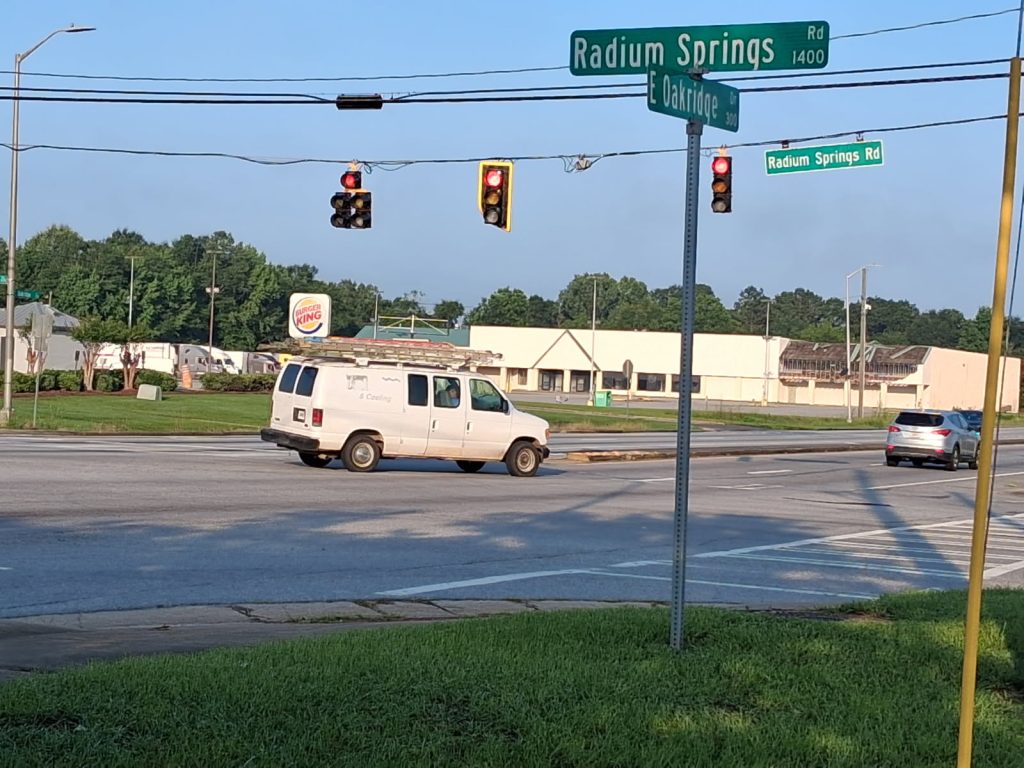
Sitting at the top of the dirty dozen list of intersections is East Oakridge Drive and Radium Springs Road, where a study indicated 1,129 instances of drivers running red lights.
“And that was in a single day,” Albany Police Chief Michael Persley said.
The North Slappey Boulevard/Palmyra Road intersection came in at 724 violations in a day, followed by South Westover Boulevard/Gillionville Road.
A study that covered the years 2022-2026 at six of the 12 intersections showed an average of 3.75 hit-and-run accidents during that time period, with an average of 104 accidents for the five years, according to police.
“When we talk about safe driving, there are plenty of examples we see every day of people disregarding red lights,” Persley said. “A yellow light, to some people, instead of slowing down preparing to stop, they see that as speed up and try to get through that intersection.”
After the installation of the school speed zone cameras in 2021, the loudest reaction came decidedly from those who were not fans. Many of those critics likely were among those who got ticketed for driving 11 miles or more over the posted speed limit in that area around the school campuses where the cameras are in place.
Over the first four years of the placement of the cameras, citations totaling $14.5 million in fines were issued.
Statistics, however, show that the cameras worked, the police chief said.
A 2024 report showed that there had been a 95% reduction in speed violators in the school zones since the program was launched.
Traffic studies conducted prior to the installation of the cameras found hundreds of instances each day of drivers in school zones exceeding the speed limit by more than 10 miles per hour.
“You see a decline in the number of violations, plus you can go out in those areas and see people are slowing down when the lights are flashing,” Persley said. “You see they’re driving 25.”
Albany first installed RedSpeed cameras in August 2021. In nine enforced school zones, drivers receive a citation for going 11 mph over the school zone speed limit. The first citation costs $80. Subsequent citations are $135. The citations are considered a civil infraction with no points added to driver’s licenses and no insurance increases.
The goal is for the traffic light cameras to produce a similar impact at intersections where drivers regularly blow through red lights.
“That was always the goal of the school zone cameras, to change the behavior,” Persley said. “It’s the same with the red lights, we want to change the behavior. When you see a yellow light, you need to slow down and prepare to stop. There are people now who are not paying attention at all to these traffic control signals.”
The chief also urged drivers to exercise caution at intersections by checking for oncoming traffic even with a green light.
As is the case for school zone infractions, the cameras at traffic lights will record a photo and video of violations. Citations are reviewed first by an Albay police officer before being referred to RedSpeed, which also reviews the information before a citation is mailed to the owner of the car involved.
Prior to issuing citations for red light violations there will be a grace period of 30 to 60 days, the chief said. During that period, violators will receive warnings instead of citations.
Police have looked at situations such as a funeral procession traveling through a red light, an instance in which citations would be waived, as well as for drivers turning left who are exposed when the light changes to red.
“The thing about it is the law (states) if you’re going into the intersection and it changes as you’re going through the intersection, that’s not a violation,” Persley said. “We’re talking about you’re approaching an intersection and we see you’re speeding up (when the light is yellow). That’s what we’re looking for.”
The impetus for looking at the situation came partially from the public.
“People have come to me saying we need to do something about people running the red lights,” Persley said.
Some of the other driving violations that the chief identified as contributing to accidents included: following too closely, driving recklessly by weaving in traffic in front of other cars, passing in no-passing zones.
“You’re in a hurry, but still you need to be a defensive driver instead of an offensive driver,” Persley said.
Other hazards he identified include driving cars with maintenance issues like poor brakes and slick tires due to wear.
While the Albany Police Department has had good fortune this year in hiring additional officers, Persley said that they can’t be everywhere. Cameras will help extend the department’s eyes on the road.
“Using technology, it doesn’t replace the human being,” he said. “It aids what we’re doing. For the places where we have issues, it’s a force-multiplier.”
The other intersections selected for camera placement are North Westover Boulevard and Nottingham Way, Dawson Road and Stuart Avenue, South Slappey Boulevard and West Oglethorpe Boulevard, West Oglethorpe Boulevard and South Jefferson Street, South Slappey Boulevard and West Oakridge Drive, West Oakridge Drive and Newton Road, East Oglethorpe Boulevard and South Mock Road, East Oglethorpe Boulevard and Thornton Drive, and East Oglethorpe Boulevard and Rosebrier Drive.
Author

Related Articles
Albany Herald – July 14, 2026
In Lee County, they saw it… Bigger budget will mean improvements at… Small actions can help save…

Classifieds – July 14, 2026
Albany Classifieds and Legals…

‘Just Africa’ festival scheduled for third weekend in September in downtown Albany
A taste of the Caribbean and Africa is coming to Albany with a fall festival that will also bring African dance, a parade of children’s fashions, as well as vendors, live bands, and arts and crafts.
