
Reviving racial unity
J.D. Sumner
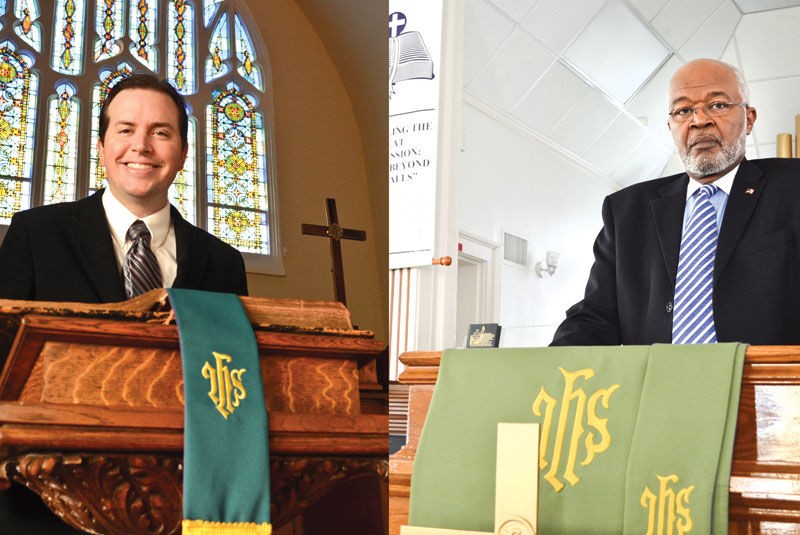
ALBANY, Ga. — Two of Albany’s oldest churches — one predominately black, the other mostly white — will come together for a revival this week that spiritual leaders say they hope will serve as a catalyst for removing the racial divisions that still haunt Albany 50 years after the start of the civil rights movement.
The congregation of Bethel African Methodist Episcopalian church on Washington Street has invited the Rev. Garrett Andrew, the pastor of First Presbyterian on Jefferson, to preach at Bethel’s three-night revival this week.
The Rev. Ernest Davis, the pastor and spiritual leader at Bethel, said the idea came to him following the city’s annual joint Holy Week services earlier this year.
MOBILE USERS: Click here to view the video with this story on your mobile device.
“I thought it was a good thing that the different churches in this community were coming together during the Holy Week services, and we’d always talk about doing other things, but once the week was over, we’d all go back to our churches and that was that,” Davis said. “So I went to Garrett and asked him if he had the time to do it, and if he was interested. He was.”
Davis said he took the idea to his congregation at Bethel, where it was well-received by his parishioners.
Traditionally, churches ask pastors from other churches to head up services during a revival, but typically those pastors are from the same denomination and from out of town.
Davis said he wanted Andrew and First Presbyterian specifically because he believed it could reinvigorate efforts by churches and other social organizations to tear down the racial barriers that he believes are hindering the city.
“Additionally, because I serve on the racial healing advisory committee for the Southwest Georgia Community Education project, which is looking at ways communities can heal themselves along racial lines … I think this revival serves as one the best demonstration projects you can have, because, again, it’s two churches coming together. We’re crossing color lines, we’re crossing economic lines, we’re going the whole gambit,” Davis said.
BREAKING DOWN WALLS
For Andrew, the 32-year-old white pastor of the 163-year-old church who cut his pastoral teeth preaching at black churches in California, the opportunity to preach at Bethel and take another step toward racial reconciliation is important.
“It’s important for me because it shows a desire in the community to have some of these walls of division, these walls of race, come breaking down,” Andrew said. “I think it’s important for the community, as a community that has suffered tremendously from division, to recognize that there’s actually movement within the community to bring these down so that we can come together for the greater good, to worship God realizing that because we can come together in Christ Jesus, we can worship God together.
“So, for the community, then it becomes an event, hopefully, whereby we can realize that all of those divisions that separated us previously for such a long time can be overcome.”
Old churches like Bethel and First Presbyterian — both of which bookend the civil war period in the United States — have come to be more than just religious havens. They’re shelters for those seeking protection from social ills.
The very foundation of the AME denomination is rooted in a desire for racial equality. Disgruntled with the way blacks were treated in a mainline denomination, the denomination split from the church, forming the AME church where black culture could be woven into worship services.
By contrast, First Presbyterian Church has historically hosted mostly white congregants. While still mostly white, the modern church is home to a mix of races and genders who have developed a renewed dedication to community service and activism.
Andrew said he believes the spirit of revival and healing can take hold throughout the community, especially in local churches.
“I guess I’m hoping for something new,” he said. “We have a God who says, ‘Behold I make all things new.’ We have a community that feels like the same old, same old is going on. We have a lot of people with a sense of hopelessness and despair, and it’s time in the midst of that to look toward our hope and joy.
“I know in our church we’re praying to become God’s hope and joy, and from this we believe that, indeed, hope and joy will be born into a community that is groaning for need and it’ll be something whereby people can actually experience the grace of God.”
A BRIGHTER TOMORROW
Davis share’s Andrew’s belief in a brighter tomorrow.
“I’m hoping this will serve as a catalyst and open doors for bigger and better things,” Davis said. “We’re not looking at this as a one-time event. We’re hoping it’ll serve as a springboard, as a mechanism to allow this city to come together as a community of faith. Because there are things we can do to bring us together as a community, and maybe someone will look at what we’re doing and say ‘hey, it’s working for them, maybe we should try it,’ and it will spread.”
The revival is not the first time black churches and white churches have co-mingled in Albany.
Recently, Mt. Zion Baptist, the city’s largest predominately black church, and Sherwood Baptist, one of the city’s largest majority white churches, formed a partnership to swap pastors and do other cross-church activities.
But Davis said he believes this revival is a little different than a pulpit swap, and he prays that it will be something that takes hold in the community.
Can this community overcome its racial issues?
“That’s my firm belief,” Davis said. “At some point, we’ll need to realize that we’re all here together on this Earth and that our survival, our well-being, is intermingled. We can separate ourselves; we can divide ourselves, thinking we can survive independently, but in actuality, you can’t.
“We need to understand that there is more that unites us than divides us, especially if we’re part of the faith-based community, the body of Christ, because we’re united in our faith. Christ didn’t discriminate. He treated all people fairly, and so should we.”
Related Articles
Public safety drives Leesburg’s $4.2 million Fiscal Year ’27 budget
The adopted spending plan reflects modest growth in city revenues and continued emphasis on maintaining core municipal services, particularly public safety and sanitation, which together account for a significant share of general fund expenditures.
Lee County property assessment notices set to arrive as farm values jump 83%
The Lee County Board of Tax Assessors approved the 2026 assessment notices Wednesday and voted to include an informational insert designed to help taxpayers understand how property values, exemptions and appeals work.
‘Sounds Like a Mutiny.’ Secret Recording Exposes Claims of Toxic Leadership After a Marine’s Suicide
This week’s War Horse story follows the systemic failures before and after the death of Cpl. Drew Mobley who was the third in two years at Marine Corps Base Quantico to die by suicide.
