
Small fish make big business for Southern farmers
The fish in a University of Florida display at the annual Sunbelt Ag Expo this week were more than technicolor aquarium pets. They are farm products, representing a multimillion-dollar industry that depends on breeding, feeding and keeping some very small livestock alive.
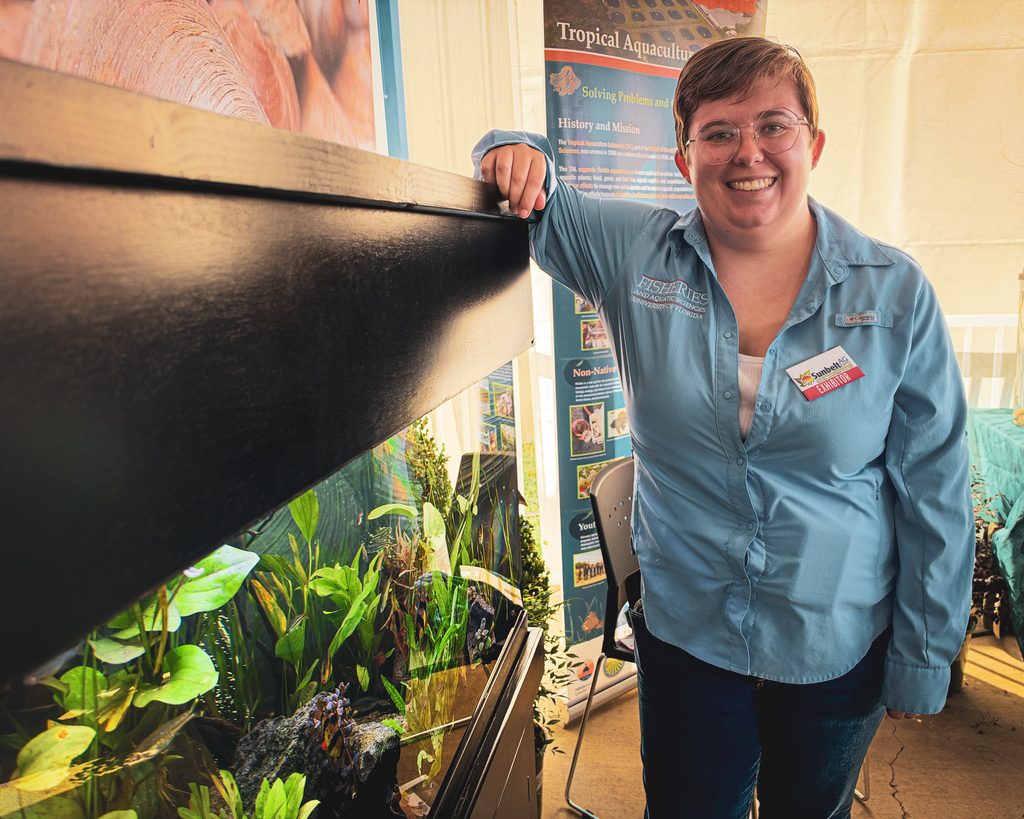
MOULTRIE — The fish in a University of Florida display at the annual Sunbelt Ag Expo this week were more than technicolor aquarium pets. They are farm products, representing a multimillion-dollar industry that depends on breeding, feeding and keeping some very small livestock alive.
“All the fish you see here are farmed in Florida,” Katie Everett, a doctoral student at the university’s Tropical Aquaculture Laboratory, said.
The display brought that industry to southwest Georgia, where university representatives used the expo to introduce families, farmers and prospective students to agricultural work beyond familiar fields and pastures. For aquarium-fish producers, research can turn on a question as basic as what a newly hatched fish will eat.
The business is growing in sales value. U.S. ornamental-fish sales reached $77.1 million in 2023, up 77% from $43.5 million in 2018, according to the U.S. Department of Agriculture’s Census of Aquaculture. Ornamental fish are raised for aquariums and decorative ponds rather than for food.
Florida accounted for more than $57 million in ornamental-fish sales in 2023, according to the University of Florida. The state’s production includes freshwater and saltwater species, with freshwater fish making up about 90% of its ornamental fish.
Everett pointed to the Tampa Bay area’s climate as one reason the industry has developed there.
“We raise lots of tropical fish here because the climate, especially around the Tampa Bay area, is really suitable for doing so,” she said.
Florida producers raise more than 800 species and varieties of ornamental fish, including guppies, mollies, swordtails, tetras, koi and goldfish, according to the Florida Department of Agriculture and Consumer Services. Production is concentrated in the state’s southern half, where favorable winter temperatures and access to international airports help support the business.
Bringing that work across the state line is part of the university’s outreach mission, Chris Vivian, the associate vice president of communications for UF’s Institute of Food and Agricultural Sciences, said.
“This is a great opportunity to meet families, and of course, farmers from across the Southeast,” Vivian said.
State extension services share similar responsibilities while working with different commodities, she said. The expo provides a place to explain those differences and show visitors what researchers and producers are doing.
“It gives our universities a chance to talk to potential students,” Vivian said.
Aquatic agriculture had other educational outlets at this year’s Moultrie show. Inside the expo’s Aquaculture Building, small aquaponics displays showed how fish and plants can be raised together. One setup used a 300-gallon tank with fish below and plants above, while a tabletop model illustrated how the same approach could bring lessons in biology, chemistry and mathematics into a classroom.
That connection between agriculture and classroom learning is already taking root in Albany. At the Commodore Conyers College and Career Academy, known as 4C Academy, agribusiness students grow lettuce hydroponically in a greenhouse, reporting harvests of roughly 800 heads every two weeks, many destined for school cafeterias in Dougherty County and beyond.
Hydroponics grows plants without soil, supplying nutrients through water. Aquaponics adds fish to the process: Microorganisms convert fish waste into nutrients plants can absorb, allowing water and nutrients to be reused. The academy’s lettuce operation is an example of hydroponics, while the expo displays introduced visitors to the combined fish-and-plant approach.
South Georgia also has university expertise closer to home. UGA’s Tifton campus offers aquaculture management among the subjects covered by its Animal and Dairy Science research and extension programs.
The interest extends beyond one exhibit. UGA Marine Extension and Georgia Sea Grant reported that the inaugural Georgia Aquaculture Conference drew 117 farmers, researchers, policymakers and other participants to Athens in April 2025 to discuss subjects including farm management and market expansion.
Nationally, aquaculture farms with sales increased 18% between 2018 and 2023, reaching 3,453, USDA reported. Total sales rose 26% to $1.9 billion. Four Southern states — Mississippi, Louisiana, Florida and Alabama — joined Washington as the five states accounting for 55% of U.S. aquaculture sales.
Georgia has its own examples of developing agricultural niches. UGA Marine Extension and Georgia Sea Grant reported that the state’s oyster-farming sector grew from one farm in 2017 to 10 in 2025, alongside training and technical assistance for growers.
On land, commercial citrus has expanded in southern Georgia. UGA Extension Agent Jake Price estimated the state had 3,936 planted citrus acres in 2023. His assessment also illustrated the risks: He estimated the December 2022 freeze killed 230 acres of newly planted trees.
For ornamental-fish farmers, one challenge comes much earlier in an animal’s life.
Everett described research by a former graduate student, now a faculty member, into feeding larval fish. Researchers needed to determine when the fish begin eating, what they can consume and how to provide it.
“And that’s a big bottleneck in ornamental aquaculture,” Everett said.
A fish can hatch successfully and still fail to thrive if its first food is unsuitable. Everett said producers need “really, really tiny food that the fish actually recognize as being food.”
Everett’s own research focuses on non-native species, particularly reptiles and amphibians. Her doctoral work involves improving tools that assess whether a species is likely to become invasive, information she said could help inform rulemaking and public policy.
Everett says the projects address different problems, but both illustrate the practical work behind a university display: identifying a gap in knowledge and finding an answer someone can use.
For the producers raising aquarium fish, that answer may begin with a first meal.
“What size do they start feeding? How do they start feeding?” Everett said. “Our work is in finding solutions.”
Related Articles
Pelham farmers turn hardship into a regenerative mission
When serious health problems disrupted April Workman’s career, she and her husband, James, began reconsidering how they earned a living, raised their family and cared for their farm.

Land bank’s deadline to reclaim blighted Radium Springs house expires
A house sold by the Albany-Dougherty Land Bank near the Radium Springs fishing pond remains unrepaired, but the deadline to reclaim it under the deed has expired, commissioners were told Monday.
Senator-elect Ed Brown unveils ‘Blueprint for Building a Better Georgia’
This is the time of year most politicians are either gearing up for the challenges that await them on Election Day or resting on their laurels, enjoying the last couple of months or so of calm before the hoopla surrounding the legislative session starts up.
