
Southwest Georgia saw a historic amount of snow. What does this mean for crops?
Parts of southwest Georgia saw as many as nine inches of snow accumulate Tuesday leading into the early hours Wednesday as a historic snow storm hit the southern U.S.. Schools closed, counties enforced curfews and law enforcement officials warned Georgians to stay off the road because of icy conditions. Some farmers braced for icy conditions.
ALBANY – Shortly after a year filled with powerful hurricanes, a near drought period and earning the title of the world’s warmest year on record ended, southwest Georgia was blanketed in snow.
Pam Knox, director of the University of Georgia’s weather network, said the weather event was unusual but not unprecedented.
“If you look at the temperature pattern across the globe, we are sitting under a massive spot of extremely cold air that’s coming from the Arctic,” she said. “Everywhere else on the globe is much warmer than usual, but we’re under this one small area that happens to be affecting us.”
Parts of southwest Georgia saw as many as 9 inches of snow accumulate Tuesday leading into the early hours of Wednesday as a historic snow storm hit the southern U.S.. Schools closed, counties enforced curfews and law enforcement officials warned Georgians to stay off the road because of icy conditions. Some farmers braced for the storm.
Knox said luckily there is not a lot growing currently.
“In some respects, it’s a good thing because usually in a La Nina winter, we’re drier than normal,” she said. “This is bringing much-needed moisture into the area that will be useful once we go into the growing season in about April.”
La Nina causes the jet stream to move north and weaken over the eastern Pacific. This means warmer and drier conditions in the South and wetter and colder ones in the North and Canada. This year’s La Nina has been very weak and didn’t appear officially until early January, Knox said.
Knox said the extreme colds also could kill off insect pests and plant diseases, meaning less chemicals needed to fight them off during the growing season.
Still, she said blueberry farmers, especially those in north Florida, as well as citrus farmers will be the most impacted by the snow storm.
Tyler Adams, a farmer who grows blueberries in Edison, said he saw about 7 inches of snow on his land. He said the timing of this snow storm means his blueberry crop was saved. As far as stages of bloom go, Adams said he had a few plants in Stage 3, which are more susceptible to freeze.
“Those were going to be the blueberries that didn’t make it no matter what,” he said. “It wouldn’t have been something that I wanted to run freeze protection on. We just kind of hunkered down.”
Had this storm come three weeks to a month later, Adams said, it would be a different story.
“I think all of us would be in bloom or … getting really close to being in bloom,” he said.
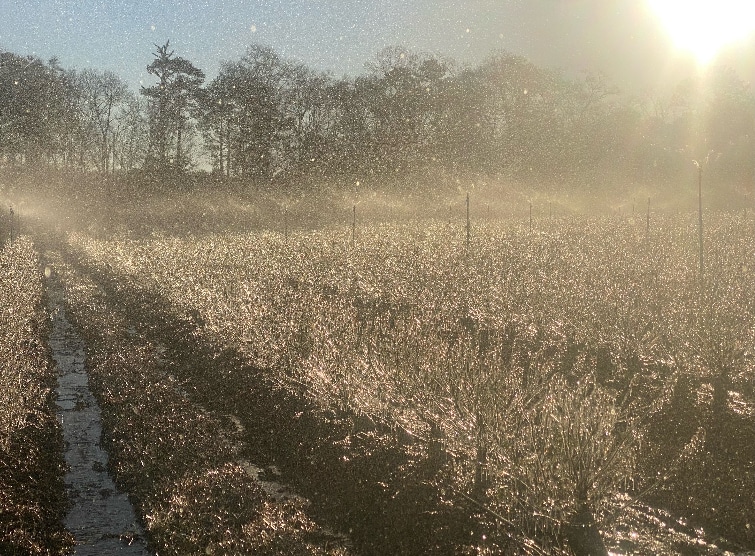
To prepare for a worrisome freeze event and protect his crops from freezing, the farmer uses a large pump to spray water over his field through sprinklers, delivering 135 gallons of water per minute per acre. As the water freezes, it forms a layer of clear ice around the plants, providing insulation. The freezing process releases a small amount of heat, keeping the temperature of the plants at around 33°F, just above freezing. If the ice stops forming — due to power failure or pump issues — the plants could freeze and be destroyed.
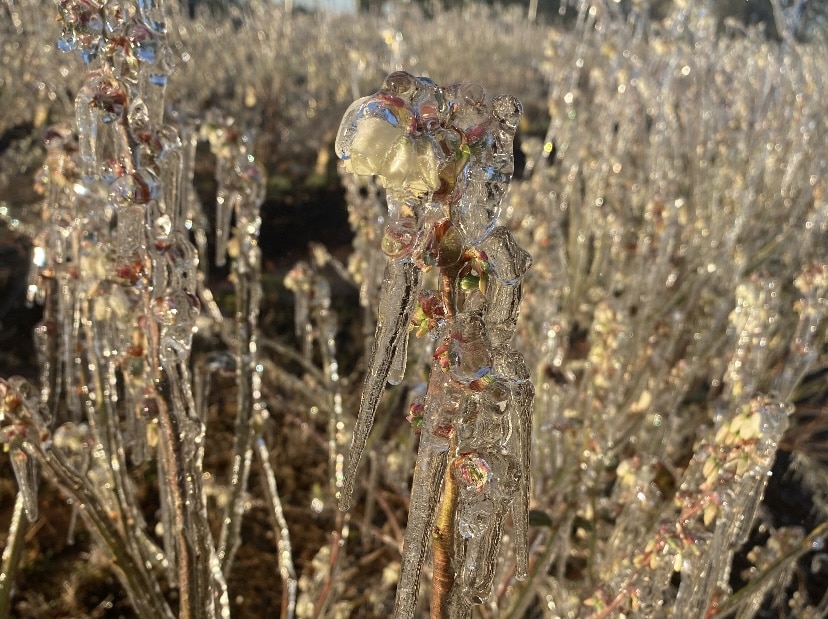
Adams said a frost-damaged blueberry crop looks like nothing for the first couple of days and then transforms into a wilting plant. The frost damages the plant’s vascular system, which moves water and nutrients. Eventually, he said it would almost look like the plant had gone through a drought.
“It’s just kind of a crazy phenomenon,” he said. “I can just guarantee in a month, there’s going to be a freeze come through, and I will have to run the pump.”
Adams said weather events like these present challenges.
“As a farmer, you try to just do everything you can to mitigate these types of circumstances,” he said. “But in the end, it’s going to be kind of what nature wants, and we’re at its mercy.”
As far as citrus goes, Mary Sutton, a UGA citrus extension specialist, said farmers won’t be able to tell the full extent of damage to their trees until a couple of weeks from now.
Citrus trees, especially young ones, are susceptible to freeze. A December 2022 freeze in Georgia significantly reduced the state’s 2023 citrus production. Georgia’s acreage dropped from 3,262 to 3,032 at the time.
Sutton said there was a lot of warm weather leading up to the December 2022 freeze, meaning trees weren’t acclimated to the cold weather. This year, she said there’s been enough colder temperatures that the trees were a bit more hardy facing this week’s snow storm.
“Farmers weren’t too worried about the temperatures,” she said. “They were nervous about the snow. Citrus doesn’t see snow very often, so everybody just wasn’t sure what to do with it. Honestly, we don’t really know what to expect the long-term damage to be because of the snow.”
One positive, Sutton said, is that this was the best time for a freeze to happen because most citrus trees are in a dormant state where most farmers have gotten all the fruit off their trees and new blooms haven’t sprouted.
Freeze damage can lead to leaf and wood injury and dried-out, hollow fruit. To prepare for a freeze, citrus farmers may modify their irrigation systems to raise up the water, wetting the entire trunk and lower limbs. Well water is warmer and therefore creates a protective layer. Maintaining a healthy tree throughout the year with good nutrition and irrigation practices set trees up to be “at their best.”
Farmers also can put trunk covers to protect the trunk and reduce damage.
“As long as there’s some of that woody trunk tissue left, usually the trees can bounce back even if they’ve lost their entire canopy,” Sutton said.
She said as farmers assess damage, they’ll look at the number of leaves that are left and check on younger branches that emerged last summer or fall.
“That would be what’s supporting this next season of growth,” she said.
But, they’ll also look at cracks and splits along trunks and structural branches.
“That damage will be what affects it in the future,” she said. “If we have another hurricane or another freeze in the future, those weakened spots will be more likely to get damaged again.”
Sutton said it’s important for farmers assessing damage to refrain from pruning out dead wood.
“You should wait until the spring because if you start pruning, you’re making open wounds,” she said. “If we have another freeze like this, you’ve now made susceptible tissue.”
Knox said it’s possible the region gets hit with a freeze or snow event in the spring. She said some of the bigger snows in Georgia occurred in February and March, including the blizzard of 1993, which stretched across the state.
“Whether or not it happens this year, it’s really hard to predict because it’s a weather event,” she said.
Knox said scientists are studying whether a warming climate will make the Earth more susceptible to extreme weather events.
“There’s some speculation that as we get warmer, we’re going to get these events more often because the polar vortex … is going to become less stable,” she said.
Sutton said each extreme weather event is a new lesson.
“It helps us learn what to do for the next time,” she said.
Author

Related Articles

Albany Rescue Mission in recovery but still can use some help
“We can’t do this without the community. We are so grateful for the willing vessels. We just can’t thank them enough. We also appreciate the other ministries that have sown seeds into our ministry.”
Plenty of oil, not enough diesel — and southwest Georgia farmers are paying for it
Sedrick Rowe doesn’t spray herbicides on his 10 acres of organic peanuts. He fights weeds with his tractor instead, which means he runs it more often than most farmers — and burns at least 30 gallons of diesel on a typical day. This harvest season, every one of those gallons costs more than it has at any point on record.

Dougherty schools plan task force as SNAP changes raise concern over free meals
The Dougherty County School System plans to create a task force to help families retain food assistance and navigate new reporting requirements as district officials warn that declining SNAP participation could eventually affect the federal provision that allows every student to eat free at school.
