
Struggling economy leaves local shoppers looking for bargains
Shoppers all over southwest Georgia said they were struggling with the tanking economy this week as the 12 days of Christmas dwindled to a precious few.
By Carlton & Tara Fletcher
ALBANY – Lee Carter and Queen Dariah were looking – perhaps a touch wistfully – at puppies in an Albany pet store.
“We’re not shopping as much,” Dariah said. “We’ve had to budget a little less, maybe not focus on the top-of-the-line stuff, but look for things a little less expensive.”
Carter agreed.
“With this economy and inflation hitting us hard, we’ve had to be a lot more selective,” he said. “We’ve got four kids – ages 14, 10, 7 and 5 – so it’s a little harder staying within our budget.”
Shoppers all over southwest Georgia offered similar stories this week as the 12 days of Christmas dwindled to a precious few. And the lack of traffic in some of Albany’s busiest retailers offered more evidence that a green Christmas may be hard to come by in a year that outrageous tariffs have been primarily responsible for a crippling economy that has seen costs rise pretty much across the board.
“The Christmas season usually makes or breaks our year,” one Albany retailer, who asked that his name not be used and his store not identified, said. “There are a few days left and, thank God, one more weekend of shopping, but things are pretty bleak right now.
“The people just aren’t spending like they used to. The economy is making it hard on everybody, the shoppers and the businesses. This could turn out to be one of the worst Christmases we’ve had in the almost 20 years we’ve been open.”
The countrywide economic downturn has been well-documented, but some recently released statistics offer a real-time look at the hardships facing southwest Georgians.
A study released recently by the United Way of the National Capital Area showed that Georgia – and in particular southwest Georgia – is among the nation’s most economically challenged states. In the state, 34% of households face eviction, 13.4% experience food insecurity and 40.5% rely on food assistance.
Based on these and other statistics, Georgia ranked eighth among states whose economy is struggling most now. Ahead of the Peach State were Mississippi, Louisiana, West Virginia, New Mexico, Nevada, Oklahoma and California.
Closer to home, according to the U.S. Census Bureau, 20-30% of the region’s population lives at or below the national poverty rate. Dougherty County’s poverty rate was 34% until recently, when it dropped to around 29%
And in a study conducted by economic/political writer Charles Hayslett for Flagpole, if the counties in south Georgia became their own state, that state might be the poorest in the nation. Hayslett noted that through the years 2002 to 2021, the south Georgia region lost more economic ground than 48 of the country’s 50 states. He also said 23.8% of the collective region’s population is at or below the poverty line.
Katie Speir of Dawson said she definitely was looking for bargains as she and her 8-year-old daughter, Ellie, shopped at the Albany Mall.
“We’re more mindful of the prices this year; we’re looking for things on sale,” Speir said.
Rubye Potts, 94, who lived in Athens before coming to Albany to live with her daughter, Debra Pittman, said their recent girls’ day out included a trip to the nail spa and shopping for family.
“We’re shopping, but we can’t do a whole lot of shopping,” Potts said. “We’re having to cut back this year; things are too expensive.”
Other shoppers, among them Amos Tookes of Baconton, Dianne of Leesburg and Dana of Albany – the latter two asked that only their first name be used – at various stores in the mall offered similar responses to questions about shopping in the 2025 economy.
“We’re definitely looking for bargains; things are much more expensive than they were last year,” Tookes said. “The economy is definitely having an impact on what we buy this year.”
“We have a lot of children in our family, so I’m having to shop smarter,” Dianne said. “Everything is sky-high this year, so we’ve had to cut back and look for deals. When you’re on a fixed income, this economy definitely affects the way you shop.”
Of course, there was the gentleman who sat on a bench in the mall, scrolling on his phone while other family members shopped. He said the economic downturn “isn’t really bothering me because I don’t plan to spend a bunch of money.”
Author

Related Articles
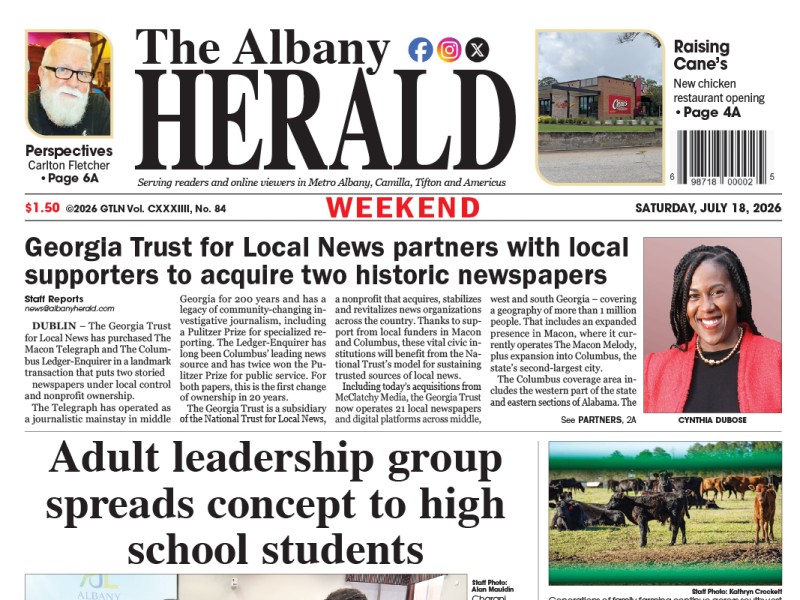
Albany Herald – July 18, 2026
Georgia Trust for Local News partners with… Adult leadership group spreads concept to… Lee County homeowners have until Aug. 1 to claim…

Classifieds – July 18, 2026
Classifieds; Legals;

Albany police make arrests in murder, robbery cases
Officials with the Albany Police Department have announced a number of arrests in cases that involved a homicide and a pair of thefts.
