
Take safety steps when cleaning up weather-related damage
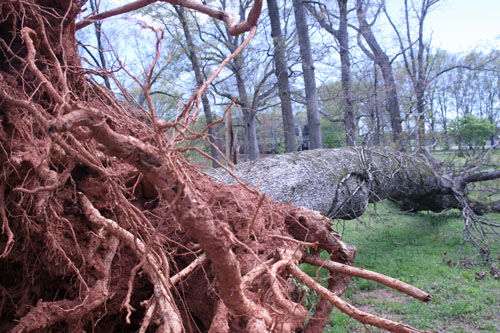
Special Photo: UGA/CAES
By Sharon Dowdy
CAES News
ATHENS — Tornadoes and heavy winds blew across Georgia in the early morning hours Monday, killing eight Georgians, destroying homes, and leaving landscapes littered with downed trees and limbs.
Strong weather is common in Georgia this time of year, and so is cleaning up after it. But there’s a way to do it safely and wisely, said David Dickens, professor of forest productivity with the University of Georgia Cooperative Extension.
Step by step
“Prioritize your chores by starting to work on trees that endanger buildings, other valuable structures and fences first with proper care, safety equipment and knowledge,” Dickens said. “If you are hesitant or think you may be hurt removing downed trees, then contact a reputable tree company.”
Don’t attempt to handle trees that overhang or touch power lines, he said. Call local utility company professionals for assistance.
“Many people are injured while trying to clean up debris after tornadoes and hurricanes,” Dickens said. “Ideally, it’s best to hire a reputable professional.”
Tree loss
Uprooted trees will often die.
“Medium to large trees that have been uprooted with severe lean (greater than 60 degrees from vertical) have little chance of surviving because the broken roots that used to structurally support the top weight and nourishment of the tree are damaged,” Dickens said.
Tackle unsightly, damaged trees next. For example, Bradford pear trees are prone to split.
“This type of injury is difficult to reshape, and the lopsided weight can cause the tree to blow over with soft wet ground and a gusty wind,” he said. Dickens recommends removing severely misshapen trees and replanting a tree with better structure.
Remove and replace
“You may have to crank up the chainsaw for the removal of an old favorite tree, but take this opportunity to consider carefully the next tree and select one that has a stronger design,” he said. “Live oak is an example of a sturdy tree that can withstand more severe winds.”
Broken limbs that are still attached to tree crowns should be properly trimmed. Leave a pruning cut that is flush to the next larger limb or main trunk. There is no need to apply wound tar to the prune cut.
“It has been shown through research that wound treatments like this can actually slow down the healing process of the tree,” Dickens said.
Brace or remove
Small trees that are bent over and have not straightened back up can be propped and then braced or cabled.
“A spindly pine tree that is bent over to the ground most likely will not stand straight again,” he said. “If the damage is severe, and over one-third of the bark is lost, this is damage few trees can survive.”
For tips on using a chainsaw safely, see UGA Extension Circular 1148, “Chainsaw Safety: Always Use Your Personal Protective Equipment,” and the UGA Center for Urban Agriculture’s saw safety website at ugaurbanag.com/safety.
Related Articles

Dougherty County Sheriff’s Office, GBI investigate inmate death
“The sheriff’s office will conduct an administrative investigation to determine if the staff response was appropriate. We have requested that the GBI conduct an investigation.”
Residents’ safety concerns defeat request to privatize Plantation Road
The Terrell County Board of Commissioners rejected a request July 7 to remove Plantation Road from the county road system after nearby residents warned that closing the roadway could leave them without emergency access when adjoining roads flood.

Albany Herald – July 21, 2026
From cotton to cloud… Dougherty Jail graduates first class of… Worldwide United
Way leader speaks…
