
Tariffs Affect Farmers
Staff Photo: Alan Mauldin
By Alan Mauldin
[email protected]
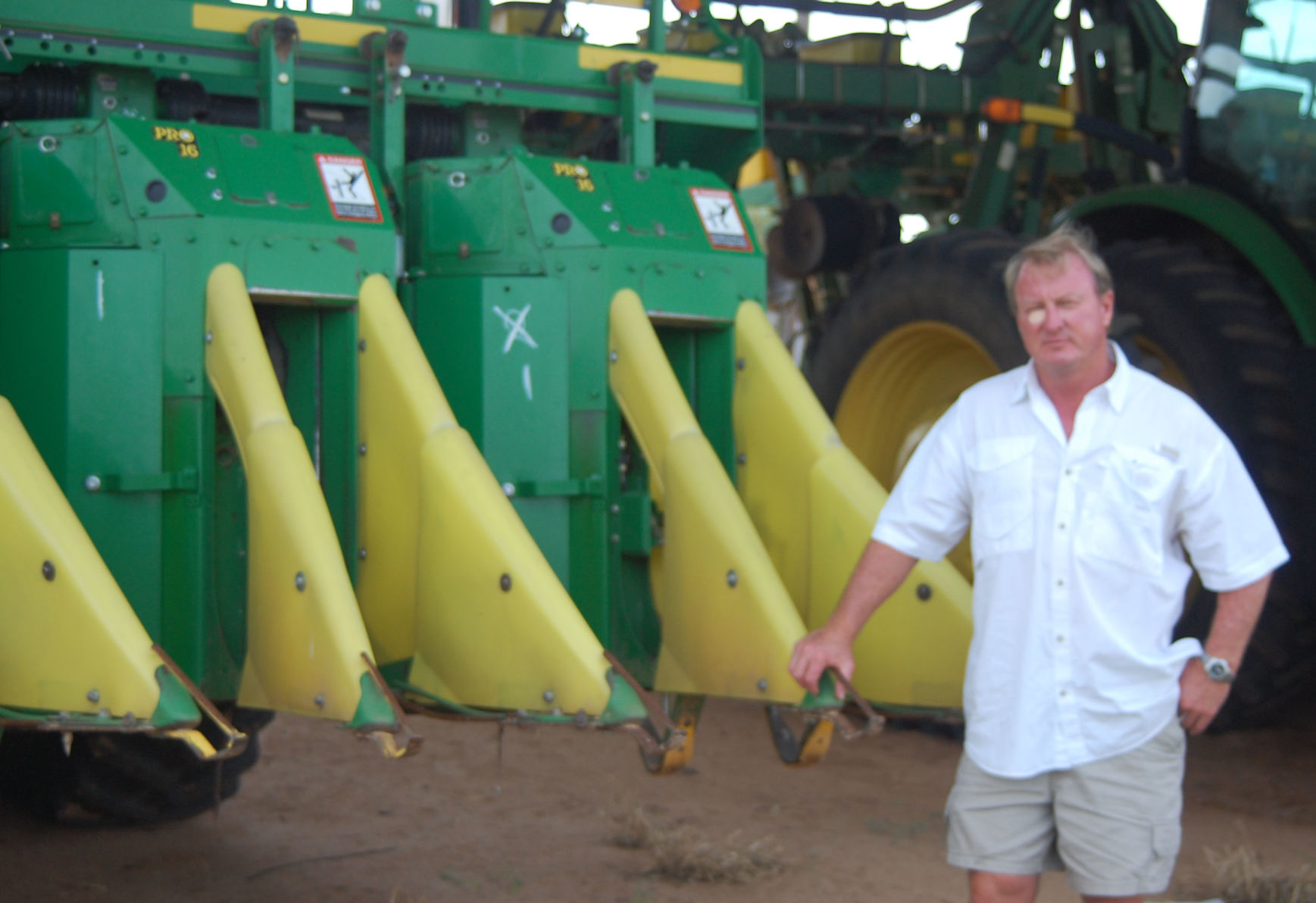
LEARY — Calhoun County farmer Jimmy Webb says he thinks the wounds inflicted by a trade war that has seen China slap tariffs on U.S.-grown cotton will heal.
He just hopes the bandage is ripped off quickly to allow for a quick recovery rather than it peeled off slowly and painfully.
While much has been written about the impact of retaliatory tariffs on soybeans, the top agricultural product exported to China, farm products grown locally that account for millions of dollars in economic activity in the region also have been targeted. Those include pecans and cotton.
“I took agricultural economics (in college),” Webb said. “I think about supply and demand. That’s how you find the true price. When politics gets in the way you don’t find the true price, with the tariffs. Tariffs are never good.”
Webb said he thinks the trade war will be settled eventually in a positive way. But the question is when.
“I really do think in the long run it’s going to benefit us, but my goodness, how bad is the short-term going to hurt us?” he said. “Now we have an administration fighting to try to get better deals for us. (But) how long is the short-term going to last? Can I survive low commodity prices in the short-term?”
It’s not as if farmers in southwest Georgia can just start growing something different tomorrow, like alfalfa. A new cotton picker is an investment in the range of $750,000 or more, and it only performs that one function suggested by the name.
The cotton gin that Webb jointly owns as part of a farmer’s cooperative needs a supply of cotton to process.
Webb said he is encouraged by the announcement of a proposed package to provide financial assistance to farmers, even though the details aren’t yet known.
Last year he picked over one of the roughly 2,000 acres he and his brother farm jointly own because the first program required taking the cotton to the local U.S. Farm Services Agency office. That meant picking the scant, lowest-yielding acre at 187 pounds when he was picking as much as 1,300 pounds in the days before Hurricane Michael because the payments were based on pounds produced.
“Some folks didn’t have any pounds” after the storm, he said.
The infrastructure in place that keeps farmers tied to cotton also has an advantage as well, Webb said. It makes them efficient.
“The advantage the U.S. has is on-time delivery,” he said. “We can get that cotton to the port and get it delivered to China so efficiently compared to other countries. We have excellent quality.”
In the past week or so, cotton prices for this season’s crop have been in the range of 66 cents to 68 cents per pound. But to break even, farmers need at least 75 cents per pound.
Under ordinary conditions, the cotton lost in Georgia, the second-largest cotton producing state behind Texas, due to Hurricane Michael would have pushed prices up, Webb said.
The tariffs have worked to keep prices down.
The main concern for farmers like Webb and Richey Seaton, the executive director of the Georgia Cotton Commission, is that during the time U.S. cotton is under tariffs that make it more expensive, China will find other suppliers.
“Man-made fiber has always been big competition,” Webb said.
China also is looking to find other sources of cotton, primarily from Australia and Brazil, countries that are making investments in infrastructure.
But China has other potential suppliers, U.S. growers have other markets. Before the tariffs went into effect, Vietnam had taken on the role as the largest buyer of U.S. cotton. Bangladesh and Turkey rank three and four after China.
U.S. farmers export more cotton than any other country by far. About 80 to 85 percent of production is sent overseas, Seaton said.
“China is a very, very important market to us,” he said. “(But) we’ve been able to increase shipments to other nations.”
At the end of the trade war, cotton growers want to maintain their market share in China, he said.
“The United States grows a very high-quality cotton, and there’s a limited quantity of that quality,” he said. “Our farmers are great. They continue to figure out ways to do things better, and they do things better even though this price situation is hurting them right now.”
Payments to Georgia farmers for the 2017 cotton crop totaled more than $900 million. That does not include additional payments such as insurance.
Pecans accounted for $401 million in income for Georgia growers that year. Mitchell, Dougherty and Lee counties were the top three pecan-growing counties in the state, accounting for, respectively, farm income of $40 million, $36 million and $32.3 million.
Worth, Mitchell and Colquitt counties were ranked second through third in cotton income, bringing in a total of $109 million.
Author

Related Articles

Albany Rescue Mission in recovery but still can use some help
“We can’t do this without the community. We are so grateful for the willing vessels. We just can’t thank them enough. We also appreciate the other ministries that have sown seeds into our ministry.”

Plenty of oil, not enough diesel — and southwest Georgia farmers are paying for it
Sedrick Rowe doesn’t spray herbicides on his 10 acres of organic peanuts. He fights weeds with his tractor instead, which means he runs it more often than most farmers — and burns at least 30 gallons of diesel on a typical day. This harvest season, every one of those gallons costs more than it has at any point on record.
Dougherty schools plan task force as SNAP changes raise concern over free meals
The Dougherty County School System plans to create a task force to help families retain food assistance and navigate new reporting requirements as district officials warn that declining SNAP participation could eventually affect the federal provision that allows every student to eat free at school.
