
Technology improving life quality for stroke patients
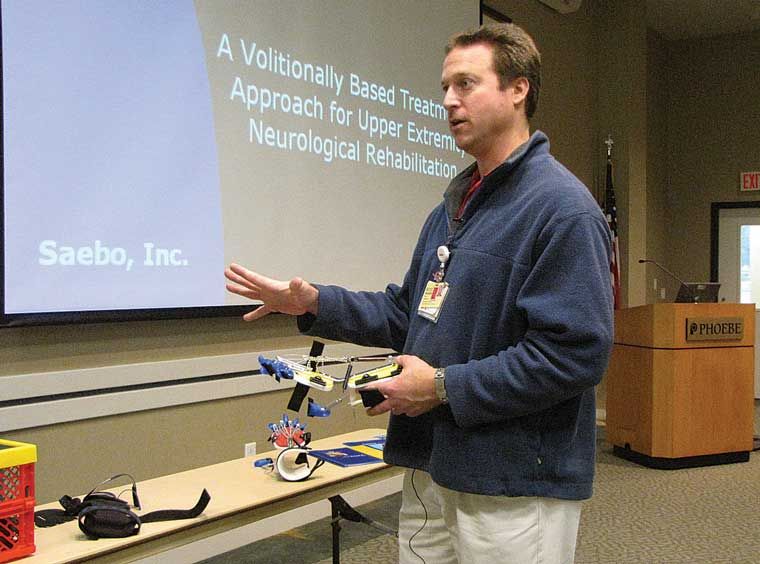
Photo by Carly Farrell
Jennifer Maddox Parks
ALBANY, Ga. — Steve Stoklosa has helped stroke survivors in Southwest Georgia get a new lease on life by introducing them to something that can assist them in things they have not been able to do for a while — the abilities many people take for granted such as grabbing a water bottle or picking up a ball.
Stoklosa is an occupational therapist with Phoebe Physical Medicine, based at Phoebe Northwest on Dawson Road. Recently, he had the opportunity to educate a few of his colleagues on the Saebo Functional Dynamic Orthoses and the Saebo Arm Training Program.
The purpose of the system is to allow patients with little residual arm and hand function to perform highly repetitive grasp and release activities by assisting the hand to open. The ultimate goal is to improve the quality of life for those suffering from neurological injuries by enabling themselves to do the things they used to be able to do.
“It helps them regain the use of their hand,” Stoklosa explained. “As they gain movement in the hand, the patient goes from there.
“The hardest part is getting patients to use it.”
Saebo is designed for individuals who have some shoulder and elbow movement but minimal, if any, hand function. Most patients begin using it several years after having a stroke, although it can be used for those still in early recovery.
One of the devices, the Saebo Flex, features a spring-loaded finger extension system, which provides resistance to the muscles that are used to grasp and assist in opening the hand and fingers.
The Saebo Reach consists of a combination of the Saebo Flex and an elbow extension system. The idea with this device is to provide resistance to the muscles used to bend the arm and assist in straightening the elbow during functional reaching.
In addition, there is the Saebo Stretch — a splint designed to prevent or decrease joint damage while maintaining or improving range of motion in the fingers and hand.
“It helps them become functional,” Stoklosa said. “The first step is to pick up a ball and let it go, and go from there.”
Saebo can be used for many neurological deficits other than stroke damage including spinal cord injuries, central lesions and multiple sclerosis.
These devices can be fitted for a patient to use at home, and have a price tag — with all three of them together — hovering near $1,600, most of which is typically covered by insurance. They are generally used three times a week for 45 minutes for a period of 12 weeks.
“After the first two or three visits it takes them awhile, but after that, they get the hang of it,” Stoklosa said. “Many physical therapists have seen a change in what they (patients) are able to do.”
The recent educational session Stoklosa conducted consisted of physical therapists and physicians who had not previously had exposure to Saebo — one of whom was Dr. LaTai Grant Brown of Phoebe Neurology Associates, whose areas of interest include epilepsy, headaches and sleep disorders.
“It seems like it will be helpful for patients,” Brown said. “It definitely helps in gaining more independence.
“It would definitely improve quality of life, especially for those that are farther out (from their strokes).”
Related Articles

Classifieds – June 20, 2026
ALBANY HERALD CLASSIFIEDS JUNE 20, 2026

Albany Herald – June 20, 2026
City Albany faces shortfall for police… Women’s Anchorage tentatively set to… Commissioner, school leaders clash over…

Public safety drives Leesburg’s $4.2 million Fiscal Year ’27 budget
The adopted spending plan reflects modest growth in city revenues and continued emphasis on maintaining core municipal services, particularly public safety and sanitation, which together account for a significant share of general fund expenditures.
