
The do’s and don’ts of searching for historic artifacts
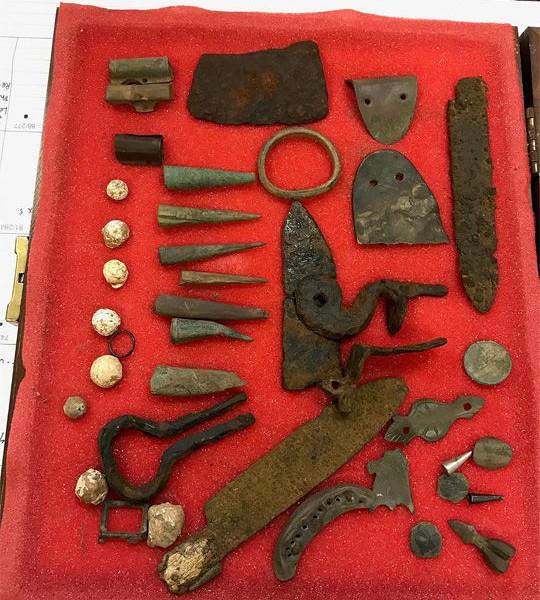
File Photo
By Tom Seegmueller
[email protected]
ALBANY — By most accounts Georgia’s history begins with the state’s colonial founding by James Oglethorpe as a British colony in 1733. However, almost 200 years earlier, in 1540, Hernando de Soto undertook an epic journey of exploration that would carry his army of more than 600 men and 250 horses through nine states in what would be a three-year odyssey of death and destruction.
Soto’s expedition cut a path through the heart of southwest Georgia, providing the first historical accounts of the region, its flora, fauna and indigenous inhabitants. The expedition would eventually be recorded in four different chronicles, which include the discovery of the Mississippi River shortly before de Soto’s death and his army’s ragtag escape to Mexico. Even though three of the chronicles offer first-hand accounts, the route that was traveled is subject to question almost 500 years later. The only real proof of de Soto’s route comes from a small number of artifacts left behind as the expedition moved forward in its search for gold and glory.
Cultural artifacts in the region date as far back as the Paleo Period 15,000 years ago, followed by the Archaic Period dating back 5,000 years and the Woodland Period, which dates back 3,000 years. Each of these artifacts tells us something about the region’s past. However, artifacts from the Mississippian Period, which covered the era of de Soto’s contact, will show the impact of this brief cultural encounter when compared to the artifacts related to European colonization just 200 years later.
Many of these artifacts are so common in southwest Georgia that we often take their discovery for granted. Others are of such exceptional quality and craftsmanship that they are worth thousands of dollars to collectors. More important, however, are the seemingly insignificant artifacts that may provide the clues to the region’s prehistoric past, as the indigenous inhabitants left no other record of their past. The last two of these categories have led to a number of changes in Georgia’s laws related to the collection of artifacts.
“Right out the gate, anytime you are on someone else’s property, you can pick up surface finds with written permission of the landowner,” Tyler McKay, a game warden with the Georgia Department of Natural Resources said. “The person hunting artifacts must have the notice of written permission with them. Landowners are free to collect any surface finds on their property.”
Surface finds are generally artifacts that have been uncovered during agricultural or construction activity, as over time most undisturbed artifacts have become covered with soil and continue to settle below the surface.
Sadly, if money is involved, things can go sideways. A hike along property bordering the Flint River can reveal what looks like a lunar landscape where illegal digs have created a labyrinth of craters and connecting trenches.
“When we find individuals digging, a lot of times they will be on the property without permission,” McKay said. “Technically, if you are going to dig, you have to notify the state archaeologist so they can determine if where you are going to dig is a cultural site.”
When it comes to collecting artifacts in the waterways of southwest Georgia, more regulations apply. Anything man-made in a waterway falls under the definition of a Submerged Cultural Resource.
“Anything submerged under water for a 50-year period or more falls in this category and cannot be removed,” McKay said.
“On navigable waterways, the state owns low water mark to low water mark — the landowner would own to the low water mark,” Game Warden Ed White added. “On non-navigable waters, the property owner owns to the middle of the waterway.”
Many of the high-dollar “points and blades” found in southwest Georgia over the years have come from the rivers and streams of the region where the currents uncovered them, and the waterway protected them from being damaged by the plow. I strongly urge anyone looking to remove artifacts from a waterway in Georgia to refer to Georgia Code 12-3-80. Interestingly, this covers “magnet fishing” as well.
One category of artifact that is much older than the 50-year cutoff of the Submerged Cultural resource are fossils, which are another story.
One reason I started this article with a focus on de Soto’s expedition was to highlight the importance a few small artifacts have had in verifying his route more than 500 years after it occurred. Although we will never be able to walk in the exact footsteps of the explorer, we get closer over time. In 1935, the U.S. Congress authorized the U.S. de Soto Commission to complete a study of the expedition. Using the existing chronicles and knowledge of the Mississippian sites in the Southeastern United States, the commission, led by noted ethnologist James Swanson, identified a route that cut through southwest Georgia.
Fifty years later, Charles Hudson, a professor of anthropology and history at the University of Georgia, would further refine the route, publishing “Knights of Spain: Warriors of the Sun,” an account of de Soto’s expedition. A number of Albanians, including Gene Black, assisted in Hudson’s research. The route Hudson charts through Georgia begins at Apalachee, de Soto’s winter camp located in present-day Tallahassee, Florida. This site is established by archaeological evidence of de Soto’s army living there with the indigenous inhabitants of that region.
Leaving the Tallahassee site, the route is defined by the known mound sites and village sites matching expedition chronicles. These include the chiefdom of Capachequi, with its central town located near Magnolia Plantation. In the chiefdom of Toa, de Soto likely camped near James Pond in Lee County before once again crossing the Flint River in search of the chiefdoms of Ichisi and Altamaha to the northeast.
If at this point you are wondering why I have rambled so much about the ramblings of de Soto, it is in an effort to highlight the significance of his expedition. Little evidence existed other than the European artifacts found at the Apalachee site, until items of European manufacture were discovered at the King Archaeological site on the Coosa River in northwest Georgia. This site matches up with the chronicles describing de Soto’s route from North Carolina westward into Alabama.
However, no physical evidence was documented on the southern part of his route in Georgia until Dennis Blanton’s work at the Glass site on the lower Ocmulgee River. His search for a Spanish mission in the area led to the discovery of a previously unknown Native American town, including a Temple complex. The initial proof, a small glass trade bead dating back to the age of the Conquistadors. An additional 13 beads, combined with brass and iron artifacts, at the site are further evidence of the conquistador’s trail. It also moves the route of de Soto 80 miles south of Hudson’s and Swanson’s routes.
So these minute artifacts found in context with the Mississippian cultural artifacts prove the two cultures came into contact here for a brief period. This highlights the importance of Georgia’s laws that protect both known and unknown archaeological sites. Within 200 years of this passing contact, the indigenous cultures that had existed there for thousands of years would not be possible when Oglethorpe arrived. Their culture no longer existed anywhere in North America.
Although de Soto and his army were brutal by their own account, killing thousands of Native Americans, this was not the cause of the native people’s demise. The Europeans brought a number of diseases for which the native population had no natural immunities. They also brought herds of pigs as a traveling source of protein. The hogs immediately began destroying the agrarian crops that supported the large populations living in the chiefdoms.
Beyond those blatantly breaking the current laws related to collecting cultural artifacts, there are those who grudgingly follow the current regulations with some resentment. As a collector myself, I can say I miss the opportunities to legally dive navigable waters in search of cultural artifacts.
Author

Related Articles

PHOTOS: Albany State – CISA Executive Exchange
Click the arrow to scroll through the photos.

Months of unresolved records requests leave Dawson taxpayer questions unanswered
The City of Dawson will move ahead with its fiscal year 2027 budget before completing external audits that remain unfinished, city officials told The Dawson News on July 31 — more than three months after the newspaper began requesting the financial records behind the city’s decisions.
Dawson’s $10.2 million sewer project leaves major financial questions unresolved
As Dawson’s finance director resigns and operating pressures mount, records show $10.2 million in sewer funding, frozen loans, missing audits and gaps in the public accounting of project money.
