
Therapeutic musicians provide relief for health care workers
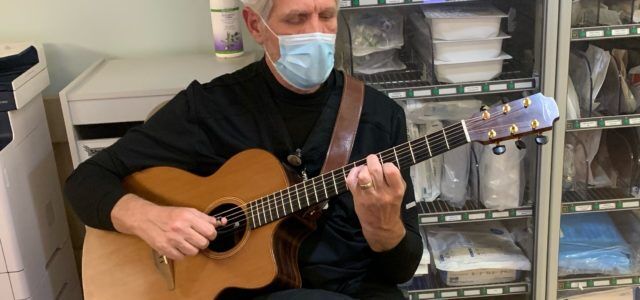
Guitarist Chuck Beckman says he was inspired to pursue a career in live therapeutic music for hospital patients after he played at the bedside of a dying friend.
Special Photo: Georgia Health NewsBy Rebecca Grapevine
For Georgia Health News
GAINESVILLE — Guitarist Chuck Beckman says he was inspired to pursue a career in live therapeutic music for hospital patients after he played at the bedside of a dying friend.
His goal, he says, “was to play for patients in the last moments of their lives.” And he founded a program to do just that at Northeast Georgia Health System’s Gainesville hospital two years ago.
But the music stopped at the start of the pandemic. Beckman and his fellow therapeutic musicians could no longer play their instruments at patients’ bedsides because of the infection risk. As the pandemic dragged on, and even worsened, the toll on health care workers became apparent.
So Beckman and his fellow therapeutic musicians returned to the hospital in May 2020, this time with a new audience: workers rather than patients.
The musicians, who are specially trained to provide and play therapeutic music, set up shop at nurses’ stations, hoping to soothe the nerves of the workers facing the onslaught of COVID cases, equipment shortages and overall medical risks.
“Almost immediately I could see the impact it was having” on the staff, Beckman said, noting he saw tears glistening in nurses’ eyes and watched nurses “fold their hands, close their eyes, and lean their head back for 30 seconds, just checking in.”
Beckman and his colleagues decided to document the impact that live therapeutic music has had on worker stress. Their study found that 30 minutes of live therapeutic music reduced the frontline COVID workers’ perceived stress by 44.74%.
Sixty workers in COVID critical care units listened to either acoustic guitar or piano (keyboard) music about halfway through their shifts, and rated their stress levels using a 0 to 10 scale, both before and after the session. They also reported on their general stress levels using a well-known questionnaire, the Perceived Stress Scale.
The musicians played classical or contemporary music with 50 to 60 beats per minute at nursing stations. They improvised in response to the workers’ moods and reactions. All of the health care workers had higher levels of stress than the average American, according to the study, published in the Interprofessional Journal of Healthcare and Research.
Those who were most stressed beforehand experienced the greatest stress reduction from the music session.
“I’m not surprised at all by the findings,” Bryant Lin, the director of medical humanities and arts and a clinical associate professor of medicine at Stanford University in Palo Alto, Calif., said. “Music calms the autonomic nervous system,” added Lin, referring to the “automatic” part of the human nervous system that controls unconscious functions like breathing and heartbeat.
“There’s substantial evidence that both music and social interaction reduce stress. The idea of bringing music and personal connection together is such a powerful one and hopefully it becomes more common across hospitals.”
The Northeast Georgia Medical Center team plans a larger, more-in depth study in the future.
The musicians are all trained to provide music for the ailing. Along with Beckman, the guitarist, the Gainesville hospital employs a pianist, a flautist and a harpist. Beckman also runs a nonprofit, Strings of Mercy, devoted to fundraising for similar programs at other hospitals.
Beckman emphasized that live therapeutic music is different from music therapy. Music therapy is centered on the patient’s relationship with the therapist. It often involves activities such as the patient and therapist playing music or writing a song together.
Live therapeutic music is “a little simpler, [it’s] an art form based on the science of sound,” Beckman said. It is geared toward helping patients feel calmer in the moment and has no expectation of a specific outcome.
Beckman gave the example of playing for a patient in pain who finally drifted off to sleep after about 20 minutes.
Prior to the pandemic, he and his fellow musicians would play for many different types of patients, even those in the ICU. Nurses could write orders for a session, and the musicians documented their sessions in the electronic medical record system, just as any health care provider would do, Beckman explained.
“There are several orders of magnitude of difference” between live and recorded music, Lin said. That’s because the audience and the performer are interacting in real time.
“There’s a thirst for human interaction, to connect,” he added. “It’s about people first and music second.”
Pianist Connie Muscenti became a live therapeutic musician at Northeast Georgia after training with the Music for Healing and Transition Program, a nonprofit that trains and certifies musicians to play in health care settings.
“Therapeutic music is an intervention that is focused on the mind and the body and the spirit,” Muscenti, a former music educator, said.
Muscenti also plays at St. Mary’s Hospital in Athens. There, like some other musicians doing this kind of work, she has switched from playing at patients’ bedsides to playing for staffers in departments around the hospital.
“The hospital administration’s decision to offer live music is one of the best parts of my day,” Evelyn Riddle, who screens incoming patients and visitors for COVID at the main entrance of St. Mary’s, said. “Typically, a hospital can be a rather intimidating place, but the soft melodies from the pianist [Muscenti] helps to provide a calm and serene atmosphere for the staff as well as the guests.”
Elizabeth Larkins, the executive director of medical nursing services at Northeast Georgia Health System, noted that the stress in her profession has only increased since the start of the pandemic. And some days can be particularly hard. For example, nine patients in the Northeast Georgia Health System died in just one 24-hour period a few weeks ago.
Employees are caring for “more patients, working more shifts, and working longer shifts” than ever before, and this “continues to be the case despite COVID numbers declining,” Larkins said.
COVID patients now are generally younger than those who were being admitted at the start of the pandemic.
“These are people who are dying in the prime of their lives … that takes an environmental and psychological toll on all of us,” Larkins said.
Four different kinds of health care workers were included in the Northeast Georgia study: nurses, respiratory therapists, patient care technicians, and unit secretaries. Respiratory therapists and those in the nursing support roles – unit secretaries and patient care technicians – had even higher levels of stress than the nurses.
Study principal investigator Cheryl Bittel, who is also a critical care nurse at the hospital, said she was surprised by that finding. She speculated that since these employees are the lowest paid of the group and likely have fewer resources to deal with challenges like child care when schools are closed, their general stress levels are higher.
Lin, the Stanford professor, added that “perceived levels of control in your environment” could contribute to additional stress for these lower paid, but essential, workers.
Bittel, the nurse and study co-author, said staff members say after they hear the music, “You just helped me get through a tough day” or “I needed that.”
Related Articles

Albany teen, 16, makes bodybuilding debut at Atlanta OCB Pro/Am
Crockett, an Albany resident and student at Albany Technical College Academy, placed second in the teen bikini division this weekend at the OCB Immortal Muscle Pro/Am Bodybuilding Competition in Atlanta, becoming the youngest competitor across all categories at the event.
Phoebe opens new urgent care clinic in Camilla
Phoebe Putney Health System has expanded its network of urgent care clinics by opening a new location in Camilla.
Colquitt Regional introduces new heart failure treatment
Colquitt Regional Medical Center recently announced a major advancement in its cardiac care services with the introduction of the biventricular implantable cardiac device (ICD)
