
Tough times: Area farmers head into 2024 with a bumper crop of worries
Staff Photo: Alan Mauldin
Staff Photo: Alan Mauldin
Staff Photo: Alan Mauldin
By Alan Mauldin
[email protected]
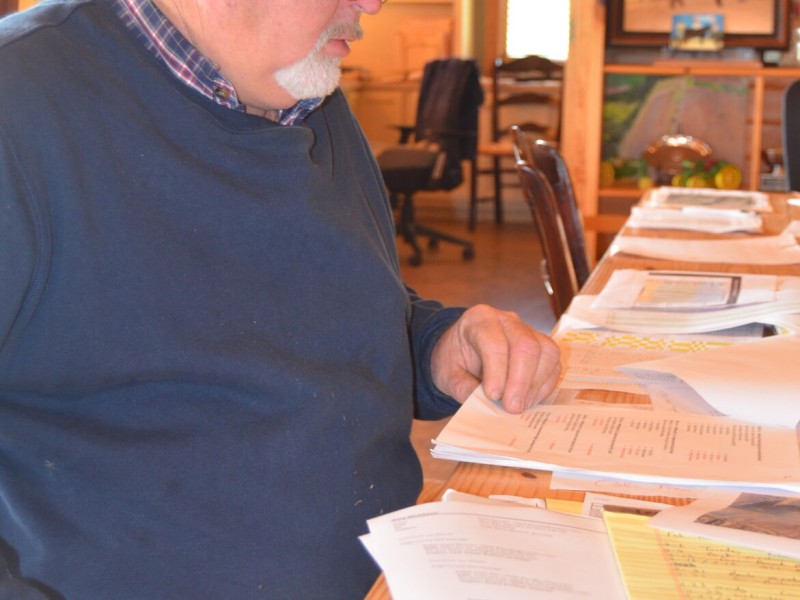
DOERUN – In more than 60 years of farming, Louie Perry remembers lots of events that have impacted southwest Georgia agriculture, from hurricanes to droughts and other disasters, both financial and natural. But 2024 may present even more of a threat.
More even than the farm crisis of the late 1970s, when low crop prices, coupled with high interest rates and shrinking markets, combined to strike a massive blow to agriculture across the country. During the Carter administration in 1979, several thousand farmers drove tractors to Washington, D.C., to protest, some traveling more than 1,000 miles to make their point.
“Even the ‘80s, when Jimmy Carter was president, that was the worst in my life, and this is worse, especially for the row crop farmers,” said Perry, 85, who planted his first crop in Colquitt County in 1962.
At the moment, area growers of corn, cotton and peanuts, like farmers across the country, are facing low prices for their products but have seen prices for everything from fertilizer and insecticides to parts, tractors, interest, labor and fuel jump significantly over several years.
Congress extended the current farm bill, approved in 2018 to run through 2023, through 2024, but that offered no increase in the reference price – the point at which assistance kicks in that was established with the 2014 farm spending plan and continued with the 2018 farm bill.
Farm legislation that makes up the overall farm bill is passed roughly each five years and dates back to the Great Depression when the Agricultural Adjustment Act of 1933 was approved. It was passed during the backdrop of the economic hardships of the times, and a drop in crop prices following World War I and the Dust Bowl.
The majority of spending in the farm bill covers nutrition programs, including the Supplemental Nutrition Assistance Program (SNAP), school nutrition programs and other elements such as agricultural conservation, trade, farm credit, research, rural development, and foreign and domestic food programs.
The commodity revenue support portion of the program represents just a small amount in the overall farm bill, said Bart Davis, whose Davis Family Farms operation near Doerun produces corn, cotton, peanuts and beef cattle. And the price threshold set in 2018 does not reflect the changes that have occurred since then.
“The farm bill is designed to help farmers when commodity prices are lower than cost of production,” Davis, who serves as chairman of the Georgia Cotton Commission, said. “What has happened is our inputs have gone up dramatically since 2022, when COVID hit, and it has stayed.”
In a best-case scenario, with a quick passage of the farm bill, farmers wouldn’t feel the benefits until 2025. If the legislation is delayed until late in the year, that could push the impact date into 2026.
And during an election year with a divided Congress, many farmers are not confident legislators will manage to steer a package through to hit the president’s desk.
“Farmers can’t wait until 2026,” Davis said. “Farmers need help now. There’s a lot of good farmers who made good yields who didn’t pay back their bank notes last year.
“We’ve got some farmers that are selling off equipment they probably need, but they need to have some money. Farmers can’t just say ‘I’m not going to farm this year’ and wait until it gets better.”
As an example, Davis checked the current contract cotton prices, which were just short of 83 cents per pound, on his phone Tuesday morning. That price is not sufficient for farmers to break even, let alone make a profit, he said.
“It needs to be in the mid- to upper-90s (cents per pound) to even break even,” Davis said. “There’s nothing on the horizon to show cotton is even going to go up.”
Corn prices also are depressed, currently at about $4 per bushel, and farmers have had yield issues with peanuts over the past few years.
The farm bill not only benefits those who produce the nation’s food and fiber, it also helps ensure that consumers have an abundant supply of those products at a relatively stable price, the farmer said.
Out of the $18.33 billion in farm income produced in 2022, according the the University of Georgia’s latest Farm Gate Report released in January, cotton was the second-largest agricultural commodity in the state after chicken broilers, accounting for 7.2% of farm revenue. Georgia farmers planted 1.3 million acres and earned about $1.3 billion in income statewide.
The row crops and forage category, which includes the area’s biggest row crops of corn, cotton and peanuts, accounted for 18.1% of farmers’ income earned.
At current cotton prices, growers are looking at going deeper into the hole financially, Taylor Sills, executive director of the Georgia Cotton Commission, said. At that price, the average cotton grower is (conservatively) looking at an actual loss of $50 per acre planted.
“Not only do we have more pressure on farmers, because of economies of scale, the capital is going as well,” he said. “There’s a lot of risk being taken on.”
The calls of alarm are coming from across the state, not just southwest Georgia, Sills said, and the risk could impact a lot more than those who till the soil. Georgia is fortunate in that it is not as heavily influenced by big ag as many other states. But family farms are at risk.
“If we lose family farmers … what replaces that?” he said. “It’s something that’s very concerning. This is something everybody should be concerned about — not just farmers, not just bankers — everybody should be concerned. This is going to affect the overall economy.”
Davis was part of a delegation of farmers that went to the U.S. Capitol last week to speak with legislators about the need for action to help farmers weather the current storm. The takeaway was not positive.
Some lawmakers have expressed optimism that Congress can take action to help farmers, while “some of them say they won’t vote for a nickel increase,” veteran farmer Perry said. “That tells me we won’t get anything in the farm bill this year.”
One story Perry shared illustrated the way things are going at the moment. Normally, he said, when he puts in a fertilizer order this time of year it could take about a week for delivery. But that’s not the case right now.
“I called them and said ‘when can I get a load of fertilizer?’” he said. “He said ‘I can send it right now.’ Nobody’s ordering any fertilizer.
“We’ve got to get all hands on deck, or we’re going to have a bunch of broke farmers down here.”
At Doerun Gin, General Manager Tom Sumner also was feeling those kinds of vibes from farmers as well.
“Right now, it’s a very odd time,” he said. “It’s just survival mode right now. It’s very lackadaisical this year. There’s nobody really enthused this year about getting started.
“Generally, this time of year they’ve got some enthusiasm, even if they had an off year. There’s no glimpse of hope that things are going to get better.”
It’s not only the fortunes of farmers that are on the line if the ag economy in the area suffers. Small towns like Camilla, Dawson, Moultrie and Sylvester depend on the income farmers bring in and spend on goods and services.
As a regional shopping hub, Albany and agriculture also have an interdependent relationship, according to Albany Area Chamber President and CEO Barbara Rivera Holmes.
“Farming – agriculture – is Georgia’s No. 1 industry, with the most abundant production rooted right here in southwest Georgia,” she said. “This supports not only the ag industry, but indirectly impacts other industries, services and goods; from retail and hospitality, to cultural organizations and schools, to finance and banking. And, of course, food security.
“Dougherty County, which itself has a respectable farm gate value, further benefits by providing ample goods and services to the farming industry. The challenges we’re seeing in ag impact all sectors of commerce and life not only in Dougherty County and Georgia, but across our nation.”

Author

Related Articles

Albany Herald – July 18, 2026
Georgia Trust for Local News partners with… Adult leadership group spreads concept to… Lee County homeowners have until Aug. 1 to claim…

Classifieds – July 18, 2026
Classifieds; Legals;

Albany police make arrests in murder, robbery cases
Officials with the Albany Police Department have announced a number of arrests in cases that involved a homicide and a pair of thefts.
