
U.S. Sen. Warnock talks farm bill, farmer assistance programs with southwest Georgia pecan farmers
File Photo: Lucille Lannigan
By Lucille Lannigan
[email protected]
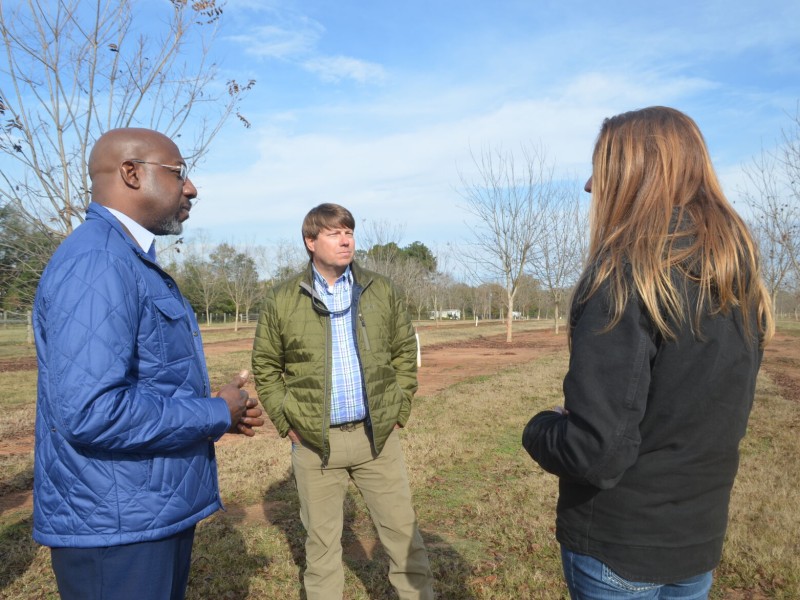
LEESBURG — U.S. Sen. the Rev. Raphael Warnock, D-Ga., visited a Lee County pecan farm Friday to hear from two local farmers about challenges facing the pecan industry and suggestions for the new Farm Bill.
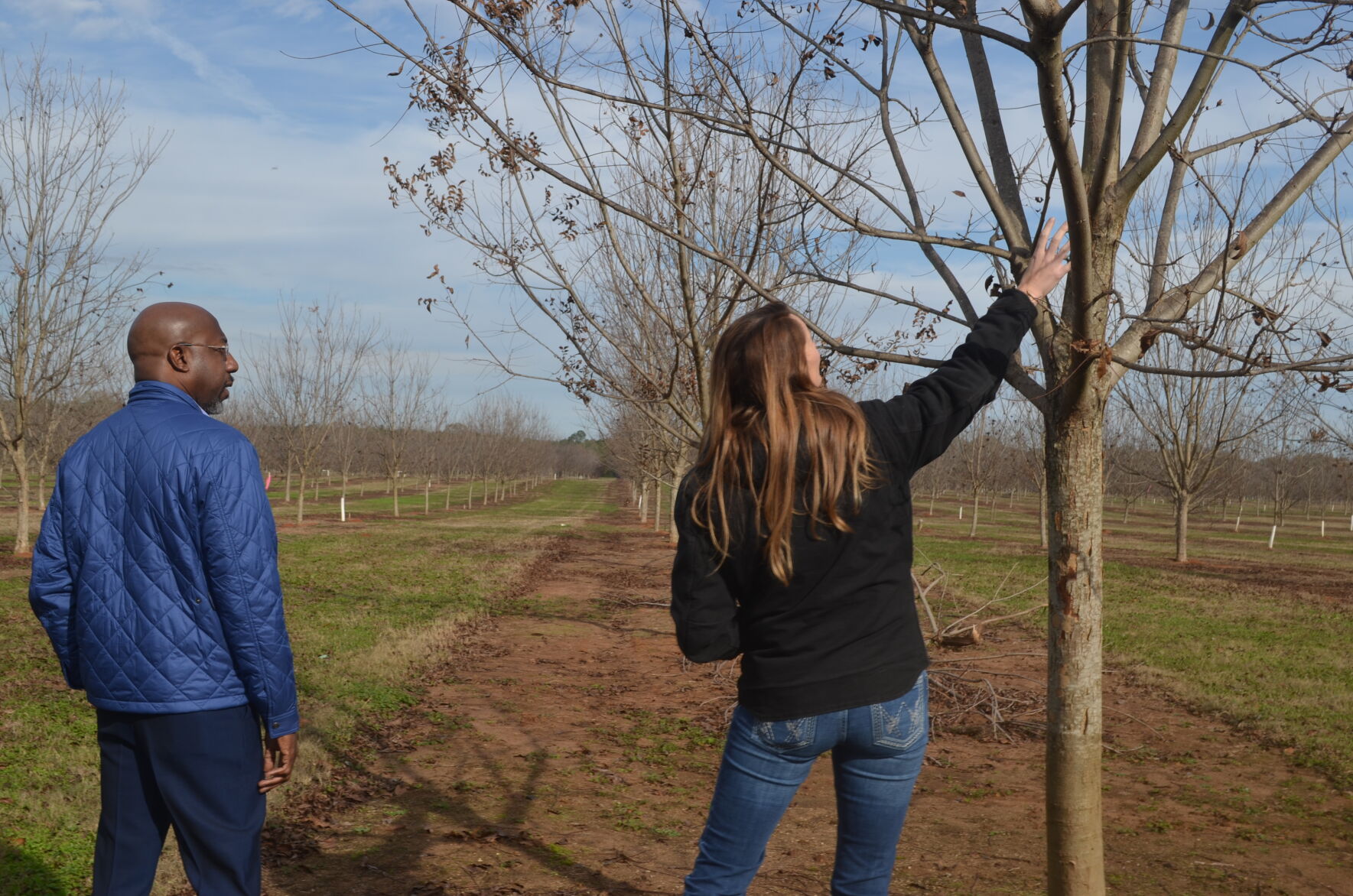
The senator walked with the two Georgia pecan growers on a 65.5-acre farm that sustained loss from summer storms.
Justin Jones of Jones Planting Co. and Marianne Brown of T&M Brown Farms both lost a significant amount of trees during what Brown called an “abnormal year.” This comes as pecan farmers continue to feel Hurricane Michael’s impact. The 2018 storm destroyed 30-50% of pecan trees in southwest Georgia, according to the UGA extension site.
Warnock worked with Sen. Jon Ossoff, D-Ga., to secure grants for Georgia farmers. The senators’ press offices announced Tuesday that six Georgia farms receiving between $190,000 and $250,000 in grants from the USDA’s Value-Added Producer Grant program.
Warnock’s Friday meeting with farmers focused on needs ahead of the 2023 Farm Bill reauthorization, as well as disaster assistance.
It’s one thing to be in D.C. and another to be here on the ground to see the impact, the senator said, adding, “It’s clear that policies aren’t keeping up with climate change.”
“We are seeing climate change,” Warnock said. “The farmers know it. We’re seeing stronger storms, they’re coming more often.”
One of the senator’s main priorities is creating more flexibility in the Tree Assistance Program.
TAP was authorized in the 2014 Farm Bill to provide financial assistance to tree growers to replant or rehabilitate eligible trees, bushes and vines damaged by natural disasters. This is more relevant than ever for Georgia farmers who have experienced abnormal, disastrous storms at a more frequent rate in the last six years.
Hurricane Irma hit in 2017, and hurricane Michael in 2018. The effects of Michael rolled into 2019, Jones said.
“It just put so much stress on the tree that the tree itself did not produce,” he said. “So, ‘19 was what we call a dud year.”
Jones said he lost about 3,000 trees in 2018 — almost 20% of his crop. The trees that were replanted have new varieties that are more resilient toward disease and less expensive to grow, but they won’t be viable for at least another five years.
Growing pecan trees is like playing the long game, Brown said. It’s a high input on a younger tree — spraying against mites and disease, monitoring roots and moisture — only for it to take years to produce as much as older trees.
“You have to have the cash flow and longevity to make it,” she said, “but money is tight for many farmers. Everything is going up in price: equipment, labor and fuel, but the commodity prices for pecans are down.”
Those realities are driving farmers out of the industry and making her question the long term vitality of her farms, Brown said.
“I’d love for my children to do this because I love it, but there are probably easier jobs with insurance … and weekends at home,” she said. “It is stressful to not know what the weather’s gonna do, what the price is gonna be, how many pounds you have.”
Then, the COVID-19 pandemic came in 2020. Pecan farmers were set to have a strong harvest but demand was low, Jones said. With a big supply and low demand, prices suffered. Farmers still haven’t recovered.
The 2023 year was an anomaly, Jones said. Farmers saw a frost in March, followed by a cool May and excessive rain and storms in June. August and September had a dry spell, and then farmers in the southwestern part of the state were slammed by Hurricane Idalia in August.
While he said he wasn’t expecting a great harvest, this season’s yield was much worse than expected, both Jones and Brown agreed.
Jones averages about 1,000 to 1,500 pounds of pecans per acre. This year’s harvest, which wrapped up in the last week of November, saw about 300 to 500 pounds per acre.
Farmers are having to change the way they grow in order to profit. This includes making a tractor cover more acres and reducing the per-acre cost by having more trees in a single acre, Jones said.
“You have to be a bigger operator to have more leverage, and it’s driving small farmers out of the industry,” he added.
Having Warnock actually see the numbers and the loss in person is a huge step in beneficial change, Jones said.
Warnock is working toward “common sense” policies and reforms to provide farmers relief from these challenges. The senator said he wants to help farmers get their products to markets and increase export possibilities.
Warnock said he wants to reform TAP so that farmers have more opportunities to plant the newer, more resilient breeds. He also wants to address crop insurance issues, strengthen federal nutrition programs and support universities like the University of Georgia and Fort Valley State University and the work they do for farmers.
Warnock listened to the two farmers describe their plights for almost an hour. He asked questions about their crop, the technologies they used and what some of their biggest concerns were. He said he plans to bring their suggestions and concerns back to the Senate for the new farm bill.
The future of the agriculture industry lies in the farm bill, which is updated every five years, many farmers say. The 2018 bill is currently extended until September 2024 as Congress debates updates for the new bill.
Both Jones and Brown emphasized the need for an Actual Production History Yield Exclusion, which was a provision of the 2014 Farm Bill that allows farmers to exclude eligible yields that occur from “exceptionally bad years” that include natural disasters.
Crop insurance is down, and there currently isn’t a yield exclusion policy. It’s penalizing farmers for their loss, Warnock said.
Brown said it was impossible to harvest in 2018 after Michael, and yields were terrible in 2019 as well. This “zero” in 2018 and the small crop in 2019 were added to Brown’s average. Her insurance guarantees are now so low that she fears she will have to dip into her savings.
Some pecan growers don’t even have that option. They just can’t do it anymore, Brown said. They’re out.
Having an automatic yield exclusion policy when an extreme weather event happens would sustain the crop insurance safety net for farmers, Jones said.
Warnock said he hopes to face little barriers in Congress as he vouches for the Farm Bill and TAP reforms desired by farmers. It’s common sense reform, he said. They aren’t bipartisan issues.
“If you care about food … about groceries, you ought to care about farmers,” he said.
Author

Related Articles
Albany recycling center enacts material separation rule
Mixed items will no longer be accepted at the Albany recycling center at its 2521 Meredyth Drive facility. Individuals will now be required to separate items befor they will be accepted.

Wild Game Dinner marks 34 years as South Georgia Scouting reaches for next generation
More than a century after organized Scouting first took root in Southwest Georgia, local leaders say the program is working to preserve its traditional mission while adapting to a new generation of young people.
Albany City Commission takes action on proposed downtown hotel, two theater renovation projects
“We’re taking the original building back to, hopefully, it’s glory days. One of the cool things about the project is we are going to restore the balcony. It’s going to have a balcony, so it’s going to be super cool.”
