
U.S. to hit debt limit much sooner than expected
Sarah Rice via Georgia Recorder
By Jennifer Shutt
Georgia Recorder
WASHINGTON — The U.S. government will hit its borrowing limit this week, forcing the new, divided Congress into negotiations over the debt limit much sooner than expected, though a potential date for the nation to default isn’t expected until this summer.
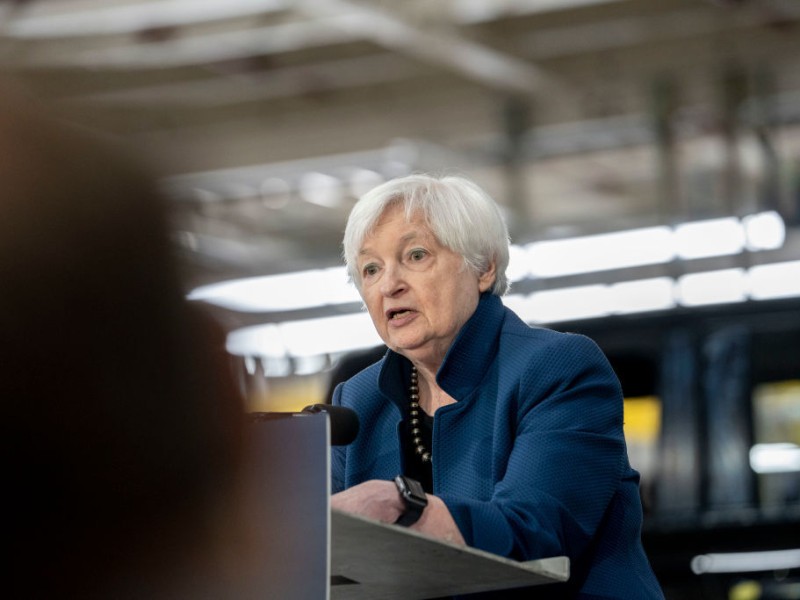
Treasury Secretary Janet Yellen wrote to Congress, telling leaders the United States will hit the debt ceiling on Jan. 19, after which she’ll use accounting maneuvers, which she called “extraordinary measures,” to keep U.S. finances up and running for a few months.
Yellen urged the Republican House and Democratic Senate to get to work on a bipartisan debt limit bill quickly, writing it is “critical that Congress act in a timely manner.” The January date is much sooner than the third quarter of this year, the preliminary estimate the Bipartisan Policy Center released last June.
“Failure to meet the government’s obligations would cause irreparable harm to the U.S. economy, the livelihoods of all Americans, and global financial stability,” Yellen wrote. “Indeed, in the past, even threats that the U.S. government might fail to meet its obligations have caused real harms, including the only credit rating downgrade in the history of our nation.”
Yellen said use of the extraordinary measures should last until early June, though that’s not a guarantee.
Senate Majority Leader Chuck Schumer and House Minority Leader Hakeem Jeffries released a joint statement calling on Republicans to begin negotiations with Democrats for a bipartisan bill.
“Democrats want to move quickly to pass legislation addressing the debt limit so there is no chance of risking a catastrophic default,” the two New York Democrats wrote. “We’ve seen in previous debt ceiling standoffs that even the threat of default leads to even higher costs for working families. Republican leaders must do the right thing to protect Social Security, the economy, and our country.”
With the country’s $31.385 trillion borrowing limit on track to consume headlines during the coming months, here’s a rundown of the debt ceiling as Congress and the world economy head toward another fiscal cliff:
Q: What is the debt limit?
A: It gives the U.S. Treasury Department the ability to borrow money to pay for all the spending that Congress has approved, including the dozen annual government funding bills and mandatory spending programs that essentially run on autopilot, like Medicare, Medicaid and Social Security.
Raising the debt limit does not authorize or appropriate new federal spending, but allows Treasury officials to continue paying all the nation’s bills in full and on time. The U.S. government has debt because nearly every year the federal government runs a deficit, meaning it spends more than it brings in from taxes and fees.
Q: What are extraordinary measures?
A: Once the U.S. government reaches the debt ceiling, the Treasury Department can use accounting maneuvers to give lawmakers more time to reach bipartisan, bicameral agreement on a debt limit bill. But the moves can add some uncertainty to financial markets the longer they go on, especially as Treasury gets closer to an actual default date.
Extraordinary measures can include “suspensions and delays of some debt sales and auctions, underinvestment and disinvestment of certain government funds, and exchange of debt securities for debt not subject to the debt limit,” according to a Congressional Research Service report.
Q: What does Congress have to do with the debt limit?
A: Whenever the federal government approaches the debt limit, Congress must pass new legislation to allow the U.S. Treasury Department to continue borrowing to meet all the country’s financial obligations.
Q: Has the United States ever defaulted on the debt?
A: There were some lapses in the 1970s that left the amount of debt above its limit, but those didn’t result in any missed payments that would constitute a default.
Q: What would happen to the federal government if the country were to go past the so-called X-date, or default date?
A: The United States defaulting on its debts would mean that the U.S. Treasury Department no longer had borrowing authority or extraordinary measures to pay all the country’s bills in full and on time.
The Treasury secretary, currently Yellen, would need to limit payments from the federal government to the amount of money on hand on any given day or week. Depending on what programs, departments or agencies were prioritized, that could mean lapses in Social Security payments or delayed Medicare reimbursements. Members of the U.S. military and other federal employees could go without paychecks, and veterans could be shorted on their health care and benefits.
Q: What’s the difference between a partial government shutdown and a debt limit default?
A: The federal government begins a funding lapse or a partial government shutdown when Congress fails to pass all 12 government spending bills or a stopgap spending bill by the start of the new fiscal year on Oct. 1 or a subsequent deadline.
Exempt government employees continue going to work without paychecks and non-exempt federal employees are sent home without pay until Congress passes a new spending bill. Partial government shutdowns have a negative impact on federal government operations, like national parks closing, but not nearly the impact a default on the debt would have.
Partial government shutdowns are called that — partial — because the U.S. military and national security personnel continue operations, staff continue feeding the animals at the Smithsonian Zoo in Washington, D.C., and Social Security, Medicare and Medicaid operations mostly go interrupted.
Q: How were debt limit deals worked out during the Trump and Biden administrations?
A: Congress and the Trump administration brokered debt limit agreements three times during his four years in office. There has been one debt limit bill so far during the Biden administration.
Q: What agreements on the debt limit did current House Speaker Kevin McCarthy make in order to secure the votes needed to hold the gavel?
A: The California Republican reportedly agreed that U.S. House Republicans wouldn’t agree to raise or suspend the debt limit without a budget agreement or “commensurate fiscal reforms.” McCarthy and his office have declined to make the various agreements with conservative lawmakers public.
Q: When is this year’s debt limit deadline?
A: The country will reach the debt limit on Jan. 19, at which point the Treasury Department will begin using extraordinary measures, according to the letter Yellen sent to Congress on Friday.
“The period of time that extraordinary measures may last is subject to considerable uncertainty due to a variety of factors, including the challenges of forecasting the payments and receipts of the U.S. government months into the future,” Yellen wrote. “While Treasury is not currently able to provide an estimate of how long extraordinary measures will enable us to continue to pay the government’s obligations, it is unlikely that cash and extraordinary measures will be exhausted before early June.”
Author

Related Articles

Classifieds – June 20, 2026
ALBANY HERALD CLASSIFIEDS JUNE 20, 2026

Albany Herald – June 20, 2026
City Albany faces shortfall for police… Women’s Anchorage tentatively set to… Commissioner, school leaders clash over…

Public safety drives Leesburg’s $4.2 million Fiscal Year ’27 budget
The adopted spending plan reflects modest growth in city revenues and continued emphasis on maintaining core municipal services, particularly public safety and sanitation, which together account for a significant share of general fund expenditures.
