
Warnock announces rural communities infrastructure grants
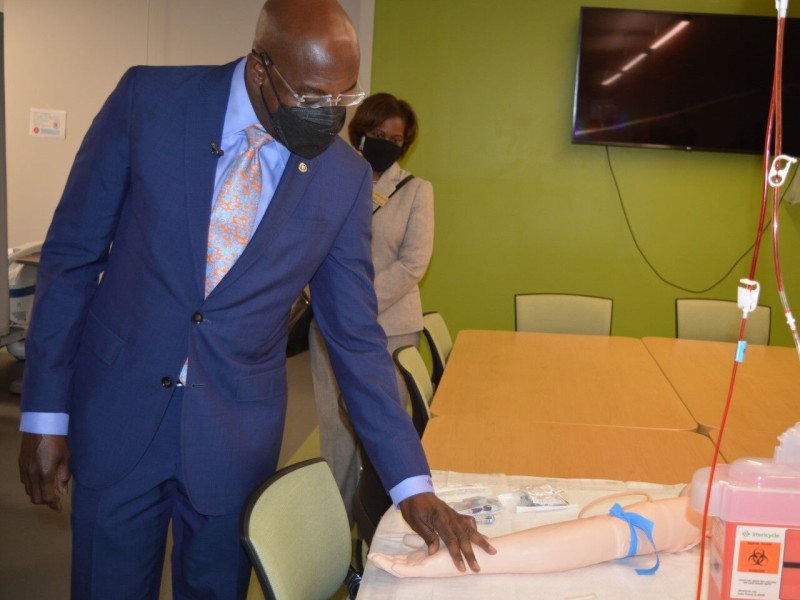
File Photo: Tara Dyer
From staff reports
WASHINGTON D.C. — U.S. Senator the Rev. Raphael Warnock, D-Ga., announced Monday that USDA will invest $13 million in Community Facilities funding for 29 rural community infrastructure projects throughout Georgia. The funding will be used to strengthen local public services, and connect rural residents to critical community services and facilities in 22 rural counties in the state.
Among the southwest Georgia communities that will be impacted are Ben Hill, Clay, Irwin, Thomas and Worth counties.
“No matter where you live, every Georgian deserves access to essential community services such as emergency response and medical care,” Warnock said in a news release. “I’m pleased to see millions of federal dollars flow to rural communities in every corner of the state to ensure rural Georgians are connected to their community and vital public resources.
“This federal funding is an investment in rural Georgians’ safety, health and quality of life, and I am committed to continue delivering for our rural communities. I was proud to secure over $9 billion in the bipartisan infrastructure law to connect rural Georgia communities physically through roads and bridges and virtually by expanding access to broadband. I will continue to serve as rural Georgia’s voice and champion in Washington.”
Among the Community Facilities grants and loans awarded in southwest Georgia are:
Ben Hill County Board of Commissioners — $18,400 (loan)
Clay County, city of Fort Gaines — $69,800 (loan) $100,000 (grant)
Irwin County — $130,900, $489,000, $30,100, $50,700 (loans) $50,000, $100,000, $16,200, $27,300 (grants)
Thomas County: City of Pavo — $19,200 (loan)
Worth County Board of Commissioners — $32,000, $100,000, $15,200 (loans)
Total Amounts: $11,920,400 (loans) $1,300,000 (grants)
Also on Monday, the office of U.S. Sen. Jon Ossoff, D-Ga., announced that momentum is building for his legislation to ban members of Congress from trading stocks.
On Friday, 14 major government reform organizations — from across the political spectrum — united to call on Congress to swiftly pass Ossoff’s Ban Congressional Stock Trading Act.
“By large majorities, the American people have made it clear that they do not support members of Congress trading stocks, and they want Congress to do something about it,” the groups wrote to Senate Majority Leader Chuck Schumer and Minority Leader Mitch McConnell. “This view cuts across partisan affiliation, so it is encouraging to see this issue garner rare bipartisan support in Congress. The public needs to know that Congress recognizes the issue of insider trading as a problem that undermines its own legitimacy and erodes the trust of voters.
“The good news is that Congress is able to respond to this concern in a meaningful way by advancing [Sen. Ossoff’s legislation] and sending it to President Biden’s desk for his signature.”
Ossoff’s Ban Congressional Stock Trading Act will prohibit all members of Congress, their spouses, and dependent children from trading stocks — ensuring they cannot use inside information to influence their personal stock trades and make a profit off their public office.
Members of Congress who violate the act would be fined in the amount of their entire Congressional salary.
Ossoff, a former investigative journalist whose company exposed corruption around the world, fulfilled his pledge to put his own stock portfolio in a blind trust last year, making him one of only 10 sitting members of Congress to do so, according to Insider. Ossoff’s opponent in the 2020 Senatorial race, David Perdue, was accused, along with then-fellow Georgia Sen. Kelley Loeffler, of using information they received in a briefing about the coronavirus to manipulate stocks in their portfolios to their financial advantage. Those claims were later dismissed.
Seventy-six percent of voters — across the political spectrum — believe members of Congress and their spouses should not be allowed to trade stocks while in office, including nearly 78 percent of Republicans and 80 percent of Independents.

Author

Related Articles
PHOTOS: Albany State Wear Pink – Breast Cancer Awareness
Two galleries. Click the arrow to scroll through the photos.

Dougherty school board vacancy, election lawsuit leave voters facing uncertainty
Dougherty County School Board members acknowledged Thursday that they must address a District 4 vacancy after Melissa Strother resigned. Meanwhile, a court challenge to the May primary alleges scanner malfunctions, mishandled ballots and incomplete election records.

Albany Symphony set to kick off 63rd season featuring ‘Magic of Music’
This season, ASO is highlighting some of the orchestra’s principal musicians during each performance.
