
What a long strange year it’s been: Extreme weather blasts, boils, drowns area row crops in 2024
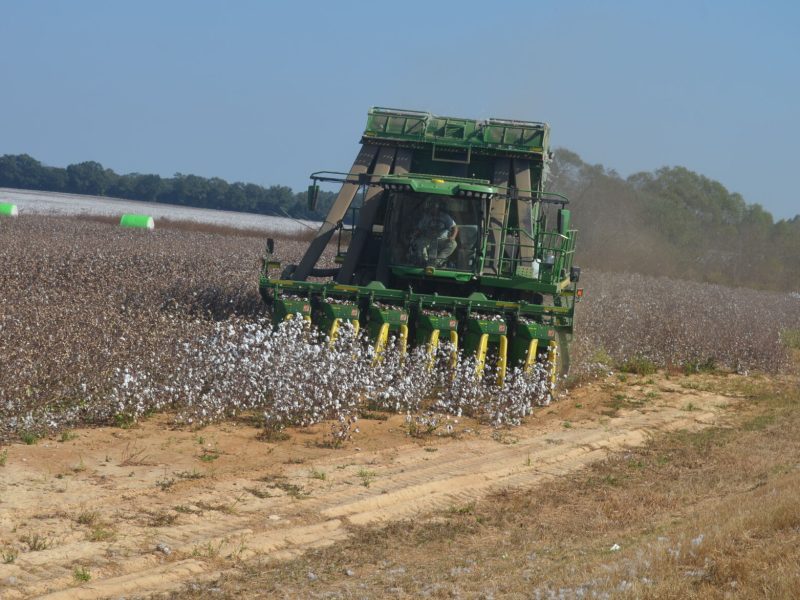
A farmer harvests cotton in Mitchell County. Area row crop farmers faced a unusually challenging year from extreme weather from start to finish this year.
Staff Photo: Alan [email protected]://secure.gravatar.com/avatar/f714026fc83d6150ab9a4350b4169940?s=100&d=mm&r=gBy Alan Mauldin
[email protected]
MOULTRIE – It’s not unusual for southwest Georgia farmers to face adverse weather conditions like extreme cold, exceptional rain, blazing heat and extended dry spells as well as impact from hurricanes. But they don’t usually all come in the same year.
That combination put an extra burden on farmers already hurting from low commodity prices, affecting yield and, for many, increasing the cost of production as they pumped lots of water to try to quench thirsty crops.
“That goes for this whole region around us,” Cody Mitchell, farm manager of the Darrell Williams Research Farm at the Sunbelt Ag Expo in Moultrie, said. “From talking to people, everybody experienced the same. The weather was absolutely up and down.”
Unseasonably cold weather delayed the normal planting date of around April 25 for cotton and peanuts until May and when that month arrived, so did the rain clouds.
During the first half of the month 13 inches fell at the 600-acre research farm, Mitchell said.
“We had 50 or 60 acres of cotton planted, 100 acres of peanuts,” he said. “Then for two or three weeks, we’re waiting for it to dry up. We had to go back and replant about 20 acres of peanuts (and) about 55 acres of cotton due to that weather.”
After the abundance of rainfall in May, the spigot was shut off for 27 of the 30 days of June.
The University of Georgia weather monitoring system station located at the Expo site recorded that in the first 25 days of June there was a little less than half of an inch of precipitation, with 0.01 inches on June 12 and June 17, before showers brought a little more than an inch on June 26.
The hot weather and sporadic rainfall made it difficult to pump enough water to keep crops growing, Mitchell said. August brought another challenge in the form of Hurricane Debby, which dumped 2 inches of rainfall in a relatively short time.
“August gets here, and Hurricane Debby hit,” Mitchell said. “It laid some of the cotton on the ground. Some is still on the ground. The major challenge when cotton is on the ground is it makes it challenging to defoliate and pick. And at the end of September, Helene got here.”
Hurricane Helene’s winds damaged more cotton.
Another lengthy period of dry weather struck after Hurricane Helene made landfall on the night of Sept. 26 and took its path through Georgia. The powerful storm dumped more than 6 inches of rain in the Moultrie area over three days, and after that skies cleared for weeks.
“The three weeks leading up to Expo and the three weeks after the Expo we had hardly any rain at all,” Mitchell said. “We got absolutely no rain for six weeks and then we get 4 1/2 inches in six hours (Nov. 6). That sums up the growing year; it was all or nothing.”
The yield results at the research farm are not all in, but the strange weather year definitely affected the corn, which is the first row crop planted in the growing season.
“It was a hot summer, as expected,” Mitchell said. “The corn yield suffered from June. It was so hot and so dry, there was no way to keep up with the needs of the corn at that time.”
Faced with those conditions there was little that farmers could do but watch and wait, he said.
“It just goes to show how Mother Nature plans,” he said. “Mother Nature just plays the biggest role in ag, in my opinion.”
The struggle for farmers was even greater than that faced at the research facility, Expo Director Chip Blalock said.
“On top of all this, input prices were high and commodity prices are low,” he said. “It was just one of these crazy years. I just sent an email out to the University of Georgia specialists we work with. I said for certain it was an unusual year, but it seems we don’t know what normal is anymore.”
Author

Related Articles

Value of Dougherty’s tax-exempt worship property more than doubles
The assessed value of property in Dougherty County’s religious-worship exemption category more than doubled over a decade, reaching $38.2 million in 2025 while the county’s net taxable value grew about 2%.

Statewide candidates hit Albany for forum ahead of Nov. 3 election
Four candidates seeking statewide office, and two representaives for an additionaltwo candidates, participated in a Tuesday forum. Statewide early voting ahead of the Nov. 3 election starts on Oct. 13.
City officials to meet with downtown developer after default letter sent on North Washington Street project
City officials are still bullish on a project that will bring apartments, restaurant and Albany Technical College culinary arts instruction space to downtown Albany. However, the project has hit a snag with faulre to meet a Sept. 30 deadline to secure funding and a commitment from Albany Technical Colle to occupy off-campus culinary arts space in the development.
