
When living the dream becomes a nightmare
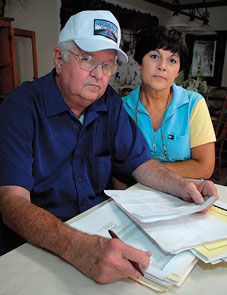
Photo by Laura Williams
Carlton Fletcher
PELHAM, Ga. — If you’re interested in testing that biblical admonition about a person not having to endure more than he or she can handle, give Bill and Phyllis Frazier a call.
The Fraziers moved into the lovely new home they built here near members of Phyllis’ family in 1992, debt free and living easy. Bill had retired after a successful if improbable career working with some of NASCAR’s early superstars, and the happy couple settled into an idyllic retirement to live life on their terms.
Flash forward to the present, and the Fraziers are on the verge of losing everything they own. Their bank accounts have been frozen as garnishment for a vehicle Bill Frazier bought for what he hoped would be a profitable joint venture with Mitchell County. The repossessed truck is part of some $114,000 in debt the Fraziers say they piled up in anticipation of starting that business, and the couple say the city and county that they decided to call home has all but abandoned them in their time of deepest need.
“I’ve got $95 in my pocket … that’s it,” Bill Frazier said, the hurt and humiliation choking his words. “We can’t even write a check for groceries from any of our bank accounts; they’ve been frozen.
“And the thing about it is, we’ve tried to be good citizens. We’ve sat down and agonized over this and agonized over it. But we’ve done nothing wrong.”
Sickness — rheumatoid arthritis and colon cancer for Bill and a mysterious blood disorder for Phyllis — started the Fraziers on the road to what inevitably may be financial ruin. But they say it’s the way they’ve been treated by local officials that hurts worst.
Bill Frazier says — and he offers copies of letters he exchanged with local officials and minutes taken at government meetings to support his claims — that Mitchell County Administrator Bennett Adams all but guaranteed him exclusive rights to discarded white goods (appliances) and tires for his recycling business.
Frazier said he purchased a $34,000 Dodge Ram pickup; paid $60,000 for additional adjacent land that Adams told him he would need for his business; had a special trailer built to haul scrap materials; paid surveying, site preparation and materials fees, and put up a $10,000 CD as bond for a DNR-required scrap tire carriers permit … all based on Adams’ word that Frazier would be granted exclusive access to scrap materials in the county.
“The county had been doing business with a company in Florida (Cumbaa Enterprises of Blountstown) for a good while, and I pointed out to Mr. Adams that that company has not paid a penny of taxes in Mitchell County,” Frazier said. “I figured it up, and through 2007 we’d paid about $40,000 just in property taxes.
“Mr. Adams said he thought my taking over the hauling of recyclable materials in the county was a good idea. In fact, he told me it would be ‘an answer to a headache,’ and in November of 2007 he said he’d work it out with the county and then tell the company in Florida to clean up the area where scrap is delivered. He said I could start collecting the materials the first of 2008.”
Frazier said he heard nothing from Adams until March of 2008, when the county administrator told him official approval by the Mitchell County Commission was needed but would be a “formality.” On March 8, Frazier got a letter saying the county would continue to do business with Cumbaa.
While Frazier said the action by the commission left him with too little business in the small community, Adams said the board didn’t feel comfortable giving Frazier’s recycling business a “monopoly.”
“We discussed Mr. Frazier handling all the recycling business in the county, but the commission had some concerns,” Adams said. “The minutes show that such a proposal was presented, but the board was concerned if they gave a monopoly to Mr. Frazier and he went out of business, the county would be right back where it started (when the county’s landfill was closed by the EPD) with no one to haul away the scrap materials.
“We have not stopped Mr. Frazier from doing business. As far as I know, his landfill is still open and people are still taking scrap materials to him. In fact, I’m a little surprised more people don’t take their materials to him. He’s paying money where under our agreement with Cumbaa, they just come and pick up materials at the county’s dropoff site.”
But Frazier argues that the county’s agreement with Cumbaa cuts deeply into his potential to collect (and pay for) scrap materials.
“What (Adams) is doing there is crawfishing; he’s being contradictory,” Frazier said. “It’s obvious if the county’s got a contract with somebody else, they know they’d better not let another company cut into business that would jeopardize that contract.
“And what gets me is that I went out and got myself deep in debt on Bennett Adams’ guarantee that I would have exclusive access to the materials. If he’d told me that there was a chance I wouldn’t get it, I would have waited to make those purchases.”
Lest an outsider get the impression Bill Frazier’s business woes are signs of someone lacking in such skills, a brief look at his history suggests otherwise.
Born in Kentucky and raised by his grandparents in north Alabama, Frazier worked at a steel mill for 11 years until he succumbed to a calling that centered on two of his passions: the gospel and car racing.
In 1969 he asked for permission and was allowed to conduct the first chapel service at a NASCAR event.
Legendary driver Richard Petty, who ruled the racing world at that time, liked the idea, and his blessing opened the door for Frazier’s 30-minute prerace devotionals to become a part of weekend NASCAR events.
“Those first few services, there were like seven people present,” Frazier, who served as a lay minister, said. “They’re still doing the services today for about 35,000 people.”
Frazier left his job and, on faith, made his devotionals a regular part of race day. During his time as a regular on the circuit, he came up with the idea of licensing and selling NASCAR souvenirs and memorabilia, an idea that led to a partnership with Petty and his racing team.
“I wrote the first royalty check to NASCAR,” Frazier says with pride.
After becoming a regular part of the growing NASCAR empire, Frazier met a 21-year-old beauty named Phyllis Gilbert during a Florida sales trip, and he was immediately smitten.
“I was working with a company that sold unlicensed souveniers, and they wanted me to spy on Bill to find out what he was doing,” Phyllis Frazier laughs. “He ended up inviting me to go with him on a business trip to Richmond, Va., and I never came back.”
Bill Frazier eventually became Petty’s business manager and landed so many endorsement deals for the star racer that drag racing king “Big Daddy” Don Garlits came calling and asked Frazier to do the same for him.
When Petty hung up his car keys in 1992 after a farewell tour, Frazier decided he’d do the same. He and Phyllis bought land near her sister’s place about three miles outside Pelham and built their 2,000-square-foot dream home, complete with 1,000-square-foot mother-in-law residence. They became a part of the local scene, involving themselves in any and all activities in the community.
Then disaster struck when, in less than a year, Bill was diagnosed with rheumatoid arthritis and colon cancer.
“We didn’t have insurance, so that wiped out about half of our savings,” he said.
With her husband in remission, Phyllis Frazier contracted the rare blood disorder vasculitis and spent a month in the hospital before doctors finally diagnosed the disease and found medication to treat it.
“That took the rest of our savings, and we had to refinance our home,” Bill Frazier said. “Our retirement was over. We went back into the business world.”
Bill opened a sign business, but that didn’t bring in enough money to pay the Fraziers’ bills. Phyllis managed and ran a convenience store located across from a new school being built in the county, but the recession hit and completion of the school slowed. The hoped-for sales boost never came, and the store closed.
New hope arose for the Fraziers with the opening of their landfill, but that venture eventually left them in a sea of red ink.
“I’ll tell you how things have gone for us,” Bill Frazier said. “When Phyllis had the convenience store, we sold fuel to the city. When the recession hit, they asked to buy on credit. We let them, and they’d sometimes take six months to pay.
“Then when hard times hit us and we got our tax bills, we asked if we could pay over time. The county said that was fine, but the city told us we had to pay it all at one time. I reminded them that they’d bought gas from us on credit, but that didn’t matter to them.”
Pelham City Manager Doug Westberry said he’s not aware of any animosity between the Fraziers and the city.
“I pray for Bill and Phyllis all the time because of their struggles, and the city spends all the money we can with them,” Westberry said. “We bought a lot of the city’s signs from Bill, spent $4,711 in 2008. We also bought almost $20,000 worth of gas from their convenience store.
“We try to work with local vendors, and when we had a money crunch, Phyllis let the city buy gas with them on credit. But we never went past 30 days paying our bills.”
The Fraziers have talked with an attorney about possible litigation against Adams as an agent of the county, but they admit that they’re about out of options.
“There have been so many things that have gone against us here that we have the feeling no one’s going to work with us,” Bill Frazier said. “I don’t know this, but I think a lot of it has to do with the fact that I opposed locating the (FUEL) ethanol plant here. It’s like because we’ve bucked (city and county officials), we’ve dug a hole we can’t get out of.
“We don’t have many options left. We’re probably fixing to just let them have it all. But you can bet one thing: When we leave, I will not turn into a pillar of salt. I will not be like Lott’s wife. When I leave here, I won’t turn back.”
Related Articles
Dougherty Commission considers $104 million budget for 2026-2027 budget year
“The other side of the coin is you could have higher revenues than projected. We’re very conservative in budgeting revenues. That also reduces the need to use fund balance”
PHOTOS: Albany State Summer Success Academy
Photos by Reginald Christian, Albany State University
Albany gas prices among Georgia’s lowest as summer fuel costs decline
According to AAA, the average price for a gallon of regular gasoline in the Albany metro area was approximately $3.45 this week, making Albany the second-least expensive metro market in Georgia behind Dalton at $3.41 and slightly ahead of Brunswick at $3.48.
