
ANTHONY PARKER: Leave no young adult behind
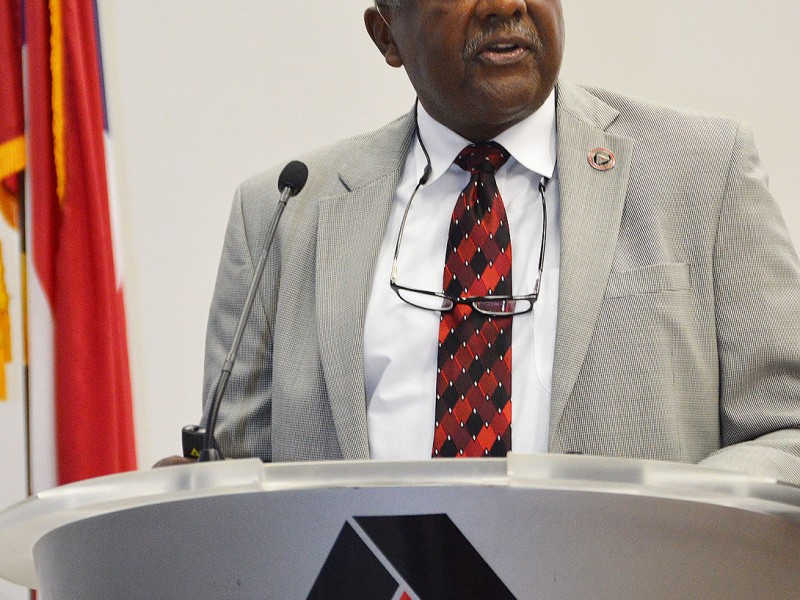
File Photo
By Anthony Parker
The boards of education and the superintendents in our service delivery area were successful in improving the quality of instruction in secondary education and increasing the percentage of high school graduates. One result of these efforts has been the Commodore Conyers College and Career Academy, which has shifted the paradigm for secondary education. Instruction for students in secondary education is far more relevant than, say, 10 years ago.
The Georgia Department of Education, the Technical College System of Georgia, and the University System of Georgia have utilized the resources available to them to shorten pathways from high school to college admission and graduation. Consequently, most high school students can earn a collegiate work force certification and/or an associate’s degree by their high school graduation date. We should feel confident this progress will not be reversed.
High school graduates are increasingly doing their part in maintaining Georgia’s position as the No. 1 state in the country to do business. However, we still have acute worker shortages for well-prepared technical-educated workers. Only high school dual-enrolled students starting the 12th grade this fall can enter the work force this spring. The number of high school students available to dual-enroll is limited by a shrinking number of ninth- through 12th-grade class sizes. In summary, there will not be an adequate number of high school graduates to fill this year’s vacancies. The question then is this: What can be done to encourage and to prepare young adults who may have dropped out of high school to fill the work force gap?
Consequently, the most important program offered by Albany Technical College is adult education. Seven of the counties in our service delivery area have high school graduation rates below the state and national averages. Therefore, we should not be surprised by the results listed below. According to Tim Scott’s and Corey Booker’s Bipartisan Plan to Wage a Smart War on Poverty, Albany Technical College operates in a region of Georgia that is considered economically distressed. Some of the economic descriptors that point in the wrong direction are:
♦ The majority of the citizens of seven of the counties that we serve live in economically distressed zip codes;
♦ Seven counties have historic high school dropout rates above 17%;
♦ Seven counties have poverty rates above the national average;
♦ Five counties have labor force participation rates below 60%;
♦ Seven counties have a median family income below the national average;
♦ Six counties are among the 20 poorest counties in Georgia;
♦ Six counties are considered distressed;
♦ One county is considered at risk;
♦ Only one county is deemed to be prosperous;
♦ Only two zip codes in eight counties are considered prosperous;
♦ Eighty percent of the citizens of Dougherty County live in a distressed zip code.
There is a distinct correlation (and causation) between high school completion and every description of economic vitality. Again, adult education is our most important program. Albany Technical College’s first priority should be to increase joint-enrolled adult education students. Increasing adult student enrollment can be done (1) through traditional ATB options or (2) through developing and adopting rigorous and relevant new paths to the high school diploma/GED. The alternative is to continue to leave 600 high-paying jobs vacant each year while 600 adults underproduce for their families.
What adults without a high school diploma or GED should know about Albany Technical College?
♦ Albany Technical College encourages non-high school graduates who are older than 18 to enroll in career education and adult education. More than 40 certificates, diplomas, continuing education courses, and AAS degrees are available through “Ability to Benefit” or “Career + High School Equivalency” enrollment. Eligible students may receive HOPE, PELL, or WIOA financial aid for career/technical education courses. Adult Education/High School Equivalency courses will be provided at no cost to the student.
♦ Albany Tech’s curriculum has a more than 80 percent overlap with the Governor’s strategic work force initiatives.
♦ Albany Technical College graduates are high achievers. More than 98% have positive outcomes, and more than 93% start their careers in their chosen fields within 30 days of graduation. Albany Tech’s graduates are in high demand.
♦ Adult education students who earn an AAS degree from Albany Technical College have baccalaureate pathway options to at least 14 colleges and universities.
♦ Albany Technical College’s success term schedule allows most certificate, diploma and AAS degree students a choice of five entry points each year. Commercial Truck Driving students have eight entry points each academic year.
It’s estimated that more than 2,000 adults in Dougherty County alone do not participate in the local labor force. Do you know someone who has completed one year of high school or has successfully completed at least one part of the GED, and is at least 19 years old? Would that individual benefit from joint enrollment in adult learning and work force education? If yes, contact Albany Technical College Adult Education at (229) 430-7881 as soon as possible.
Applicants may show the ability to benefit from and earn PELL financial aid by successfully completing two gateway HOPE Grant-eligible courses. An ability to benefit from work force education may also be demonstrated by a satisfactory score on the 90-minute Ability to Benefit test. We look forward to seeing you on campus soon.
Related Articles

CHARLES OCHIE: Let’s finally make Albany the college town it deserves to be
Albany has strengths, the legacy, and the potential to be a true college city.
KING RANDALL: Never giving up on a ‘new day’ in Albany
No matter the challenges, the people of Albany have the strength and perseverance to turn the city around.
JASON ESTEVES: Georgia farmers deserve disaster relief they were promised
Georgia farmers, reeling still from the effects of Hurricane Helene, have not received emergency funds promised them.
