
GAIL DRAKE: John Jay — The forgotten Founder
John Jay doesn’t generate the hype of most of America’s Founding Fathers, but he was quite an accomplished patriot.
American Founding Father John Jay enjoys the distinction of serving as the first Chief Justice of the United States Supreme Court, appointed by George Washington in 1789.
The U.S. Supreme Court was in its infancy, and Jay spent those early days establishing rules and procedures, and “riding circuit” over miles of bumpy colonial dirt roads. In six years, the court adjudicated a whopping four federal cases. But the Jay Court laid the foundation for the principle of “judicial review” (the Supreme Court can decide a law is unconstitutional and therefore void) and the independence of the court.
It was amazing to discover how many other different roles Jay played during our nation’s founding, more than any other patriot. It’s a challenge to squeeze such a diverse and expansive resume of titles into a single lifetime, let alone an article. In sequence: It appears Jay was influenced by his family background. He was the grandson of French Huguenots (Protestants). Their property was seized by the French crown because of their religion, and they escaped to America. Hard-working, the Jays built a wealthy trade business.
Jay’s other grandfather was mayor of New York City, and his mother, Mary, a homeschooling mom who educated her children until young John enrolled in King’s College (later Columbia University) and graduated with honors.
Attorney: Jay started his law practice in 1768, known as a meticulous and principled jurist. Then came Britain’s “The Intolerable Acts,” robbing the rights of people of Massachusetts as punishment for the Boston Tea Party. Delegate of First Continental Congress: In 1774, Jay joined the New York Committee of Correspondence that fought violations of British law. Jay was a “Radical Whig” who believed in property rights and preserving the rule of law but without mob rule. The “Intolerable Acts” fueled resentment, and colonists met to discuss a unified response. This gathering was the birth of the First Continental Congress. Jay was a moderate delegate and wrote addresses offering an olive branch to the British.
Colonel in Continental Army, 2nd New York Regiment: When the British military burned down Norfolk in January 1776, Jay became an ardent Patriot and joined the Continental Army. Spy catcher: A fascinating discovery was that Jay headed a counter-intelligence group with secret agents that rooted out spies against the American cause. His work inspired James Fenimore Cooper’s novel “The Spy.”
State legislator, 1777: Jay was elected to the New York Provisional Congress and drafted the Constitution of New York. First Chief Justice of the New York Supreme Court: Elected in 1777. President of the Second Continental Congress: Elected in 1778. Minister to Spain: 1779. He was charged with getting financial aid and came away with a $170,000 loan (worth $6.5 million today). Peace Commissioner, 1782: Jay joined Benjamin Franklin and John Adams in Paris to negotiate the Treaty of Paris, ending the War of Independence. Secretary of Foreign Affairs, 1784: (under Articles of Confederation).
Author of Federalist Papers, 1788: The fledgling American colonies struggled as a weak confederation. Jay joined Alexander Hamilton and James Madison to write five of The Federalist Papers to urge the new nation to build a stronger central government.
Chief Justice of the United States in 1789: One of his judicial rulings: “The people are the sovereign of this country, and consequently … fellow citizens and joint sovereigns cannot be degraded by appearing with each other in their own courts to their controversies determined … and they ought not to forget that nothing but the free course of constitutional law and government can ensure the continuance and enjoyment of them.” (Chisholm v. Georgia, 1793). Second Governor of New York, 1795: While in Britain, Jay was elected governor, where he served six years.
Abolitionist: Throughout his career, Jay advocated for the abolition of slavery. He founded the New York Manumission Society that provided free legal counsel to blacks. Over his life, he bought and then freed 17 slaves. President of American Bible Society, 1821: After he retired and his beloved wife Sarah died, Jay declined further political offers and retired to his country farm to raise his children. He was active in his personal faith. He believed that the most effective way to promote world peace was to promote the Christian faith. “No human society has ever been able to maintain both order and freedom, both cohesiveness and liberty apart from the moral precepts of the Christian Religion.”
John Jay: An American hero … lest we forget.
Author

Related Articles

CARLTON FLETCHER: Lousy customer service leaves a fowl taste
Before I get into this, let me say from the get-go that I understand that we all have bad days, that the aggravations of life can put a damper on everything that gets in our way on a given day.

Squawkbox – June 27, 2026
Albany’s “leadership” is involved in criminal activity and will be… Franklin Graham and the other pastors of “super churches”…
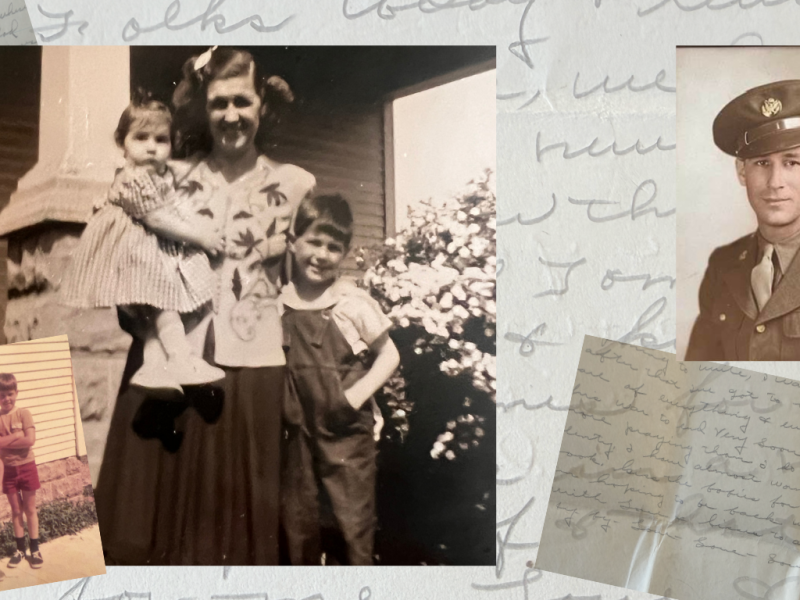
My Grandpa Was Killed in World War II. I Met Him Through His Letters Home
Gina Wolf’s grandfather died before she was born. His letters sent to her grandmother from Europe during World War II made it possible to know what kind of man he was.
