
GAIN DRAKE: ‘I lift my lamp beside the golden door’
Gail Drake
By Gail Drake
[email protected]
She stands 151 feet, 1 inch tall and weighs 225 tons. She used to gleam like a shiny copper penny, but her color now leans more toward light green. Her formal name is “La Liberté éclairant le monde” (Liberty enlightens the world). But we know her as the Statue of Liberty, which was publicly dedicated in New York Harbor on Oct. 28, 1886.
I had the delight of visiting Lady Liberty on two occasions and climbed up to her crown. The first time was at age 14, when Dad had to see about lost shipping containers. He dropped off my 12-year-old sister and me at Battery Park dock to catch the ferry and went on his way to the shipping company. (Mom didn’t know about this until later. He had no fear, that man.) Ruth and I rode over to the island, climbed up the pedestal inside the green statue and up the metal spiral stairs to the small platform with a row of small windows that overlooks the harbor. There was a ladder that looked like it reached up the arm to the torch, but it was closed off. Then we climbed down another set of spiral stairs to catch the ferry back.
The next visit was a few years ago to make my kids hike up to the crown. Someday they’ll thank me. The statue now uses a double-helix staircase.
For those who may want this adventure, early reservations to Liberty Island are now required online through the National Park Service, along with security clearance information.
The idea for the statue was conceived by Frenchman Edouard de Laboulaye, historian and president of the French Anti-Slavery Society. He proposed a monument to celebrate the 100-year celebration of U.S. independence, as well as the liberation of slaves following the Civil War. He suggested that the people of France pay for the statue and the U.S. provide the site and build the pedestal. Fundraising in the U.S. dragged for several years until publisher Joseph Pulitzer pledged to publish the names of every donor, no matter how small the amount.
Laboulaye recruited assistance from French sculptor Frederic Bartholdi, who researched designs in Egypt and Europe. He later recruited designer and builder Gustave Eiffel (who built the Eiffel Tower). Eiffel’s design made the statue a “curtain wall” construction, where the exterior “skin” is supported by an interior framework, allowing for movement with harbor winds.
As to the design, Lady Liberty is a classical Roman beauty modeled after Libertas, goddess of freedom. Bartholdi avoided the “liberty cap” and helmets, and chose the “nimbus,” a radiant halo that graces her head. She holds a “tabula” inscribed July 4, 1776 (in Roman numerals). She is fully robed with a “stola” and “pella,” and her pose is the classical “contrapposto.” Under her feet lie chains and a broken shackle.
Her right arm holds up the famous torch. At the museum, we saw the original torch – and hand – that was made of gold leaf, then holes were carved in to install lighting, then colored glass panes were installed – until they leaked. Her current torch is closer to the original design.
She was built in France, then boxed up into 350 pieces and shipped to the U.S. and rebuilt on the pedestal. The pedestal is inscribed with lines from an Emma Lazarus poem: “Give me your tired, your poor, Your huddled masses yearning to breathe free.” She wrote the sonnet “The New Colossus” to raise funds for the statue and to bring attention to the plight of Jewish immigrants. The sight of the Statue of Liberty has exhilarated immigrants arriving in New York Harbor for decades.
A short distance across the water lies Ellis Island. Formerly an Army fort, Ellis Island was once the country’s busiest immigration processing station. From 1892 until 1954, nearly 12 million immigrants were processed there. My grandmother proudly displayed the Ellis Island certificate for her forefather, Joseph Janacek, who immigrated from Austria.
First- and second-class passengers were processed on their ships. “Steerage” passengers disembarked at Ellis Island in long lines for medical examinations to ensure new arrivals were not disabled or diseased. The second phase included interviews of a dozen questions to document the arrival, screen for criminals, and ensure new arrivals would be self-sufficient. Immigrants had to show they had some cash and/or family and would not become “a public charge.” The vetting process took 3-5 hours. About 5% were disqualified for disease and 2% as a public charge and were deported.
The millions of immigrants who passed through the doors of Ellis Island a century ago came from Europe and Asia, seeking a new life of opportunity in America. The “push factors” from their homeland were economic deprivation, starvation, religious persecution. The “pull factors” were the hope of jobs in factories and possibly small family farms, rewards from hard work. Immigrants of that era were not given free housing, food, cash, medical care or any other public benefit. Having no money or family in the U.S. would have placed them back on a boat to their country of origin.
Happy 128th birthday to Lady Liberty. I’m grateful that my great-great-grandpa Joseph purchased a trans-Atlantic ticket, sailed past the lovely lady, processed through Ellis Island, worked hard and started a new life and family in this beautiful country called America. How blessed we are.
Author

Related Articles

Dawson police arrest wanted suspect after Flock Safety camera alert
According to police, May drove into the yard of a nearby residence instead of complying with officers’ commands. He then exited the vehicle and ran into the home on foot.
Lee County stands alone without E-SPLOST. Here’s what that means for schools, taxpayers and the county’s future
Following the defeat of its referendum, Lee County became just the second of Georgia’s 159 counties without voter approval for an active ESPLOST, leaving the school system without the state’s primary local funding source for major construction, renovations, school buses and other capital improvements.
Chamber celebrates new businesses, invites community to Coffee and Connections event
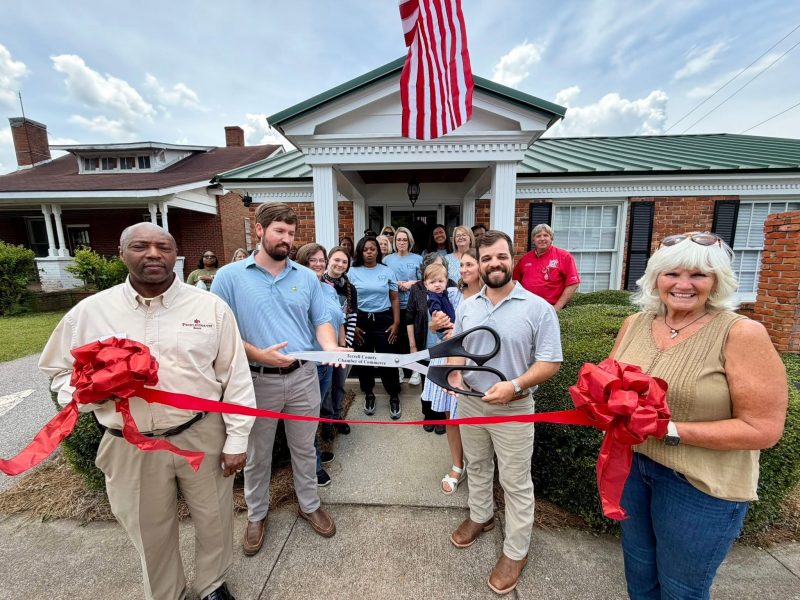
The Terrell County Chamber of Commerce is continuing its efforts to strengthen local business relationships through community celebrations and networking opportunities, recently recognizing two new businesses with ribbon-cutting ceremonies and announcing its next “Coffee & Connections” event in Sasser.
