
Armadillos are adaptable nuisances
Insect-eating animals help control pests, although they can cause yard damage
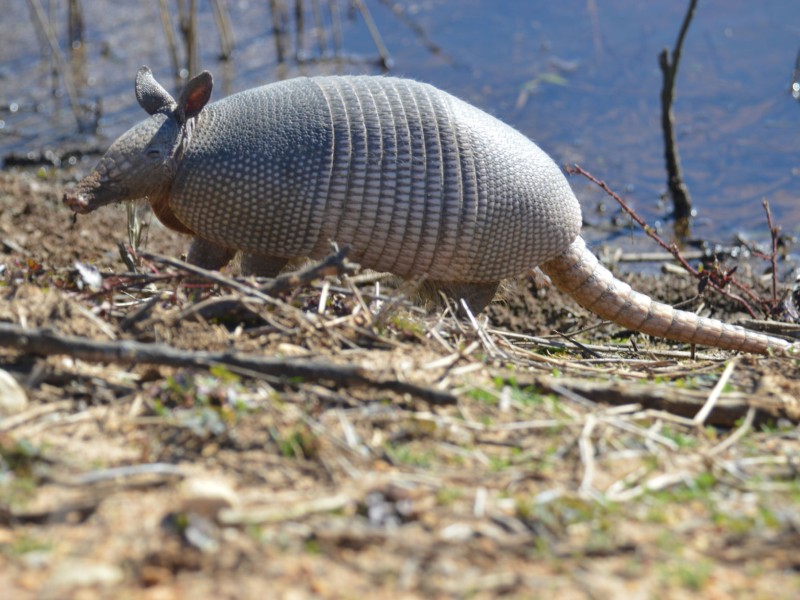
By Bob Kornegay
Have you ever walked out into your well-kept yard and found your lawn dimpled by a multitude of cone-shaped craters several inches deep and wide? Have you ever noticed the mulch around your shrubbery looking as if it had been plowed up and scattered? How about small plants in your garden destroyed and the entire area seemingly rooted up by miniature hogs?
If you can affirmatively answer any of these questions you have likely been visited by Dasypus novemcinctus.
Not familiar? Okay. Let’s not wax so scientific. Does “armadillo” ring a bell?
The nine-banded armadillo is a frequent and usually unwelcomed visitor in area landscapes. It is one of 20 existing species of armadillo, originally from South America, and is the only one found in the United States.
“Armadillos may be the size of opossums, but pound for pound can do nearly as much damage as a feral hog when it comes to digging up a yard,” said wildlife biologist aide Myron Wiley. “As anyone who has seen the results of their foraging knows, they can be very destructive feeders.”
The armadillo, “cousin” to the anteaters and sloths of South America, is primarily, although not exclusively, an insectivore. Its diet largely consists of beetles, grubs, earthworms and various other soil-dwelling insects and invertebrates. These food items naturally attract the animal to lawns, flower beds and gardens. It locates its prey with extremely keen senses of smell and hearing, unearths it with large claws on legs specifically adapted for digging and captures it with thick, sticky saliva on the tongue.
“The armadillo’s voracious appetite for insects isn’t all bad,” Wiley said. “Many of the creatures they consume are lawn and garden pests that can do considerable damage to landscapes themselves. For instance, it’s common to see a crater in the top of a fire ant mound where it has been dug open by an armadillo searching for ant eggs, larvae and adult ants.”
Armadillos are known colloquially by many common names. The bony plates covering and protecting their bodies has led to descriptions such as “armor-plated ‘possum” or “’possum crossed with a turtle.” The natural fright response of the armadillo when startled is a vertical leap before fleeing, a dangerous reflex when approached by a vehicle that might otherwise pass over without harm. This fatal trait spawned the nickname “hillbilly speed bump” and makes the animal a frequent highway casualty.
“Of course, they’re not closely related to opossums, turtles, or any other animal they’re often compared to,” said Wiley, “but some of the common references to their appearance are fairly close to the technical description. Their family name Dasypodidae roughly translates to ‘turtle-rabbit.’”
Prior to 1850, armadillos were not found north of the Rio Grande River except for fossilized evidence of extinct species. Due to a combination of factors such as human colonization with its accompanying habitat alteration, extirpation of natural large predators and intentional release or escape of captive animals, the armadillo has rapidly expanded its range at a rate ten times that considered normal for mammals.
Now abundant throughout most of Texas and other Southern and Southeastern states (they were deliberately introduced into Florida in the 1920s), armadillos have been observed as far north as Illinois and Nebraska and westward to Colorado. Because of its abundance and wide distribution, the armadillo has become a nuisance animal to many homeowners in suburban residential locations, especially where wooded areas with favorable burrowing and nest sites are included or nearby.
Controlling armadillos on one’s property is not an easy task.
“In many cases,” Wiley explained, “it might be better to just tolerate the occasional visitor rather than take on the expense and possible collateral damage of control attempts. However, if frequent and serious damage is occurring, some action may become necessary.”
Removing individual animals by trapping and relocation/elimination, use of repellents, fencing of specific areas (fencing must extend below ground), and control of soil insects and invertebrates with pesticides to minimize food sources are some of the armadillo control methods most commonly recommended.
“Any of these methods has its limitations,” Wiley said. “Practicality, environmental pollution, expense and long-term effectiveness are all major concerns. Whatever control technique is used, whether it’s mechanical or chemical, you have to be careful to use it in a manner that minimizes danger to people, pets, birds, fish and other desirable wildlife.”
If an armadillo control method involves handling an armadillo; either for relocation, consumption (yes, armadillo meat is edible), or disposal; be aware they can on rare occasions be infected with leprosy, which may be communicable to humans by contact or the consumption of undercooked meat. Handle the animals and/or meat with sanitary and culinary methods as you would any wild game to prevent contracting any communicable diseases that might be present.
“Just use common sense and good judgment if you ever decide armadillo control is your best option,” Wiley said. “In a lot of cases, the property damage caused by armadillos is minimal compared to the potential drawbacks of some of the control methods. This is especially true where pesticide use is concerned. Once you make the decision, be sure to proceed with caution.”
Related Articles

New York Jets could land Brendan Sorsby
There is going to be a run on quarterbacks in the NFL next season, with the draft class shaping up as the best in years, and a handful of teams have positioned their roster rebuilds in hopes of cashing in.

Albany State’s Paxton, Poteat selected for HBCU All-Star Classic
Albany State basketball standouts Na’Haviya Paxton and Shakur Poteat have been selected to participate in the fourth annual HBCU All-Star Dream Classic, scheduled for Aug. 8 at the famed Rucker Park in Harlem, New York.

Georgia shortstop Kolby Branch wins Gold Glove
University of Georgia senior shortstop Kolby Branch is a Gold Glove winner after being named to the NCAA Division 1 Gold Glove team.
