
Barn swallows are tolerable temporary mess-makers
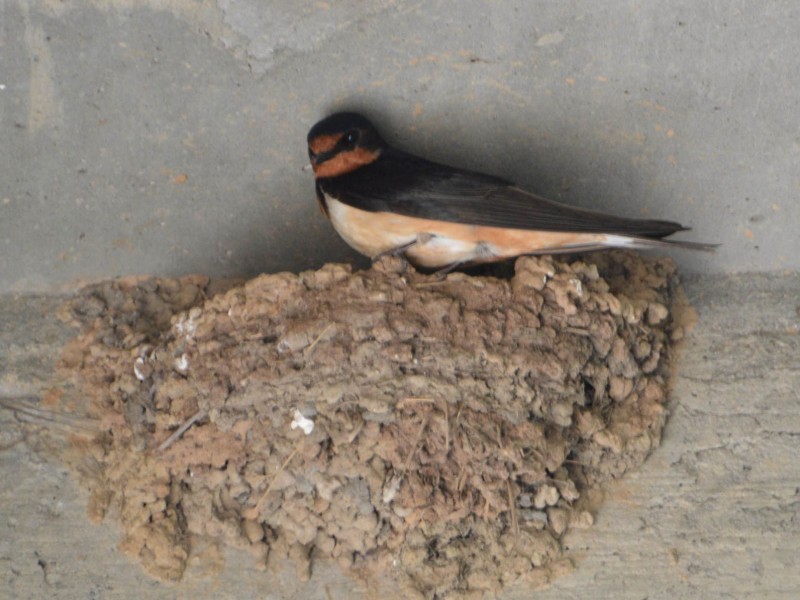
By Bob Kornegay
Ever noticed a bird’s nest made of mud on top of a porch light, exposed ledge or the eave under a porch? What about in a barn or maybe on the underside of an old bridge? Chances are those nests were made by barn swallows.
Barn swallows are commonly seen in southwest Georgia perched in social groups on electrical wires or fences. They are acrobatic fliers, which makes them entertaining to watch, and they voraciously hunt and devour pesky flying insects.
The very attractive barn swallow (Hirundo rustica) is one of the most widely distributed swallow species in the world and is commonly found throughout North America and the southern United States. The diminutive bird has a slender body about 5 to 7 inches in length and weighs between 6 and 7 ounces. The tail is distinctive; long and deeply forked. Adult birds have an iridescent dark blue crown, wings, back, and tail. The forehead, breast, and abdomen are rust colored.
“Barn swallows require open areas for foraging, a suitable surface with a ledge or overhang for attaching nests, a body of fresh drinking water nearby, and a source of mud for nest construction” wildlife biologist Ericha Nix said. “The birds feed exclusively on insects, with 99 percent of their diet consisting of flies, grasshoppers, crickets, dragonflies, beetles and moths. Prey is caught while in flight, and they can also feed their young at the nest while flying.”
Before the encroachment of humans into their habitat, nests were constructed in caves and on cliffs, but now the majority of barn swallows almost exclusively make their mud nests on man-made structures. They also have a homing tendency toward previous nests, meaning they will return to one’s front porch if they have nested there before.
“The nest of a barn swallow is unique in that it is attached to a vertical structure and the nest shell, or cup, is made of individual mud pellets,” Nix said. “The cup of the nest is lined with fine grass, hair, and feathers. Both sexes construct the nest in one to two weeks.”
According to Nix, breeding occurs in May and August (varying by location), and a swallow pair typically produces two clutches of eggs and young per year. The female lays four to five eggs in early April and both sexes share in the incubation. The chicks hatch in 13-17 days.
“Chicks are fed by both parents and fledge (leave the nest) in 17-27 days,” Nix said. “Once the young leave the nest, they stay in the general area and roost at night close to the nest site. By fall, the adults and young migrate south.”
Barn swallows, unlike many wildlife species, have flourished over the years due to human activity. Houses, docks, barns and other man-made structures make nesting habitat abundantly available, thereby making nesting populations higher than ever before.
“Though most people enjoy watching and having barn swallows on or near their property, they can become a problem or nuisance when too many set up residence in undesirable locations,” Nix said. “With an increased number of nesting birds at one site also comes an increase in fecal matter that accumulates at the bottom of or on structures, sometimes making an unsightly mess. Most people tolerate this during the short time barn swallows are raising their young, but some consider them a pest.”
In the U.S., all swallows (there are eight species) are classified as migratory insectivorous birds under the Migratory Bird Treaty Act of 1918. Swallows are also protected by state regulations. It is illegal for any person to take, possess, transport, sell or purchase swallows or their parts (feathers, nests, or eggs) without a permit. As a result, certain activities affecting swallows are subject to legal restrictions.
“A depredation permit issued by the U.S. Fish and Wildlife Service may be required to remove swallow nests,” Nix said. “This includes nests under construction, completed but empty nests, nests with eggs or young, or nests abandoned after breeding season. Not all regions require permits to remove nests in the early building stages if young birds or eggs are not present, but it pays to check if you intend to do this.”
Nix points out that the legal and ethical way to control barn swallows is to modify the nesting habitat to make it unattractive to the birds or prevent them from building a nest in the first place. Successful exclusion methods are accomplished by creating a barrier between the birds and where they want to nest.
The use of plastic netting or mesh wire attached under the eaves of a porch or other applicable area has been successful in deterring barn swallows from nesting. Metal, needle-like projections that are attached to the ledge and wall have also been successful. Finally, the use of a fiberglass panel mounted in a smooth, concave form will create undesirable nesting habitat.
“Fortunately, though, most people seem to appreciate the barn swallow for what it is,” Nix said. “These birds are interesting, entertaining, and, above all, beneficial creatures to have around because not only do they devour bothersome insects in and around a human habitation, but also provide a great opportunity to observe Mother Nature in action from the beginning of nest-building, egg-laying, watching the young develop, and then seeing them fledge from the nest.
“Most observers, after seeing a pair or social grouping of barn swallows go through one season of nesting behavior, become a lot more tolerant. That’s a good thing.”
Related Articles

Kilcrease, Logue lead All-Albany prep baseball team
Southwest Georgia baseball enjoyed one of its finest seasons in recent memory.

USMNT victory over Australia draws nearly 15M viewers
The United States men’s national team turned a Friday afternoon match into must-see TV with an overnight rating of 14.78 million viewers, according to Nielsen.

Wyndham Clark up by 6 at US Open, Scottie Scheffler leads chasing pack
Wyndham Clark has a reputation he wants to shake.
