
Breathe easy, most outdoor animals won’t hurt you
There are wild things encountered by outdoorsmen that strike fear into the heart for no good reason
By Bob Kornegay
Poisonous snakes can hurt people; even on rare occasions kill them. Poison ivy and similar noxious plants can drive one to distraction and have the potential to make a person ill. Bees, wasps, and hornets can be nuisances and, for some, real dangers.
In short, there are several things outdoor enthusiasts regularly encounter that are dangerous and deserving of caution. However, there are also wild things encountered by outdoorsmen that strike fear into the heart for no good reason. These creatures incite terror, panic, and sometimes even self-inflicted injury, all of which are unnecessary.
Here are a few common South Georgia animals we look upon more times than not with unfounded fear.
Five-lined skinks and broadhead skinks abound in the piney woods of the Southeast. These smooth-scaled lizards have terrified many an unwitting discoverer and, according to traditional Southern folklore, are purported to be extremely poisonous. Broadhead skinks are often called redheaded “scorpions” by the superstitious or misinformed.
“In fact, a mature male of either species does present a wicked appearance,” said wildlife biologist James Abramson. “He’s about ten inches long with an orange or fiery-red head, and resembles a miniature dragon. The broadhead’s head even has a really sinister triangular shape. The old belief in the skink’s deadliness and ferocity isn’t really surprising.”
Contrarily, however, no poisonous lizard exists east of the Mississippi River and only two are found on the entire planet. Skinks of all species are as harmless as they are scary.
“They are also very shy and will flee from you as rapidly as you flee from them,” Abramson allowed.
The Eastern fence swift is another lizard species often believed to be poisonous or otherwise dangerous. Reaching five inches in length, the swift presents a rough, spiny appearance with an aggressive-looking expression in the eyes.
“It’s commonly encountered around woodpiles, fallen timber, and dry leafy debris,” Abramson explained. “It looks like a pugnacious little dinosaur with hurt feelings, but is deadly only to worms, grubs, and small insects. The appearance of a human normally puts it to flight very quickly. Sometimes they’re quite amusing; especially on the trunk of a tree as they continually circle around to stay out of your sight.”
Spiders probably frighten more people than any other commonly feared creature, largely because they are so often encountered by both outdoorsmen and “indoorsmen” alike. Books, movies, and folklore serve to inflict most humans with arachnophobia well before they are old enough for grade school.
True, all spiders are venomous to a degree. They have to be. How else can a relatively small predator like a spider subdue prey that is often several times larger than itself? (The often-feared and myth-surrounded daddy longlegs, or harvestman, is not a true spider and is totally nonvenomous.)
“Most spiders do not have a poisonous ‘punch’ virulent enough to adversely affect an adult human,” Abramson said. “There are, of course, notable exceptions, such as the black widow and the brown recluse (fiddleback spider). Outdoorsmen, particularly hunters and wildlife watchers who spend a lot of time sitting on the ground, are probably more prone to spider bites than other segments of the human population. However, even among outdoor enthusiasts, spider bites are extremely rare. And we’ve all heard the tale about the daddy longlegs being the most poisonous spider in the world, but it doesn’t have fangs long enough to bite humans. Forget that. Number one, it isn’t a spider and, number two; it usually feeds on decaying plant and animal matter. What does it need venom for? ”
Fact is, people have little to fear from spiders, even the “bad” ones. Most of the visible eight-legged organisms crawling up our arms or across our necks as we enjoy the outdoors are quite harmless. Arachnids such as chiggers are much more annoying and certain species of ticks much more dangerous. Except on rare occasions, even spiders with deadly potential are largely nonaggressive. For these creatures, respect is definitely warranted. Blatant fear, however, is not.
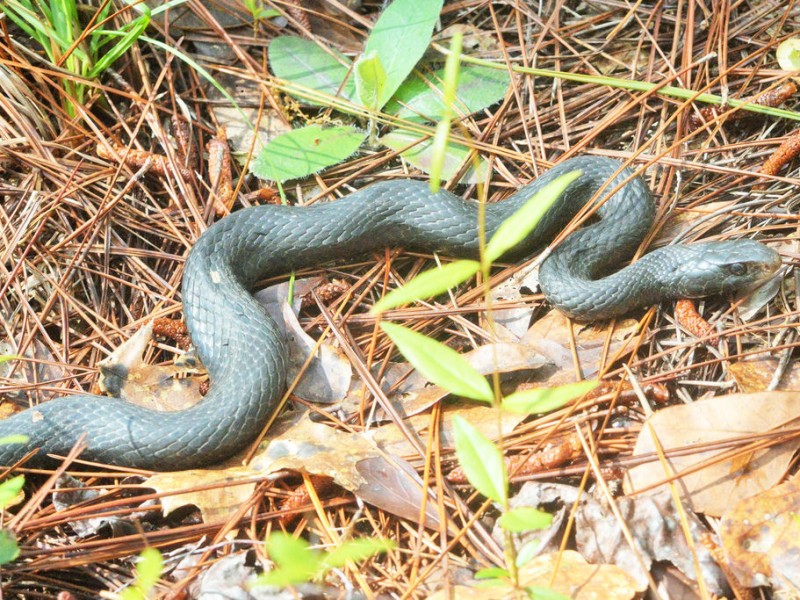
The water moccasin is a dangerous snake. Relatively common and sometimes aggressive, it packs a potentially deadly wallop and is to be avoided with utmost respect. There are, however, quite a few anglers, canoeists, and bank waders who harbor the mistaken notion that all “wet” snakes are moccasins.
“You’ll usually find several harmless water snake species inhabiting the same areas as the water moccasin and one kind of water snake or another is commonly seen sunning on overhanging branches, partially submerged logs, or swimming leisurely across a lake or stream,” said Abramson. “Approximately a dozen different kinds of nonpoisonous water snakes inhabit the South and, more often than not, are the snakes observed by people who excitedly describe the many ‘water moccasins’ they regularly see on fishing or boating trips.”
Water snakes range from slim, brilliantly colored reptiles to thick-bodied, aggressive creatures that do in fact somewhat resemble the cottonmouth in appearance. None of the water snakes are venomous, however, and the mere sight of a snake in or near water should never provoke a fear response.
“When it comes to our outdoor activities,” Abramson concluded, “there are plenty of real hazards with which to concern ourselves. There’s no need to add to them all the wildlife that is, as a rule, no more dangerous than the mockingbird nesting in your shrubbery. Most people could avoid many ‘scary’ situations outdoors if they’d just take the time to learn what can harm them and what can’t. It’s largely just a matter of paying attention and keeping your eyes open.”
Related Articles

New era for Westover basketball nears
When the first basketball bounces across the hardwood floor inside Westover High School’s new gymnasium this fall, it will signal much more than the opening of a new building.

Braves hope to wake up bats against visiting Cardinals
The Atlanta Braves will try to snap out of their offensive funk on Wednesday when they host the visiting St. Louis Cardinals in the second game of their three-game series.

Georgia Tech’s James Ramsey named ABCA Coach of the Year
Head Coach James Ramsey made program history when he was named American Baseball Coaches Association (ABCA) Southeast Regional Coach of the Year earlier this month.
