
Eagle nest surveys provide encouraging results
By Bob Kornegay
Staff Correspondent
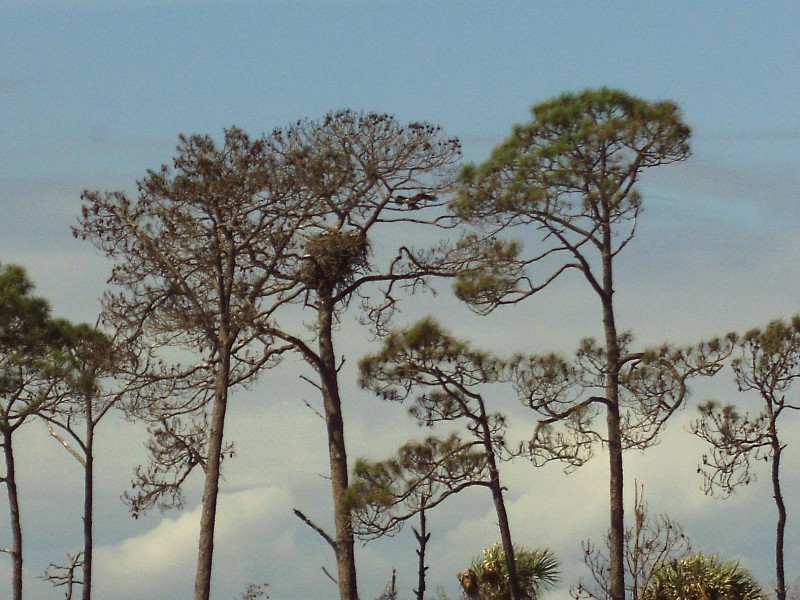
Recent surveys of bald eagle nests across the eastern half of Georgia underscored the national bird’s continued resurgence in the state. Checking by helicopter, Department of Natural Resources survey leader Bob Sargent counted nearly 110 eagle nesting territories in the six coastal counties and in an area bounded roughly by Interstates 16 and 85 and the South Carolina border. Those nests fledged an estimated 127 young.
Three to four nests were either substantially damaged or destroyed by Hurricane Irma last fall. However, 11 new nests were found, including five on the coast. One of these was the first known ground nest of a bald eagle recorded in Georgia. It was made in the wrack on Cabbage Island, southwest of Tybee Island. Unfortunately, the nest failed sometime in late March.
The totals are encouraging. So is DNR’s switch in 2018 from flying the entire state each year to only half. According to Sargent, the change maintains standardized monitoring while synching with the raptor’s range-wide comeback and mirroring slimmed-down eagle counts in some neighboring states. It also frees money for other needed conservation projects.
“What the change doesn’t signal is that conserving eagles should now be viewed as less important,” said Sargent, a program manager with DNR’s Nongame Conservation Section.
Bald eagles are state-listed as threatened and remain a priority in the State Wildlife Action Plan, a guiding strategy to restore and protect native species and natural habitats.
“We determined that cutting the survey effort by 50 percent would not compromise our ability to identify and address a decline in productivity of our nesting eagles, should it occur,” Sargent said. “That was the most crucial consideration.”
The revisions follow three straight years of 200-plus occupied nest territories and only 11 years after Georgia’s nest total topped 100. Almost 30 years ago, the Southeastern recovery plan for bald eagles set a goal of 20 nests for the state. DNR documented a state record 218 last year.
Many factors have fueled the bald eagle’s recovery: a U.S. ban on DDT use in 1972, habitat improvements after enactment of the federal Clean Water and Clean Air Acts, protection through the Endangered Species Act, increased public awareness, restoration of local populations through release programs and forest regrowth.
Yet, even though on the rebound, eagles still face threats. These vary from avian vacuolar myelinopathy, a disease primarily affecting coots and the eagles that prey on them, to being shot by people and hit by automobiles.
The Nongame Conservation Section monitors eagle nesting through aerial surveys in January and again in March and April. The initial flights are focused on finding all active nests: those with eggs, eaglets, an adult in an incubating posture or evidence that eagles have been prepping the nest for use. The second round of surveys is aimed at determining the reproductive outcome of those nests and checking recently reported new nests.
The public is encouraged to report eagle nests via www.georgiawildlife.com/bald-eagle, by phone (478-994-1438 or contacting Sargent ([email protected]).
DNR works with landowners to help protect bald eagle nests on private property. Although de-listed from the Endangered Species Act in 2007, eagles are still protected by the Bald and Golden Eagle Protection Act, the Migratory Bird Treaty Act and state law.
The Nongame Conservation Section’s mission is to conserve eagles and other Georgia wildlife not legally fished or hunted, as well as rare plants and natural habitats. The agency depends primarily on fundraisers, grants and contributions to the Georgia Nongame Wildlife Conservation Fund. That makes public support critical to ongoing efforts. Georgians can help by buying or renewing a DNR eagle or hummingbird license plate. Most of the tag fees are dedicated to wildlife conservation. Motorists can upgrade to a wildlife tag for only $25. Learn more at www.georgiawildlife.com/licenseplates. Supporters can also donate at www.gooutdoorsgeorgia.com. Click “Licenses and Permits” and log in to contribute. Details are available at www.georgiawildlife.com/donations.
Related Articles

New York Jets could land Brendan Sorsby
There is going to be a run on quarterbacks in the NFL next season, with the draft class shaping up as the best in years, and a handful of teams have positioned their roster rebuilds in hopes of cashing in.

Albany State’s Paxton, Poteat selected for HBCU All-Star Classic
Albany State basketball standouts Na’Haviya Paxton and Shakur Poteat have been selected to participate in the fourth annual HBCU All-Star Dream Classic, scheduled for Aug. 8 at the famed Rucker Park in Harlem, New York.

Georgia shortstop Kolby Branch wins Gold Glove
University of Georgia senior shortstop Kolby Branch is a Gold Glove winner after being named to the NCAA Division 1 Gold Glove team.
