
Early movements crucial to whitetail fawn
Mothers take active role in raising young deer
By Bob Kornegay
Every wild animal has certain behaviors and physical characteristics that protect it in its native environment, and the white-tailed deer is a perfect example. The steps taken to improve the odds of a newborn fawn’s survival fit perfectly into the deer’s natural history scheme.
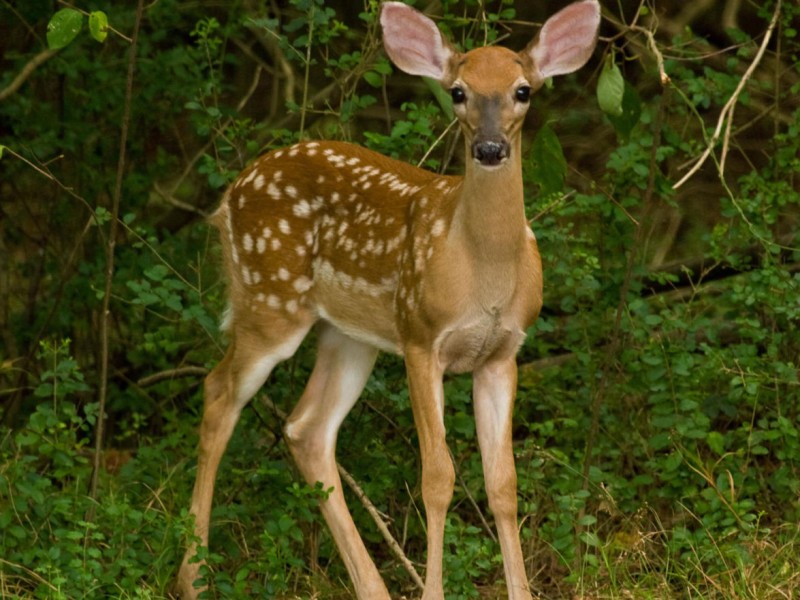
“When a fawn is born, its coat is reddish brown with white spots covering the body,” wildlife biologist Steve Bryant said. “There are two rows, one on each side of the spine, each containing 60 to 80 spots. The neck, shoulders, sides and flanks are also covered with approximately 100 irregularly sized, randomly scattered white spots. The hair of the spots is not white to the roots but is white-tipped. As the fawn ages, the white is gradually worn away so that the spots begin to disappear before the fawn molts into winter fur.”
According to Bryant, white-tailed does always care for their newborns in a manner that maximizes their chances for survival. Immediately prior to birthing, for example, the mother doe reduces her home range to a small acreage. This ensures she can remain as close as possible to her baby after it is born.
“In a secluded spot with adequate cover, she lies down to give birth,” Bryant explained. “Usually, the fawn is born and licked clean within 30 minutes after the doe makes the necessary preparations. After birthing, like many other wildlife mothers, the doe will eat all birth by-products to minimize tell-tale odors that may attract predators. The fawn will stand and nurse soon after birth and become reasonably steady on its feet.”
Because body fluids from the birth process have soaked into the leaves and forest-floor litter, the doe will lead the fawn away from the birthing area as soon as it can walk. If two fawns are born, she usually places them in separate locations.
“During the first month, the doe will actively restrict other deer from entering her constricted home range,” Bryant said. “For the first four to seven days, she will nurse her fawn(s) four to six times in 24 hours with each feeding lasting around 10 minutes.”
For the first week, the fawn primarily remains hidden and still. Fawns usually do not attempt to follow the doe when she leaves them to go foraging. According to Bryant, however, observers have seen does force fawns to lie down with a head or foot. The fawn may be moved to new locations from time to time but still remains hidden.
The spots on a fawn play an important role as the fawn hides. When lying still, the fawn blends in well with the dappled spots of sunlight filtering through the leaves onto the brown forest floor. If it remains motionless, it is relatively easy for the young deer to go undetected, even when passersby move relatively close.
“Spotted fawns up to four days old will lie down if discovered,” Bryant said. “This is theorized to be a fright response similar to the one seen in humans when they are ‘too terrified to move.’ Sometimes good-willed humans unwittingly ‘kidnap’ fawns because they mistakenly think the young animals are orphaned. The rule is never pick up a fawn that appears abandoned, because it usually isn’t. After five days, most fawns are leg-sturdy enough to begin fleeing from danger.”
Bryant explains that fawns normally gain 10 percent of their body weight per day for the first week and then 5 percent of their body weight per week thereafter. When a fawn is nursing, the doe constantly licks the youngster, concentrating near the tail. The mother also eats the fecal material of the fawn to help eliminate identifying odors near it.
After one week, the doe begins to reduce the number of feeding periods and remains in the general area, but not as close to the fawn as when she is nursing it. Fawns, like other curious wild babies, will begin to wander and the doe either trails the fawn or, if the scent is too weak, will vocalize a soft cat-like mew to call the fawn to return. An endangered fawn will bleat similar to the call of a goat to alarm the mother.
“Fawns begin to eat vegetation and ruminate at around two weeks of age and are dependent on rumination at five weeks,” Bryant said. “During this time, the doe spends increasingly more time with the fawn. The fawn also begins playing after nursing. Usually this involves darting and running in a circle about the mother. Month-old fawns run 50- to 100-yard circles around the doe. Play occurs throughout summer, decreases in fall and ceases by winter. Most fawns are completely weaned at 10 to 12 weeks of age.”
It is a short carefree childhood for the fawn, but a vitally important one. The diligent care and attention a young deer receives during those first three months after birth does not guarantee its survival but certainly ups the odds.
Related Articles

Falcons players visit U.S. service members in Japan
Atlanta Falcons safety Jessie Bates III, defensive lineman Zach Harrison, outside linebacker Jalon Walker and Falcons Legend defensive end John Abraham recently participated in an NFL-USO Tour, visiting U.S. service members stationed at military bases across Japan.

Braves designate Rowdy Tellez for assignment
The Atlanta Braves designated veteran first baseman Rowdy Tellez for assignment on Thursday.

Mystics, Dream refreshed after much-needed break
It’s probably a good thing the Atlanta Dream and Washington Mystics had a few days off. They both needed the recovery time.
