
Giving wood ducks a leg up
Improving nesting sites an important step in preserving wood duck habitat
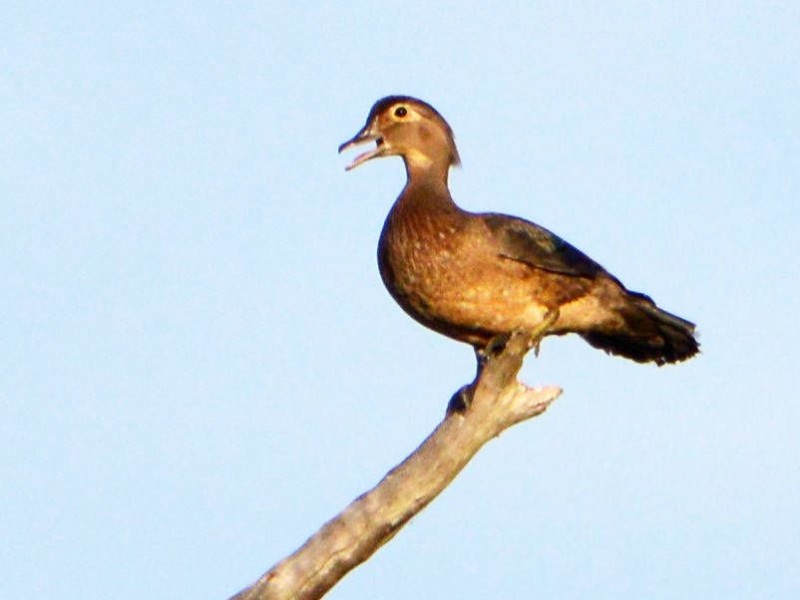
By Bob Kornegay
Most of the waterfowl species that spend the winter in Georgia and neighboring regions migrate north to their breeding grounds in the spring. A notable lovely exception is the wood duck. Though some wood ducks do migrate every year, there are many that remain in the South during breeding season when conditions and habitat are to their liking.
“Historically, the limiting factor for wood duck breeding in the South has been the availability of suitable nesting sites,” explained wildlife biologist Charles Sharp. “Wood ducks are cavity-nesters, as a rule requiring mature trees with appropriate openings. With today’s forestry practices, though, most trees don’t reach sufficient size to develop cavities that can accommodate wood duck nests.”
In the 1960s, a wood duck nest box program was initiated throughout the southern U.S. to help reestablish resident wood duck populations. Wooden nest boxes were installed on trees and poles over or near water. The project proved successful and reversed the decline of breeding wood ducks throughout the region. Wood duck nest-box installation is still an ongoing project today. Government agencies such as the U.S. Fish and Wildlife Service, State Departments of Natural Resources and waterfowl conservation groups like Ducks Unlimited continue to enhance resident wood duck habitat with artificial nest receptacles. Many private individuals pitch in as well, installing their own nest boxes in on their properties.
Wildlife biologists from various federal and state agencies have developed a variety of nest box designs. Those constructed of wood are the most popular due to simple construction and ready acceptance by wood ducks. Cypress or cedar is the lumber of choice.
Key elements in nest box design include:
*A 4-inch-wide strip of hardware cloth fastened to the inside of the box from the bottom of the entrance hole extending to the floor. This will function as a ladder for the hatchlings to exit the box. Be sure to bend the sharp cut edges of the cloth inward towards to box surface to avoid injury to the young ducklings.
*A layer of approximately 3 inches of wood shavings or sawdust in the box to serve as suitable nesting material. Wood ducks do not bring nest material to the cavity.
*A hinged lid or side to allow access for annual cleaning, nesting material replacement and monitoring the use of the box.
A critical element of the next box is the predator guard. Typically fashioned from sheet metal and affixed to the box mounting pole, the guard acts as an umbrella that prevents predators from climbing the pole.
“Improving wood duck nesting sites was an important step in improving wood duck habitat,” Sharp said. “But it’s only the first step. It does little good to increase the number of breeding wood ducks if we don’t also provide adequate brood-rearing and feeding areas for the birds to raise their chicks.”
According to Sharp, the need for a plentiful wood duck food source begins even prior to nesting. Researchers estimate that a wood duck hen will consume several thousand aquatic insects just to produce one egg. Since a hen may produce a clutch of 12 eggs, it is easy to imagine the volume of insects required to produce just one clutch. Also, after hatching, wood duck chicks require an abundant high-protein food source located near adequate protection from predators.
“The aquatic habitats used by wood ducks are almost exclusively emergent scrub and shrub wetlands with a high degree of forestation,” Sharp continued.” These wetlands commonly occur along the floodplains of rivers, streams, and lakes as natural occurrences or with the aid of beaver colonies or man. When flooded, these lowland areas offer a thick layer of leaf litter and provide ideal conditions for the growth of aquatic invertebrates and insect larvae. These are usually seasonal wetlands and are the type of habitat that is easiest to manipulate for wood ducks.”
Many times, all it takes is the plugging of a ditch with an earthen plug or small control structure to create a wood-duck-friendly impoundment of several acres. If a landowner has beaver activity on his property, it is often possible to simply let the beavers do most of the work constructing a dam. After the duck broods have attained the ability to fly, usually in mid to late spring, the dam can be opened to lower the water level. Lowering the water during the spring and summer months allows the once-flooded hardwood trees to survive.
“Wood ducks need a variety of wetland types throughout the course of a year,” said Sharp. “During spring and summer, when many of the flood plains are being rejuvenated, the adult wood ducks and their young will move to more permanent bodies of water such as streams and ponds. It is important to remember that managing for wood ducks requires their needs be met year round, not just seasonally. Managers interested in wood ducks must meet those needs for a management program to be completely successful.”
Wood ducks are the only truly resident duck species in our part of the country. These birds are the waterfowl species most often pursued by area hunters and, because of their eye-catching natural coloration, one of the most often painted and photographed species of wildfowl. They are regularly enjoyed by people with a wide spectrum of interests. With a minimum of effort, their habitat can be improved on a significant portion of the landscape, thus ensuring this enjoyment for a long time to come.
Related Articles

Braves open against Padres tonight in San Diego
Two National League contenders start a big series on Monday in San Diego.

Thunder trading Aaron Wiggins to Hawks
The Oklahoma City Thunder are trading reserve guard Aaron Wiggins to the Atlanta Hawks for two second-round draft picks, according to multiple reports on Sunday night.

Padres begin tough six-game homestand with clash against Braves
The good news for the San Diego Padres: They will start a six-game homestand on Monday night after finishing a 4-5 road trip Sunday with a 4-3 loss against the Texas Rangers.
