
The Long Count: Scott Humphrey’s journey through wrestling and survival
It began as the dream of a six-year-old boy on a farm outside Albany in 1972.
It began as the dream of a six-year-old boy on a farm outside Albany in 1972.
Every Saturday afternoon, Scott Humphrey sat in front of a flickering television with rabbit-ear antennas, hoping the signal would lock in just long enough to watch professional wrestling.
“If you pointed the antenna the right way, you might get one or two channels,” Humphrey said. “One of them came out of Dothan, Alabama, and every Saturday at 5 p.m., they showed wrestling. I watched guys like Arn Anderson, Bob Armstrong, Mr. Wrestling I,I and Tommy Rich.”
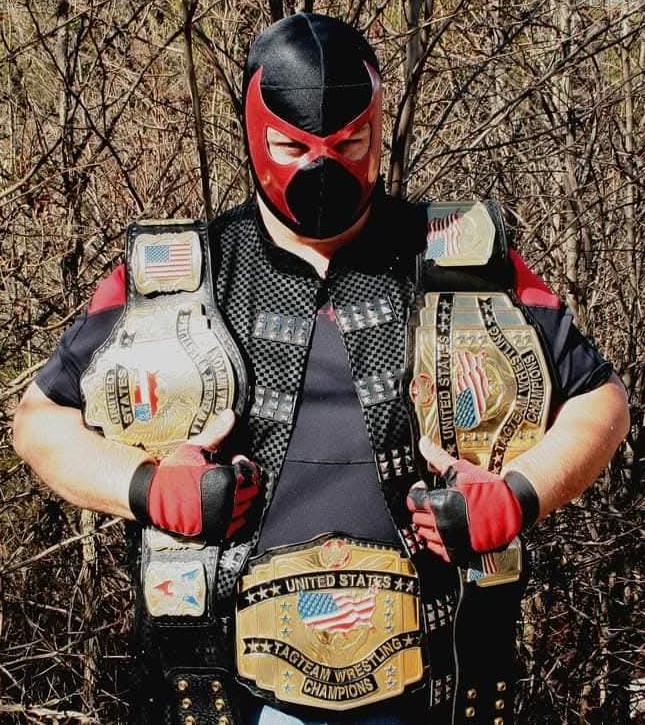
One afternoon, Humphrey turned to his grandmother and told her that one day he would be a professional wrestler.
“She told me I could do anything I set my mind to,” Humphrey said.
That moment planted a seed — one that would take decades to grow.
A 1985 graduate of Westover High School, Humphrey remained in Albany until flooding in 1994 forced him to relocate. He eventually settled in Tennessee and later Marietta, Georgia, where his path to professional wrestling finally took shape.
At the time, Humphrey owned a sign company and struck a barter deal with a North Georgia wrestling promotion — banners in exchange for training. Promoters created a bodyguard character for him called “The Peacekeeper,” pairing the 6-foot-3, 350-pound Humphrey with a much smaller wrestler.
“It just worked,” he said.
But six months into his career, a violent chair shot ended it abruptly. Humphrey suffered a moderate-to-severe concussion and doesn’t remember the 90-minute drive home from the arena.
“I walked in the house, and my daughter looked at me and asked if I was done,” Humphrey said. “I said yes.”
At the time, he believed it.
Years later, living in Crossville, Tennessee and approaching his 40th birthday, Humphrey noticed dark spots and cysts appearing across his body. Doctors soon delivered devastating news: a rare genetic cancer known as Gorlin Syndrome.
“The doctor told me to get my affairs in order,” Humphrey said. “He said if there was anything left undone, now was the time.”
One thing immediately came to mind — wrestling.
Despite warnings from others and while his grandmother battled brain cancer, Humphrey returned to the drawing board. In less than two days, he created a new persona: Doomsday.
“The name came from being told I was facing my own doomsday,” he said. “The black represents the darkness of cancer. The red represents the fight. The mask was a tribute to Mr. Wrestling II.”
Humphrey relocated to North Georgia and found a promoter willing to help him retrain. In June 2006, Doomsday debuted in Calhoun, Georgia, launching a second — and defining — wrestling career.
Four months later, his grandmother passed away. Unable to reach Albany due to a tropical storm, Humphrey wrestled that night and captured a tag team championship, dedicating the victory to her memory.
“She knew I was a pro wrestler before she passed,” he said. “That meant everything.”
Doomsday soon moved on to Georgia Wrestling Federation, where he became a two-time world heavyweight champion and established himself as one of the Southeast’s most respected independent performers.
Over nearly 20 years, Humphrey wrestled primarily across the Southeast but traveled nationwide, compiling a remarkable résumé: 104 championships, six world titles, three Hall of Fame inductions, multiple year-end awards, and a national Top-60 rookie ranking.
All the while, he continued battling cancer — enduring repeated surgeries, often returning to the ring before fully healing.
“I was told the cysts would get more aggressive over time,” Humphrey said. “They did.”
From 2004 through 2025, Humphrey lost more than 130 pounds without trying — a sign his body was reaching its limit.
“By May 2025, I knew my career was coming to an end,” he said. “My body finally said no more.”
Doomsday closed his career on December 27th with the Knightsend Tour, a farewell run that allowed him to connect with fans and cities he had never visited before stepping away for good.
Though the character has been laid to rest, Humphrey’s legacy lives on — most notably through his daughter.
At 18, she entered the sport as Lady Doomsday, carrying forward the family name and passion. Already a tag team champion herself, she represents the next chapter of a journey that began decades earlier on a farm outside Albany.
“It doesn’t feel real that 20 years have passed,” Humphrey said. “The only reason I lasted this long is by the grace of God. The fans knew my story, supported me, and gave me a life I never imagined. It’s been the ride of a lifetime.”
Related Articles
Twice as Nice: Jin Chung captures second Georgia PGA Championship
Jin Chung, PGA of America Teaching Professional at Chateau Elan Golf Club, captured his second Georgia PGA Championship on Wednesday at Champions Retreat Golf Club, finishing at 5-under-par 211to add the 2026 title to his 2024 victory.
Allisha Gray, Dream put away Mystics, advance to face Liberty
Allisha Gray posted team highs of 22 points and four steals, Jordin Canada had a stellar all-around performance and the Atlanta Dream defeated the host Washington Mystics 93-75 to sweep their first-round playoff series on Wednesday.
Atlanta Dream can close out youthful Mystics in Game 2
The Atlanta Dream knew better than to panic at a double-digit deficit against the Washington Mystics.
