
Remember harvest records and tree-stand safety for upcoming archery season
Last year, 139,043 archery hunters harvested just over 50,000 deer
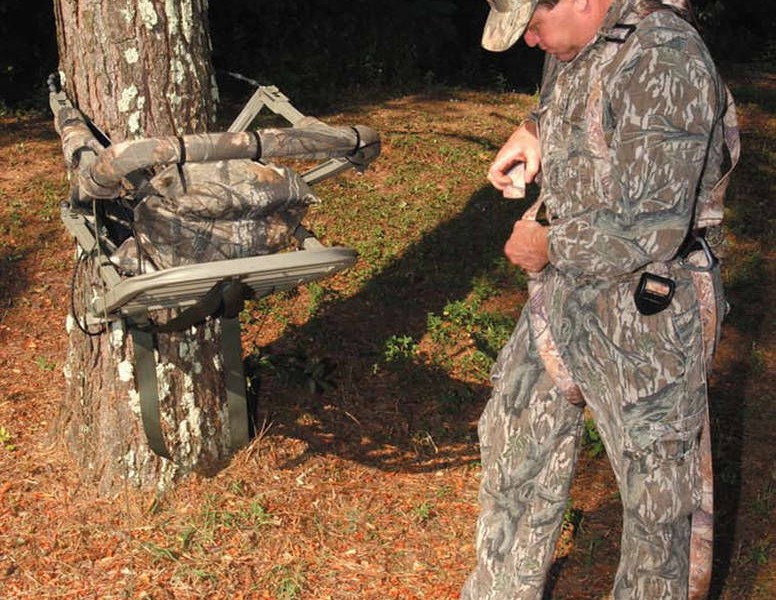
File Photo Courtesy of Alabama DCNR
By Bob Kornegay
Hunters utilizing archery equipment will get the first opportunity to bring home a deer beginning Saturday, according to the Georgia Department of Natural Resources’ Wildlife Resources Division.
Last year, 139,043 archery hunters harvested just over 50,000 deer. Statewide, hunters can use archery equipment throughout the entire 2017-2018 deer season.
“Archery season is an excellent time to get an early start on putting some venison in the freezer,” said state deer biologist Charlie Killmaster. “Although it’s still warm this time of year, it’s the easiest part of the season to pattern deer. Just don’t forget to report your kill to Georgia Game Check.”
Georgia hunters can check out an interactive map that allows them to see the best opportunities available for the counties they hunt at http://georgiawildlife.com/rut-map.
All hunters must report their deer harvest through Georgia Game Check, including hunters under 16 years of age, landowners, honorary, lifetime, and sportsman license holders. They will need to obtain a free deer harvest record each season. Before moving a harvested deer, hunters are required to immediately enter the date and county on the harvest record and within 72 hours must complete the reporting process through Georgia Game Check (https://gooutdoorsgeorgia.com). Or hunters can go paperless and report through the free Go Outdoors GA app.
State-managed public lands are funded through a combination of state license fees and matching federal funds from the U.S. Fish and Wildlife Service’s Wildlife Restoration Program. Hunters account for $977 million in retail sales in Georgia each year with a $1.6 billion ripple effect and almost 24,000 jobs.
Many public lands offer specialty deer hunts, including primitive weapons hunts, adult/child hunts, and ladies-only hunts. Dates and regulations for these hunts are listed in the 2017-2018 Georgia Hunting Seasons and Regulations Guide. Georgia offers more than 100 state-operated wildlife management areas (WMAs) for the public’s use.
Hunters are allowed a season bag limit of 10 antlerless deer and two antlered deer (one of the two antlered deer must have a minimum of four points, one inch or longer, on one side of the antlers).
To pursue deer in Georgia, hunters must have a valid hunting license and a big game license. Licenses can be purchased online at http://georgiawildlife.com/licenses-permits-passes, by phone at 1-800-366-2661, or at a license agent (list of agents available online).
For more information on deer hunting seasons, regulations, licenses, and WMA maps, visit http://georgiawildlife.com/hunting/regulations.
Many hunters utilize tree stands to give them a leg up on their quarry. Sometimes, however, these are improperly installed or show signs of wear after several years. As a result, according to the WRD, hunters may find themselves a statistic in a hunting-related tree stand incident. Though undeniably advantageous hunting tools, tree stands can be dangerous, even deadly, when improperly employed.
Not every tree stand is the same. Hunters should be familiar with their particular model’s features. Following are recommended safety tips:
1. When using a non-climbing portable or ladder stand, hunters should securely fasten the stand to the tree and install ladders or steps according to the manufacturer’s directions.
2. Hunters should always wear a Fall-Arrest System (FAS)/Full Body Harness during ascent and descent. Be aware that single strap belts and chest harnesses are no longer recommended and should not be used. Failure to use a FAS could result in serious injury or death.
3. Hunters should always attach their FAS in the manner described by the manufacturer. Failure to do so may result in suspension without the ability to recover and re-enter the tree stand. Be aware of the hazards associated with full body harnesses and the fact that prolonged suspension in a harness may also be fatal.
4. Have in place a plan for rescue, including the use of cell phones or signal devices that may be easily reached and used while suspended. If rescue personnel cannot be notified, you must have an alternate plan for recovery or escape. If you have to hang suspended for a period of time before help arrives, exercise your legs by pushing against the tree or doing any other form of continuous motion or use your suspension relief device.
5. Consider your personal physical condition before going out. If you do not have the ability to recover or escape from a FAS, it is recommended that you hunt only from the ground.
6. Hunters should always use a haul line to pull their gear and unloaded firearm or bow into their tree stand. Never climb with anything in your hands or on your back. Prior to descending, lower equipment to the ground on the opposite side of the tree.
7. Staying awake and alert is important. Hunters should avoid taking medications that cause drowsiness prior to hunting. Also, never use alcohol or drugs before or while hunting.
8. Hunters should always inform someone of where they are hunting and what time they expect to return.
When it comes to hunting this season, be informed and prepared where regulations are concerned. Regarding safety, tree-stand or otherwise, use common sense and good judgment. These factors will go a long way toward making this hunting season a safe and happy experience.
Related Articles
New era for Westover basketball nears
When the first basketball bounces across the hardwood floor inside Westover High School’s new gymnasium this fall, it will signal much more than the opening of a new building.

Braves hope to wake up bats against visiting Cardinals
The Atlanta Braves will try to snap out of their offensive funk on Wednesday when they host the visiting St. Louis Cardinals in the second game of their three-game series.

Georgia Tech’s James Ramsey named ABCA Coach of the Year
Head Coach James Ramsey made program history when he was named American Baseball Coaches Association (ABCA) Southeast Regional Coach of the Year earlier this month.
