
In Lee County, they saw it coming [Part One]
Property taxes, traffic congestion, school spending, development pressure and the loss of rural land remain at the center of public debate. That raises a basic accountability question: If county leaders understood these challenges 20 years ago, why do so many of them remain unresolved?
From property taxes to development, Lee County’s current debates were anticipated two decades ago. If the county identified these challenges years in advance, why are so many of them confronting taxpayers today?

Editor’s Note: Part 1 in a series.
LEESBURG — In 2005, Lee County leaders did more than predict rapid growth. They identified the risks that would come with it, laid out specific goals and warned taxpayers what could happen if residential development outpaced jobs, infrastructure and commercial investment.
Two decades later, many residents are still raising the same concerns.
Property taxes, traffic congestion, school spending, development pressure and the loss of rural land remain at the center of public debate. That raises a basic accountability question: If county leaders understood these challenges 20 years ago, why do so many of them remain unresolved?
The answer matters beyond assigning blame. Understanding which goals were met, which were abandoned and which were never adequately funded is essential if Lee County is to avoid repeating the same planning failures as it continues to grow.
The 2005 community assessment, prepared as the foundation for the county’s long-range comprehensive plan, offers a clear benchmark. It estimated Lee County’s population at about 31,000 and projected that it could reach 90,122 by 2025, nearly tripling over two decades.
The population did not ultimately reach that projection, but the report’s underlying warning was broader: Even growth below that level would place increasing pressure on schools, roads, utilities, health care, recreation and housing.
Officials noted that young families were driving much of the growth in the county. Residents ages 25 to 44 made up 34% of the population, those ages 45 to 64 accounted for 21%, and another 25% were 14 or younger.
Those figures made the county’s future needs relatively easy to anticipate. More children would require more classrooms, teachers, buses and recreational facilities. More households would mean more traffic, greater demand for water and sewer service, and a need for additional commercial development.
The report concluded that growth itself was not the county’s greatest problem. The greater challenge was whether the local government would manage it responsibly.
One number exposed the county’s economic imbalance: About 85% of Lee County residents worked outside the county, primarily in Dougherty County. The report described Lee County as a “bedroom community” with limited local employment opportunities. Agriculture, government and the school system were among the largest employers, while industrial and commercial employment remained comparatively limited.
County planners warned that dependence on neighboring counties for jobs weakened the local economy and left Lee County carrying the cost of residential growth without receiving the full economic benefit of a strong employment base.
That imbalance remains one of the most important measures of the county’s progress.
Did Lee County create significantly more jobs within its borders? Did the share of residents commuting elsewhere decline? Did commercial and industrial growth begin contributing a larger share of the tax base, or did homeowners continue carrying much of the burden?
The assessment repeatedly warned that residential construction was outpacing commercial and industrial development.
New subdivisions required roads, schools, emergency services, utilities and other public investments. Planners argued that without corresponding business and industrial growth, the county would continually add service obligations faster than it added revenue-producing development.
The report stated plainly that residential growth was “far exceeding commercial and industrial growth” and was eroding the tax base.
To reverse that trend, planners recommended expanding industrial infrastructure, recruiting major commercial projects, encouraging mixed-use development, building out existing industrial parks, attracting large retail anchors and creating more jobs within Lee County.
Those recommendations were not abstract. The county had identifiable opportunities before it.
The assessment noted 74 acres of developable property in Oakland Meadows Industrial Park, a 20-acre commercial site near Walmart and Fairway Toyota, and six industrial sites identified by a Georgia Tech study as suitable for development. Planners also believed the four-laning of U.S. Highway 19 could stimulate tourism, commerce and regional investment.
Infrastructure was identified as one of the county’s largest barriers to realizing those opportunities.
Officials wrote that expanded water and sewer service would be necessary to attract industry and commercial growth. At the time, a $400,000 Employee Incentive Program Grant was supporting sewer extensions in Oakland Meadows Industrial Park, while water and sewer lines were also being installed along Forrester Parkway, Old Leesburg Road and U.S. Highway 19.
The accountability question now is not simply whether those projects were completed. It is whether they produced the economic results county leaders said they were intended to produce.
How many businesses are located in those areas? How many permanent jobs were created? How much taxable commercial and industrial value was added? Were infrastructure extensions followed by productive investment, or did the county absorb the cost without achieving the promised return?
The report was equally direct about residential development.
Officials acknowledged that growth during the previous decade had largely followed developer proposals rather than a community-led plan. The county’s Future Land Use Map had not kept pace with actual development, and leaders had not clearly defined where neighborhoods should be built, where infrastructure could support them and where natural areas should remain protected.
That failure had already produced expensive consequences.
The report cited the 1994 flood, after which Lee County spent millions of taxpayer dollars purchasing homes built in flood-prone areas. Planners argued that those homes should never have been approved in the first place.
The example revealed the cost of weak planning in concrete terms: Poor land-use decisions do not end when a subdivision is approved. Taxpayers may continue paying for those decisions decades later through road improvements, drainage projects, school construction, emergency services and property buyouts.
The 2005 assessment envisioned a county that would grow without sacrificing fiscal stability or rural character. Leaders said Lee County should strengthen its commercial tax base, attract employers, direct development toward existing infrastructure and prevent unchecked suburban sprawl.
Residents now have reason to ask whether those commitments were followed.
Amid intense public scrutiny over rising property assessments, the county’s tax digest controversy and the recent failure of the E-SPLOST referendum, the question of how Lee County built its tax base has moved back into the spotlight.
Twenty years ago, county leaders warned that relying too heavily on residential growth while failing to expand commercial and industrial development would place increasing financial pressure on homeowners. Today, as debates over taxation, development and public investment dominate commission and school board meetings, that warning takes on renewed significance.
This series will examine whether the county achieved the objectives it set for itself in 2005, what measurable progress was made, which recommendations were never implemented, and how those decisions continue to shape the issues residents are confronting today. Before Lee County charts its next 20 years of growth, it may be worth asking whether it fulfilled the vision laid out for the last 20.
Related Articles

Lee County hospital financing plan proposes up to $200 million in bonds, with county-backed portion still to be defined
The Lee County Hospital Authority will hold a public hearing Sept. 22 on a proposal to issue up to $200 million in financing for a planned acute-care hospital. Lee County Commissioner Billy Mathis said the debt is intended to be repaid from hospital revenues rather than taxpayers.

State superintendent: Lee County High firefighter certification program a model for Georgia
Georgia State School Superintendent Richard Woods said Thursday that a new partnership training Lee County High School seniors to become certified firefighters could serve as a blueprint for school districts across the state.
‘There’s only one Palmyra’: Residents defeat Ledo Road rezoning
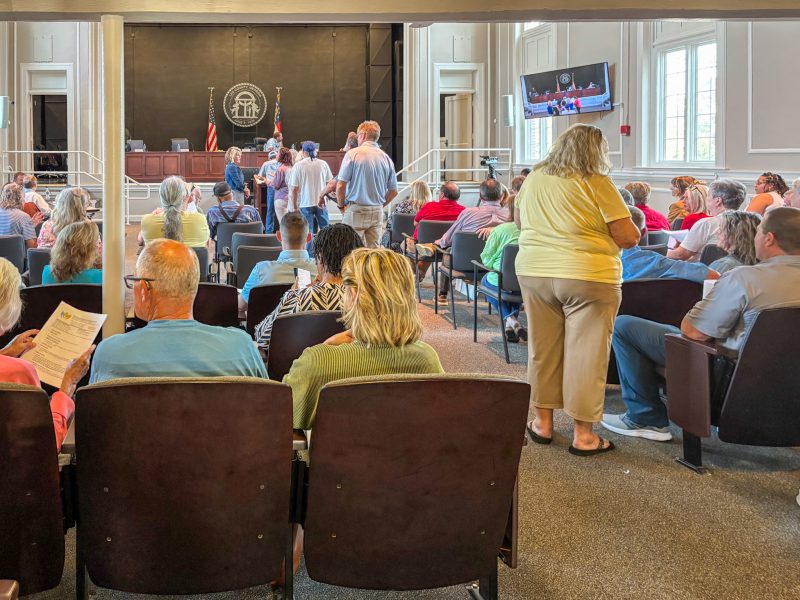
A standing-room-only crowd erupted in applause Tuesday after Lee County commissioners rejected a request to expand general commercial zoning along Ledo Road beside the Palmyra subdivision.
