
Lee County would repay $30 million for a hospital it won’t own
The authority approved resolutions moving the process forward. Final construction costs, interest rates and repayment terms remain unsettled. The larger portion of the borrowing depends on a federal guarantee that has not yet been approved, and the entire plan must still be validated in court.
Hospital Authority advances financing plan following TEFRA hearing; nonprofit would own facility, and excess hospital revenue could eventually reimburse county.
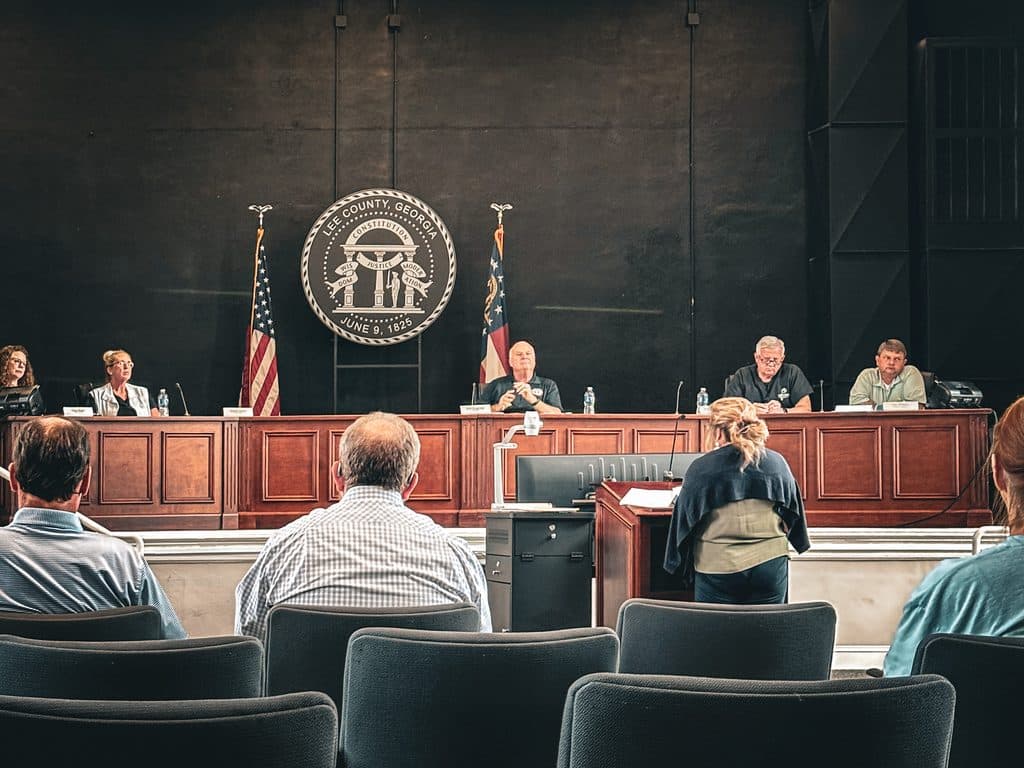
LEESBURG — The Hospital Authority of Lee County held a public hearing Tuesday on plans to borrow up to $200 million for a proposed hospital, advancing a financing arrangement that would rely on county payments to repay roughly $30 million of the debt.
The authority approved resolutions moving the process forward. Final construction costs, interest rates and repayment terms remain unsettled. The larger portion of the borrowing depends on a federal guarantee that has not yet been approved, and the entire plan must still be validated in court.
Bond attorney Roger Murray, a partner at Murray Barnes Law LLP who has specialized in public finance since 1989, outlined the steps that remain.
“It’s not the final authorization; it just allows us to go to the next step,” Murray said.
The public hearing at the T. Page Tharp Governmental Building gave residents a chance to comment on the proposed tax-exempt financing. County and authority attorney Jimmy Skipper said the County Commission must also approve the financing plan.
How the structure works
The arrangement works something like buying a house.
Most of the price is covered by a mortgage. But the buyer still has to bring money to the closing table, and this buyer doesn’t have it. So a second, smaller loan supplies that money — and someone other than the buyer agrees to repay it.
If MCLCG Inc., the nonprofit that will own the hospital, is a young couple buying their first home, Lee County is the parent who took out a loan to cover what the couple owed at closing. The couple gets the house. The parent gets the payment book.
In the actual financing, the mortgage is the roughly $169 million issue insured by the federal government and repaid from what the hospital earns treating patients. The second loan is the roughly $30 million issue Lee County has agreed to repay. That money doesn’t stay with the county — it goes into the project and is spent building the hospital, which MCLCG will own.
The comparison isn’t exact. Hospital financing covers more than a purchase price: construction, equipment, startup costs, working capital and the cost of borrowing itself. But the central point holds. Borrowing that upfront contribution creates a separate repayment obligation — someone has to make the payments.
Under the plan Murray described, that someone is Lee County.
“The county-backed bonds will be paid solely with intergovernmental contract payments by the county,” Murray said.
The two issues have separate backing. A proposed U.S. Department of Housing and Urban Development guarantee would protect the larger issue if hospital revenue falls short, subject to federal review. County payments directly support the smaller one.
Who issues the bonds, and who pays
The Hospital Authority would issue both series, but it has no money of its own.
That distinction explains how the public notice can say the bonds are not a debt of Lee County while the county still makes the payments. The bonds are issued in the authority’s name. The county’s obligation lives in a separate document, the intergovernmental contract.
In the house comparison, whose name is on the loan and whose name is on the check are two different questions. The paperwork at the bank doesn’t cancel the promise the parents made in writing to cover the payments.
Both statements are accurate. The bonds are not county debt. However, the county has agreed, by contract, to pay them.
Authority Chairman Rick Muggridge made the point after District 1 Commissioner Dennis Roland questioned the arrangement during public comment.
“This board, this hospital authority, we don’t have the power to levy taxes. We don’t have any money,” Muggridge said. The county-backed bonds could be issued only with a commitment from the County Commission to fund the payments, he said, which come with an estimated cost of $1.8 million a year.
The numbers aren’t final
Murray cautioned that the $1.8 million estimate is not settled. The figure depends on interest rates and whether repayment is structured over 20, 30 or 40 years.
“That was an estimate,” he said.
He also said the financing team is developing a way for excess hospital cash flow to reimburse the county — though a future County Commission could instead choose to leave that money with the hospital for improvements or expanded services.
In the house comparison, that resembles expecting rental income to reimburse the parent making payments on the second loan. Peoples Health System LLC would be the property manager, overseeing operations intended to generate that income. Whether enough money remains after operating expenses to reimburse the county is a separate question from the county’s commitment to make the bond payments.
The $200 million figure is a borrowing ceiling, Skipper said. Proceeds would cover acquisition, construction, equipment, startup expenses, working capital and financing costs.
Some bonds would be taxable and others tax-exempt. Murray said the goal is to use as much tax-exempt financing as possible, because investors accept lower interest rates when their earnings are exempt from federal income taxes. He compared 6% taxable borrowing with 4% tax-exempt borrowing to illustrate the savings; although those were not rates announced for this project.
What the county has already spent
Murray said architects, engineers, an investment banker, a feasibility consultant, attorneys and other specialists have worked on the financing plan over roughly two years.
How much of that work Lee County has already paid for is unclear.
The 2024 intergovernmental contract assigns the project’s “Upfront Costs” to the county — expenses and legal fees for planning, design and proposed financing, including architectural and engineering work. The contract estimates those costs at $3 million to $4 million. The county can be repaid from bond proceeds, but only if the bonds are issued and only “with the consent of the owners of the bonds.”
Separately, the contract commits the county to pay for utility lines and public roads serving the site, but sets no limit on that amount, and provides no reimbursement.
Two costs are not the county’s. The contract assigns the feasibility study and the certificate-of-need work to the hospital’s manager, People’s Health Systems.
The county has not released an accounting of what it has spent on the project to date.
What happens next
The financing plan goes first to a court for validation, which Murray described as a review of whether the financing complies with Georgia law. The process gives investors assurance the bonds were legally authorized.
Project representatives would finish architectural plans and construction cost estimates, then feed those figures into the feasibility consultant’s financial models. Murray said feasibility work already exists and is being updated with the final version reflecting completed plans and current pricing.
That study, an appraisal and other required documents would go to HUD for independent review. If HUD approves the guarantee, the team would update its calculations, sell the bonds and lock in interest rates. Final authorizing resolutions would return to the authority before closing releases the money to begin construction.
Residents press for numbers
Jane Gray, who identified herself as a retired health care executive, asked how the projections account for staffing, physician recruitment, reimbursement rates and operating costs, and urged officials to release the feasibility study and its assumptions.
“The most beautiful facility without doctors and staff to work there will not do this county much good,” Gray said.
Laura Hancock also asked for more transparency, and whether the authority would be prepared to stop if the eventual borrowing terms made the project impractical.
Mike Sabot supported the plan, saying Lee County needs a hospital and more competition for Phoebe Putney Memorial Hospital in nearby Albany.
Muggridge said the authority’s role is to facilitate the financing, and that questions about county revenue, land transactions and infrastructure commitments involve other public bodies.
All five authority members were present: Muggridge, Vice Chairman Dr. Bruce Houston, Secretary Jennifer Heyer, Dana Hager and Cole Williams. The board unanimously approved a resolution requesting county approval of the financing plan, then approved separate resolutions advancing each bond issue.
The Lee County Commission was scheduled to consider approval of the financing plan later that evening.
Related Articles

Voters will decide on Dougherty County Commision District 4 in Nov. 3 election
Only one competitive Dougherty County Commission race remains to be decided on Nov. 3. Democratic challenger Anthony Patterson is the challenger for incumbent Republican Russell Gray in District 4.

Lee commissioners adopt 29.71-mill tax levy, including school bond payments
Lee County commissioners adopted a combined county and school property tax rate of 29.71 mills Monday, formalizing a levy that includes 17.96 mills for school operations and a separate 0.58-mill charge to repay school bonds.
PHOTOS: Albany State and Phoebe Ceremony
Click the arrow to scroll through the images.
