Seed time and harvest: A Georgia story of faith
Southwest Georgia, history has a way of reminding us that the seeds planted by one generation may not produce a harvest until generations later.
By Michael Ferguson II
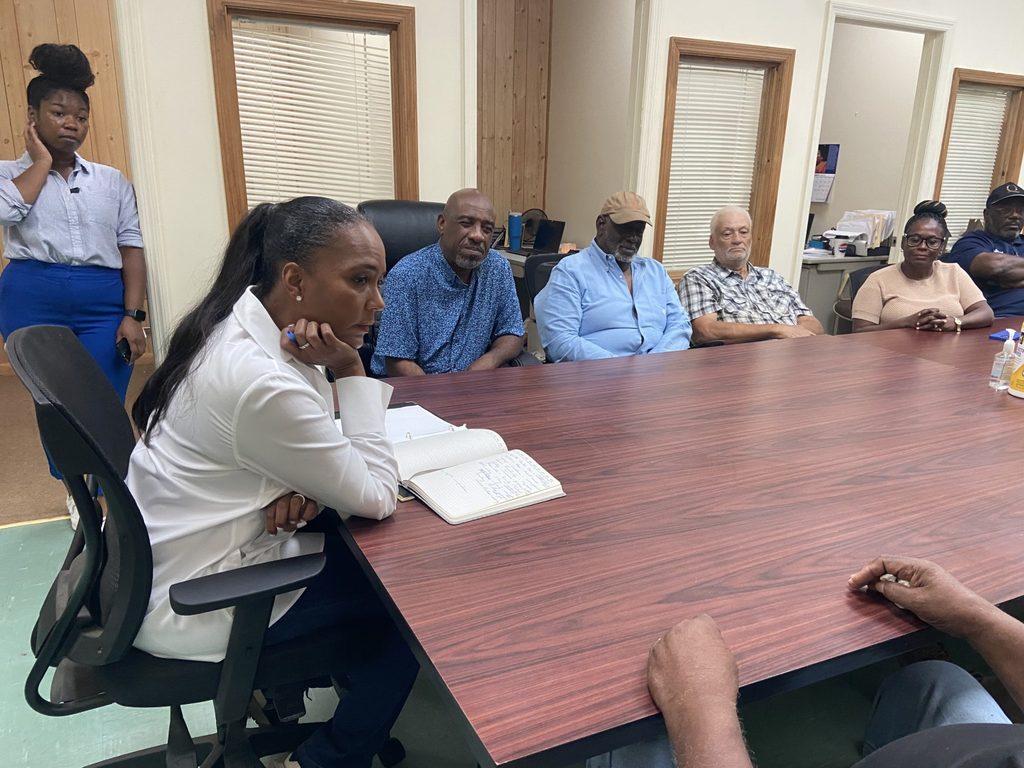
Keisha Lance Bottoms, shown in an earlier campaign stop in Albany, brought her message back to the Good Life City and other southwest Georgia cities over the weekend. File Photo
ALBANY — Southwest Georgia, history has a way of reminding us that the seeds planted by one generation may not produce a harvest until generations later.
On Tuesday, Georgia may witness such a moment, with the possibility of becoming the first state in our nation’s history to elect an African American woman as governor. Regardless of one’s political persuasion, the historical significance deserves our attention.
On Saturday, gubernatorial candidate Keisha Lance Bottoms returned to southwest Georgia with a message that extended beyond the usual political rhetoric. The occasion brought together some familiar faces in Georgia politics: Albany’s own
former Lt. Gov. Mark Taylor introduced Congressman Sanford Bishop, drawing upon his wealth of political knowledge to reflect on Bishop’s congressional
legacy.
Taylor emphasized Bishop’s ability to secure federal resources, attract economic investment, and ensure that southwest Georgia receives its share of the tax
dollars necessary to serve our communities.
Bishop followed by introducing Bottoms, expressing his confidence in what her leadership could bring to the governor’s office, particularly her commitment
to making life more affordable and equitable for Georgians.
Then came Keisha. And Keisha did what Keisha does. She connected.
There was something genuine about her message, something that reached beyond the boundaries of race, political affiliation, and economic standing. Yet, of everything she shared, I found myself particularly drawn to her reference to “seed time and harvest.”
For those of us whose roots run deep in the agricultural soil of southwest Georgia,
those words carry meaning far beyond a familiar biblical expression. We understand
that between planting a seed and gathering a harvest lies a season of uncertainty, sacrifice, patience and faith.
The ground must be prepared. The fields must be cultivated. And even after the labor
has been done, there are no guarantees. Droughts come, storms gather, and sometimes the harvest falls short of what our labor deserves. Such is life.
Bottoms understands that every individual has a history. Hers, as she shared, reaches back at least five generations in Georgia, to ancestors who labored on a
plantation. Consider the journey of a family whose roots extend back to a period when earlier generations were denied the fundamental freedoms we now recognize as essential.
Today, a descendant stands among those seeking the highest office in the state.
What a remarkable reflection of history, faith, and the possibilities that emerge when
generations refuse to surrender their hopes for a better tomorrow.
Like countless others throughout this nation, our predecessors prayed, worked,
sacrificed, and planted seeds of opportunity for generations they would never live to
see. They labored toward a future they could only imagine, believing their descendants might someday walk through doors that had remained closed to them.
I am reminded of Hebrews, Chapter 11, often referred to as the Hall of Faith. In verse
13, Scripture speaks of those who died in faith without having received the promises
they had embraced. Their faith was not diminished because the harvest did not arrive in their season.
Perhaps one of the greatest contributions we can make to humanity is planting a seed whose harvest belongs to another generation. But the significance of this moment should not be viewed simply as a black-and-white matter. Georgia’s history, with all its contradictions, struggles, and accomplishments, belongs to all of us.
Our state capital, Atlanta, gave the world Martin Luther King Jr., whose leadership
helped awaken the conscience of a nation and whose dream challenged America to live up to the promises of its founding principles.
Atlanta also became known as “The City Too Busy to Hate,” an ambitious declaration
by a city attempting to reconcile the divisions of its past with the possibilities of its future. Georgia’s history is filled with contradictions. Yet some of its most meaningful
advances have emerged when ordinary people dared to believe that the future did not
have to resemble the past.
Neither history nor progress belongs exclusively to one race, political party, or
generation. The advancement of our society has required individuals willing to confront adversity, challenge injustice, and recognize that our common interests are often greater than the circumstances that divide us.
As Georgians, and, indeed as Americans, we can recognize Keisha Lance Bottoms and countless others who continue to “fight the good fight” while appreciating the
opportunity to participate alongside them in this unfinished journey toward a more
perfect union.
There is a profound paradox in another passage of Scripture. Psalm 126:5 tells us, “They that sow in tears shall reap in joy.” Consider the meaning of those words. The tears do not simply dissipate. They become part of the cultivation process. Tears
shed in sorrow, frustration, disappointment, and even despair can nourish the seeds of something greater than the circumstances that produced them.
What began in suffering can eventually produce a fruit of its own. And Scripture calls that fruit joy. Keisha Lance Bottoms indeed bring that joy.
Related Articles

Georgia vs. Florida: Bulldogs look to rebound from Auburn loss in Atlanta
Georgia has had two weeks to address the mistakes that cost it an unbeaten record.

Dawson approves $6,500 gas safety settlement; penalty figures conflict
The Dawson City Council approved a $6,500 settlement Oct. 8 in a natural gas safety case involving 13 alleged violations, including failure to promptly repair a hazardous leak and inadequate protection against excessive pipeline pressure.
Albany State hosts Lane for Homecoming with postseason hopes alive
The math is messy. David Bowser’s message is not.