
Radiation oncology advancing at Phoebe Putney Memorial Hospital
New LINAC machines, HDR technology coming to Radiation Oncology Associates at Phoebe Cancer Center
Jennifer Parks
ALBANY — During the treatment phase of cancer, a patient might be exposed to medical oncology, surgical oncology or radiation oncology specialists. Many patients in Southwest Georgia needing the radiation element go to Radiation Oncology Associates (ROA) at Phoebe Cancer Center.
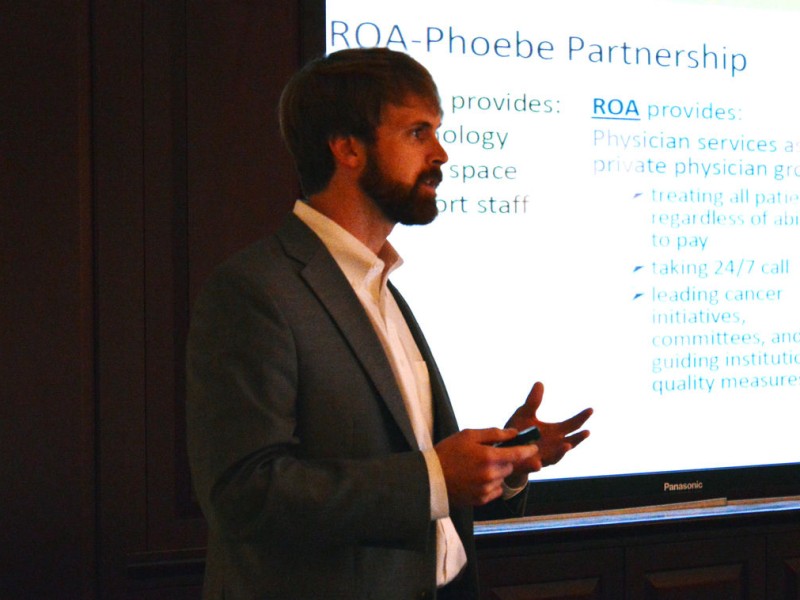
The newest physician on the ROA team, radiation oncologist Dr. Adam Jones, told the Phoebe Putney Memorial Hospital board on Wednesday that new technology is coming down the pipeline with the intention of treating patients more safely and effectively.
Radiation therapy can be given on a definitive, adjunctive or palliative basis. At ROA, there are four providers — including three physicians — along with three nurses, 12 radiation therapists, two physicists, three medical dosimetrists and one engineer, among others, providing services to patients.
A linear accelerator, or LINAC, is used during the radiation process. Utilizing accelerated microwaves, it creates high energy photons and electrons for treatment, Jones said.
The job of ROA, Jones explained, is to determine the “if, when, how, how much, how fast,” manage side effects and determine the body’s response to treatment.
“(The goal) is to get them the dosage and get them home,” he said.
In 2008, TomoTherapy was placed at ROA for treatment of patients. There are three functional machines, which are now beyond the expected LINAC lifespan, Jones said.
The future for ROA is anticipated to include the installation of twin LINAC machines from Elektra Infinity. The advantages, Jones said, should be less downtime, faster treatment times through the use volumetric-modulated arc therapy, expanded use of ablative regiments and double the degrees of freedom.
Ground was broken on the installation last week. Part of the installation will include a platform for an upgrade — and all is meant to improve quality, safety, efficiency and patient experience, the radiation oncologist said.
“Patients are living longer who are beating their cancers,” he said.
Jones added that ROA is also hoping for the acquisition of high-dose rate (HDR) brachytherapy technology through Nucleotron. It uses the placement of a radioactive source to increase the dose within the tumor, and is said to be very effective and considered standard treatment for prostate, female reproductive and breast cancers.
Jones said the HDR technology has advantages in current technology in that a dosage can be better customized to a patient, treatment times are often condensed from several weeks to one week and it can better enable ROA to offer everything to patients.
“(Dosages) are calculated on a guiding system so we can administer the dose more effectively … (Such technology) enables us to take care of 99.9 percent our patients under one roof.” he said.
Jones practices with Dr. Chuck Mendenhall and Dr. Jay McAfee at the Phoebe Cancer Center. Raised in Statesboro, he graduated from the University of Georgia with a degree in biology, and earned his medical degree at Mercer University School of Medicine. He completed an internship in internal medicine at the Medical Center of Central Georgia, and trained in radiation oncology at Fairview Hospital at University of Minnesota in Minneapolis.
Related Articles

Putting on the Ritz: The rise, fall and renewal of Albany’s Harlem District
On July 7, the Albany City Commission unanimously approved final construction drawings for a comprehensive restoration of the Ritz Theatre and Cultural Center, clearing the way for the project to move into competitive bidding after years of planning and preservation efforts. The decision marks the latest chapter in a decades-long effort to preserve one of Southwest Georgia’s most significant African American landmarks.

Albany City Commission set to vote on skate park funding
“There have been other sites discussed. Based on information (from) the community, we decided on the current site. That’s the only site we’re looking at right now.”
Food, mini menagerie provide inspiration for Mitchell County’s Lydia Griffin
“I would like to open, like, a Caribbean/tropical buffet where everybody can eat anything and everything. If I can’t do that, I would start small with a coffee shop (and) deli and keep going.”
