
Orlando shooting brings thoughts of humanity to LGBT community in Albany
Sexual orientation of Orlando shooting victims not the issue for some
By Brad McEwen
ALBANY — When area business owner Jennifer Gordon awoke around 3 a.m. Sunday morning, news of what would turn out to be the worst mass shooting U.S. history was already flooding the Internet.
It was less than an hour after a gunman, later identified as Omar Mateen, walked into Orlando nightclub Pulse and opened fire, and already the headlines were trumpeting a fact Gordon, herself a recently engaged lesbian, already knew: that the club in question was a well-known gay bar.
“I had not been to that club, but I knew about it,” Gordon recalled less than 36 hours after Mateen ultimately killed 49 people, sending shock waves of fear across the globe. “I (also) knew this was some kind of terrorist attack. We (members of the lesbian, gay, bisexual, transgender, intersex and questioning community) don’t shoot at each other. That’s just not something that happens.”
Gordon can offer her feelings about the incident as a member of the LGBTIQ community, and is proud to do so. But she is quick to point out that her immediate reaction to the incident, and her attitude in its aftermath, isn’t centered around her sexual orientation.
“I didn’t react as a gay person, I reacted as a parent,” Gordon said. “I have a 21-year-old son in California who is at an age where he could have been in a club. I have a 17-year-old daughter on the verge of being in the mix of these types of things. I saw the reports about the mother who was getting texts from her son saying, ‘Mommy I love you.’ As a mother, I couldn’t imagine what she was going through. I couldn’t imagine feeling so incredibly helpless.”
In addition to seeing the Orlando attack as a parent, Gordon said she also processes what happened through the lens of being a Christian and an American citizen who sees this as an attack, not on the lifestyle of a certain group, but on the entire country’s way of life.
“When I think about it, I get angry as a person, as a human being,” Gordon said. “These are people. It doesn’t matter if they’re gay or straight, innocent people were savagely and brutally attacked. We, not as gays, not as straights, we as people, as Americans, we don’t tolerate that.”
That notion that the victims were more than just people of a certain sexual orientation is also prevelant in the mind of Chris Hendley, a faculty member in the Albany State University Fine Arts Department and the assistant music director at St. Paul’s Episcopal Church.
“I think the LGBTIQ community is certainly taking it heart because gay people were targeted, but it was still people,” said Hendley. “That’s my thing that I come back to. It’s doesn’t matter what your orientation is or what your race is, you were still targeted, and a violent person who obviously had some mental disorder decided to go and take matters into his own hands. It’s tragic, period.
“Father Lee (Lowery) and I were talking about it, and he said, ‘I don’t see it as 50 gay men were killed, it was 50 people,’ and that’s exactly how I felt, too. It’s 50 people.”
While she is hesitant to atrribute what happened to anyone other than Marteen, Gordon also shared her belief that others most certainly need to reflect on how their actions might have created a situation where someone could somehow feel justified in taking the lives of people they don’t agree with.
“I think there’s a whole lot of people with blood on their hands,” said Gordon. “There’s a lot of politicians who have spoken pretty poorly of gay people. When a transgender was attacked in a bathroom and you stood up as a representative and a leader and you condoned it, you bore some of the responsibility.
“Anytime politicians or religious clerics teach that someone is lesser than another, they have to expect there’s somebody in their flock that thinks it’s okay to act against those people. It’s absolutely crazy when one person’s beliefs are being pushed on another.”
Like Gordon, Hendley’s thoughts also drifted toward intolerance and the notion that people can attack others simply because they have different views or beliefs.
“The way I look at it is we can say, ‘Oh it’s other countries, it’s Islam, it’s ISIS.’ But we’ve created a lot of that ourselves in our own society,” said Hendley. “We’ve created a lot of hate. A lot of our religious organizations have fostered an environment of intolerance where ‘If you don’t agree with what I agree with, you should die.’ Hate is hate. It doesn’t matter if it comes from ISIS or it’s just simply because I disagree with you.”
If anything, Hendley said he hopes the Pulse massacre will galvinize people, bring them together and lead them to take some kind of action that fosters education and understanding, rather than continuing to allow hatred to exist.
“That’s my thing: We need to focus on finding a way to educate people that it’s okay to disagree,” Hendley said. “It’s okay to not have the same belief. You don’t have to wish people to die. That’s what this person basically did. He said, ‘You guys don’t deserve to live in my opinion because you don’t live a lifestyle that I believe in or uphold.’ This is something that American culture needs to really, really look at. What have we done to create this hate, and what can we do to undo that?”
Ever the optimist, Hendley said he feels as though the tragedy can bring about change, and he pointed out his belief that positive change is already being demonstrated.
“When I saw the pictures and the posts about the enormous line of people willing to give blood for this, there’s that little ray of hope right there,” said Hendley. “We focus on the people that are mean and bad and hateful and whatever, but we forget about all those who aren’t. They’re the ones not getting the attention, the ones giving their support that are in that line to give blood. We don’t see their stories. So, yes, I think that this could very well be an unfortunate, but a good, step toward educating our culture on just agreeing to disagree.”
The images of blood donors also struck Gordon, who like Hendley sees something powerful about that level of solidarity among strangers.
“What struck me was all the people that stood in line in the scorching heat to give blood,” said Gordon. “They were compelled to something good, to make a difference.”
Both Gordon and Hendley also pointed out that what happened in Orlando does not make them nervous or make them regret their decisions to come out. And it won’t impact how they live their lives moving forward either.
“We don’t do that scene, we’re too old for that,” Hendley said. “But even if I wanted to go, it would not impact my decision to go or not. It could happen in a school; it has happened in schools. If I’m going to say ‘We’re not going to attend any gay bars,’ then my kids can’t attend any schools anymore because somebody could come in and take everybody out. You’ve got to live your life.”
Gordon echoed those remarks adding that, if anything, the incident at Pulse has strengthened her resolve to live life on her terms and to not be afraid.
“You let them scare you away from doing what makes you happy, they’ve won,” Gordon said. “We’ve been the brunt of anger, confusion and misunderstanding, or whatever, for a long time. That hasn’t changed. It happened and it’s happening. It’s nothing new. I’m not going to let anybody tell me how to live my life, what I’m going to do. I’m not going to be intimidated. I’m not any more afraid than I was yesterday. I’m full charge ahead, I’m not going to change who I am. I will be at the gay events and at the festivals. And I think it’s important that we keep speaking out.”
Related Articles
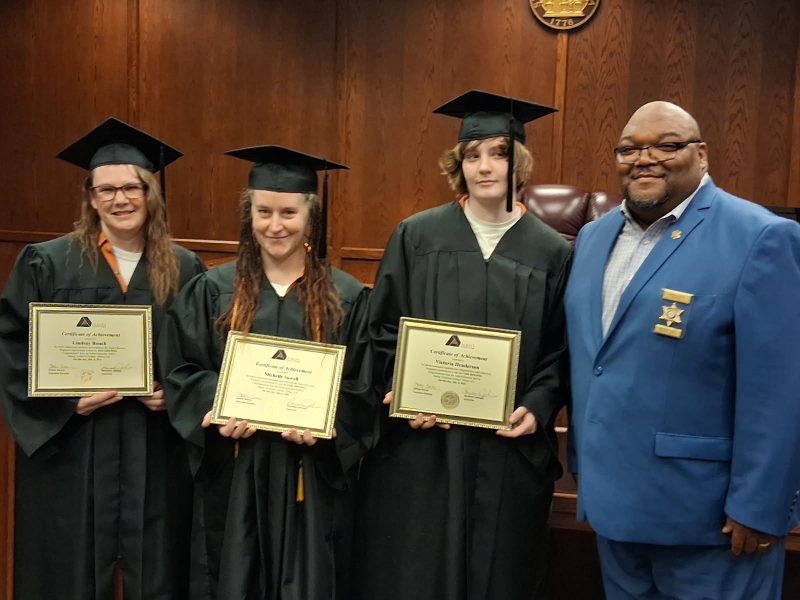
Dougherty Jail graduates first class of female GED recipients
“It was an escape. I can say this has been challenging. I want to express my gratitude for being able to attend this program.”

From cotton to cloud: In the data center debate, is rural Georgia once again being asked to carry the cost?
Across much of rural Georgia, the abandoned cotton warehouses and shrinking tax bases remain — enduring reminders that industries built to serve distant markets do not necessarily stay rooted in the communities that first sustained them.
Dawson Council approves $400,000 lifeline in emergency meeting as financial accountability remains elusive
Less than a week after city officials publicly acknowledged the City of Dawson cannot continue operating without additional financing, the Dawson City Council convened a hastily called emergency meeting Tuesday evening and unanimously approved authority to borrow up to $400,000 through a tax anticipation note.
