
Project Elevation to provide prostate cancer awareness beyond Dougherty County
By Alan Mauldin
[email protected]
ALBANY — After two years of screenings, hanging out, bonding and reaching out to Dougherty County’s African American community, the prostate cancer-fighting program the Elevation Project is growing and looking to expand to a much larger slice of southwest Georgia.
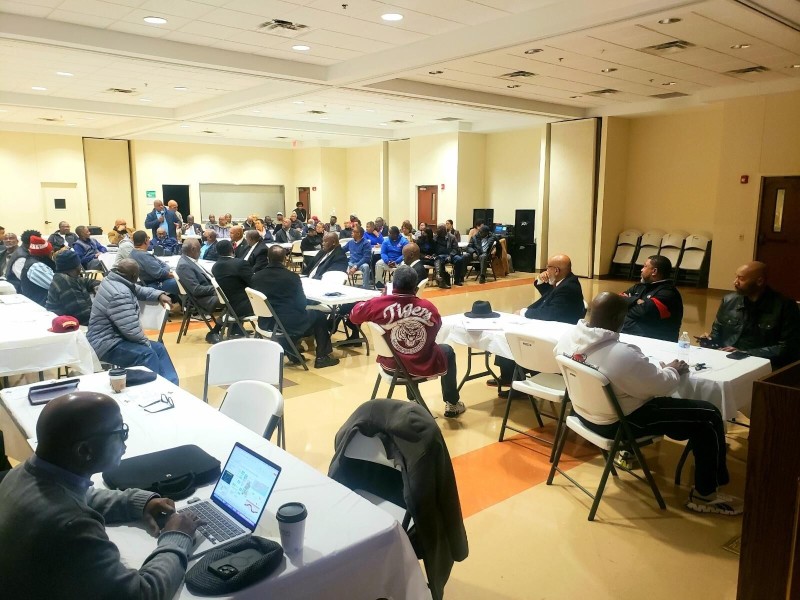
On Saturday, the first step in that effort came together with the participation of about 25 churches from multiple locations, including Ashburn, Lee, Sumter and Terrell counties.
The Morehouse School of Medicine has pledged a grant of $500,000 to the Phoebe Putney Health System to extend and expand the prostate cancer screening program. That amount could grow as Project Elevation expands.
In addition to the program’s work to screen and steer individuals who test positive to treatment, the program also includes a research component.
In recent weeks, prostate cancer has been in the news with stories about U.S. Secretary of Defense Lloyd Austin, who had treatment complications, and the death of Dexter King, son of the late Rev. Martin Luther King Jr., said Brian Rivers, director of Morehouse’s Health Equity Institute and a professor in the college’s department of community health and prevention.
“So we see the need,” he said. “We know that black people are more at risk for prostate cancer, but we don’t know why..
“We hope to reach between 1,000 and 1,500 people each year for the next two years to help us better understand this disease and put some programs in place to help those who are suffering and dying disproportionately. We’re just excited about this new initiative we have launched.”
Ten Dougherty County churches participated during the first two years of the program, with training sessions held to help the team of “champions” reach out to men to discuss prostate cancer. Each of those churches in turn held events to which men were invited for PSA screenings for prostate cancer.
During the process, area barber shops expressed an interest and became involved. In addition to PSA screenings, the program offered testing for diabetes and hypertension.
While the focus is on black men, the program is not limited by race, said the Rev. Daniel Simmons, pastor of Albany’s Mt. Zion Baptist Church, which was one of the initial 10 congregations involved in Project Elevation.
“It’s for any man,” he said. “Any man can get prostate cancer, so we want all men to come.”
For the African American community, churches and barber shops are the best resources to reach everyone who needs to hear the message, Simmons said.
“The first logical place is the church because that’s where we gather,” he said. “The next logical place is the barber and beauty shops. Every man at some point ends up in the barber shop.
“Out of that connection comes awareness. There’s awareness, and then there’s an invitation to an event at a church or a barber shop.”
The turnout for the initial meeting, at which Morehouse staff made presentations, went well, and Simmons said he is excited that the Albany area will be part of the research project. In the future, each church plans to have three members go through the training process.
“One of the shortcomings of medicine, as we know it, is when clinical trials are being done, when research is being done, so many times the African American men are left out of the studies,” the pastor said. “What’s true for the population as a whole is not true for every population. We’re expanding, including African American men in the church trials and the research.”
During the first two years of the Elevation Project, 559 men received PSA screenings, said Keisa Mansfield, Phoebe’s manager of clinical research, genetic testing, oncology outreach and oncology wellness. Of those, about 50 had abnormal PSA test results, and three were diagnosed with prostate cancer.
Where Project Elevation goes above and beyond is through its commitment to follow up with those who have an abnormal PSA result and make sure those who have prostate cancer receive treatment, whether they can afford it or not, said Darrell Sabbs, Phoebe’s former community benefits director.
“‘No man left behind’ is our motto,” Sabbs said. “Saturday was fabulous. We had over 25 denominations of African American churches. We had Baptists, Methodists, Muslims.”
Phoebe officials say they hope to do more outreach to military veterans with the expansion of the program.
Among those who attended on Saturday as part of the new contingent of champions to be trained was Frank Wilson, the former director of the Albany Civil Rights Institute, who is a four-year prostate cancer survivor.
Wilson has been involved with the effort with Sabbs since its inception and decided to become more involved. He said he hopes his experience will help him spread the message on early detection. That will involve overcoming many men’s reticence to seek out medical care.
“Men will make sure their children go to the hospital when they’re sick, that their wife goes to the doctor,” Wilson said. “They’ll make sure the oil is changed in the car. I think that as a grou,p men are just reluctant to talk about or get engaged in their personal health.
“I hope I can help other men realize they are important to their families, they are important to their communities. Like they take care of the car, they need to take care of their health issues.”
Author

Related Articles

Albany Herald – June 25, 2026
Dougherty Commission considers $104
million budget for… Theatre Albany’s first 55-over production set for… Homeschool students reduce prep time for ‘Anastasia’…

Classifieds – June 25, 2026
Classifieds; Legals; Garage Sales; Auctions, etc.
Dougherty Commission considers $104 million budget for 2026-2027 budget year
“The other side of the coin is you could have higher revenues than projected. We’re very conservative in budgeting revenues. That also reduces the need to use fund balance”
