
Georgia chief Supreme Court justice discusses court backlog during Albany visit
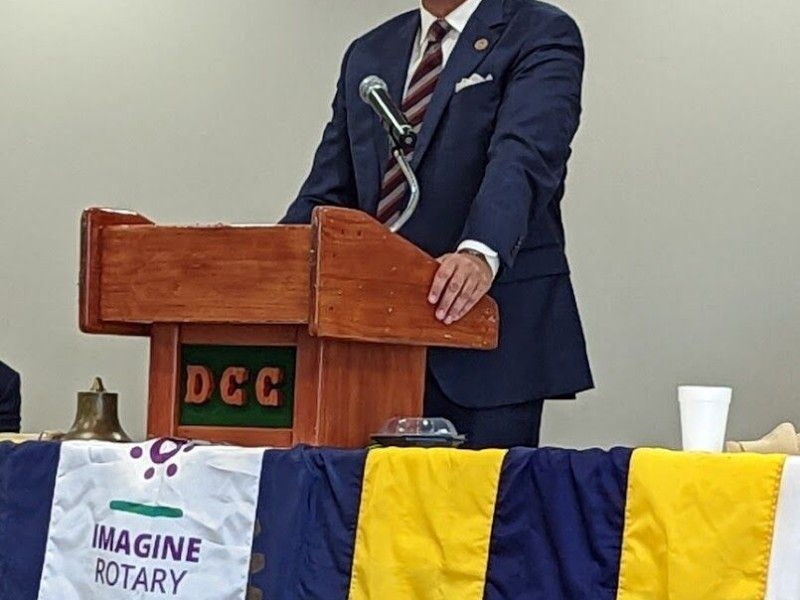
File Photo
By Alan Mauldin
[email protected]
ALBANY — The impact of the lengthy closure of Dougherty County courts on criminal cases during the COVID pandemic has been in the local news for a couple of years now. But that is not the only place where courts are backed up. Courts around the state also are behind on civil cases and divorces and juvenile cases as well.
In Dougherty County there are some 10,000 pending felony cases alone, with one-quarter of those involving some of the worst crimes imaginable, from murder to aggravated child molestation, according to Chief Dougherty Judicial Circuit Judge Willie Lockette, who recently shared those statistics with the Dougherty County Commission.
During a trip this week to Albany, Chief Justice of the Supreme Court of Georgia Michael Boggs met with Lockette and other court officials.
The state has 49 Superior Court circuits, and many of those are overwhelmed in the best of times, the chief justice said during an interview with The Albany Herald.
About a third of the assistant district attorney positions in Dougherty County are vacant, which has caused further delays. And the workload of judges in Dougherty County has been ranked as the highest in the state, with each judge shouldering the burden of 1.8 judges.
“The problems are significant,” Boggs said. “The problem has been (that) COVID has exacerbated the issue. We asked for resources in the earlier stages of COVID to alleviate the backlog.”
About $96 million has been earmarked from federal American Rescue Plan Act funds to assist courts in addressing the backlog, and $44 million of that amount was made available, with grants to 42 circuits, for the 2022 calendar year.
Dougherty County was awarded about $4 million from the grant fund that can be used for hiring temporary court personnel and prosecutors as well funding to rent additional court space.
Boggs has been involved in that process as chairman of the Judicial Council of Georgia. That council also has recommended that Dougherty County be funded for a fourth judge for Superior Court.
The Georgia General Assembly will have to approve that recommendation, and the body usually approves two or three new judges each legislative session, Boggs said.
“We had eight circuits that requested and qualified” this year, he said.
Dougherty County is not alone in having a shortage of prosecuting attorneys. While Boggs said the reason for that is not certain, newly minted attorneys these days can bypass the traditional stint in a district attorney’s office to get better-paying jobs at private firms, particularly in the Atlanta area.
The chief justice, a Waycross native, spent some time in Atlanta himself before returning to his hometown to form a private practice until he was elected to the General Assembly in 2000. In 2004, he was elected as a judge for the Waycross Circuit.
“I enjoyed that service and oversaw our first felony adult drug court,” he said.
Gov. Nathan Deal appointed Boggs to the Georgia Court of Appeals in 2011, and then in 2017 to the Supreme Court, where he was elected chief justice by his peers.
Author

Related Articles

Foreclosures jump 52.9% across the region as buyers regain negotiating power
In Dougherty County, the number of residential properties advertised for foreclosure has nearly doubled this year. In neighboring Lee County, developers are preparing to add hundreds of new houses and apartments, including homes aimed at buyers who have struggled to find newer housing at an attainable price.
PHOTOS: Albany State New Employees Luncheon
Click the arrow to scroll through the photos.

Albany Commission will revisit downtown park project at October retreat
“Right now it’s a sea of asphalt there. It doesn’t encourage gathering. Parks and green spaces encourage gathering.”
