
Pink Moon again a ‘blood moon’ with full lunar eclipse Saturday
Jim Hendricks
ALBANY — The third of a series of four consecutive biannual lunar eclipses will occur Saturday morning. Unfortunately for sky-watchers in Southwest Georgia, the moon will set before it fully enters Earth’s shadow.
The lunar eclipse has been nicknamed “blood moon” in part because of the reddish hue that the lunar surface takes on even though direct sunlight to the moon is blocked when the much larger Earth is situated directly between it and the sun. Saturday morning’s event is the third in what is known as a tetrad, a relatively rare celestial occurrence, and it’s the second year in a row of an eclipse of the April full moon, which is nicknamed the Pink Moon.
The red color is caused by the lens effect of the Earth atmosphere, which bends the path of the longer red photons, allowing them to reach the lunar surface and be reflected back to Earth as a dim red glow. Shorter blue photons don’t make it to the moon because they’re scattered by the atmosphere. If the Earth had no atmosphere, the moon would be completely black during a full eclipse.
What makes the tetrad unusual isn’t the frequency of the lunar eclipses. Those happen roughly every six months, though the places where they’re visible from Earth varies. The rarity is that these four consecutive eclipses — April 15 and Oct. 8 2014, Saturday’s and another in September — are total eclipses, meaning the moon falls entirely within the Earth’s shadow. Because the moon’s orbit of the Earth is on a 5.2 degree angle compared to the Earth’s orbit around the sun, most lunar eclipses are partial, with some sunlight reaching the lunar surface.
In Southwest Georgia, the full eclipse portion of the event will not be seen Saturday. The moon is set to move into the phase where it is fully shielded from the sun about 7:54 a.m., roughly 28 minutes after it has set in the Albany area, placing it below the horizon. Sky-watchers will get to see some of the partial eclipse, which starts about 6:15 a.m., though the view also will be hampered the lighter sky with sunrise in Albany coming about 7:22 a.m.
The final eclipse of this tetrad will occur Sept. 28 and will be friendlier for viewing from Southwest Georgia, weather permitting. That eclipse, which will be fully visible from the area, starts at 9:07 p.m., entering full eclipse at 10:11 p.m. with the moon starting to emerge from the Earth shadow about 11:23 p.m. The partial eclipse ends at 12:27 a.m. Sept. 29.
Part of the mystique that has arisen around the so-called blood moons has been a religious connotation that was sparked in large part by a Texas minister, John Hagee, who contends the unusual sequence of full lunar eclipses and their proximity to solar eclipses and important Christian and Jewish holy days are signs of an earthshaking event being imminent for Israel and the world. Last week, “Four Blood Moons,” a film described by one of its producers, Rick Eldridge, as a docudrama examining events that coincided with previous tetrads, was released.
Saturday’s full moon occurs on Passover, which begins at sundown Friday. That also is the penultimate day of the Christian Holy Week that ends with Sunday’s observance of Easter. The Sept. 28 lunar eclipse will come shortly after Yom Kippur, the Day of Atonement, which starts at sundown Sept. 22.
While tetrads can be rare, Dr. Robin Shelton, a professor in the Department of Physics and Astronomy at the University of Georgia, noted in an interview with The Albany Herald last fall that one set of tetrads has already occurred this century with little fanfare in 2003-04. There also were five in the 20th century.
“But part of the hoopla,” she said, “is because before that, from 1600 to 1900, there were zero tetrads. They kind of come and go, and we’re in the midst of a large set of them.”
NASA officials say that the tetrads are made possible by the eccentricity of the Earth’s orbit, something that is gradually decreasing. Once that eccentricity goes away sometime in the distant future, tetrads will no longer be possible.
But for now, they’re possible and, this century, fairly plentiful. After the Sept. 28 eclipse, the next tetrad will be in 2032-33, followed by 2043-44, 2050-51, 2061-62, 2072-73 and 2090-91. The 22nd century will start off with a tetrad in 2101-02, which means there will have been nine sets of tetrads in the 100-year period starting in 2003.
According to NASA’s website, 568, or 16.3 percent, of the 3,479 full-lunar eclipses that will have occurred from 1999 BC to 3000 AD will have come during tetrads.
Related Articles

Bringing (positive) changes to The Herald’s Squawkbox
The Herald, as part of The Georgia Trust for Local News, is altering the way the Squawkbox is presented.
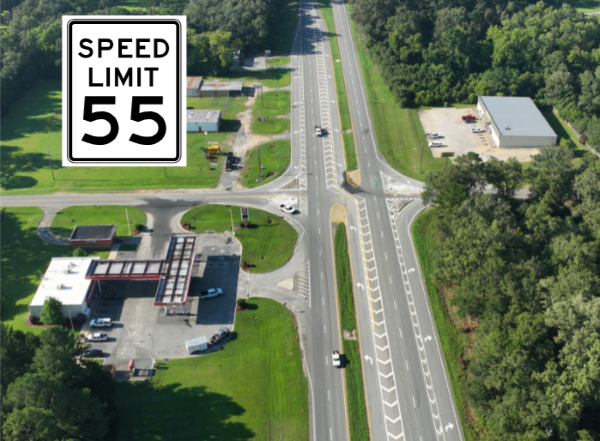
U.S. 19 speed limit reduced for traffic approaching Nelms Road intersection
The speed limit for U.S. 19 traffic approaching the Nelms Road intersection has been reduced from 65 mph to 55 mph.
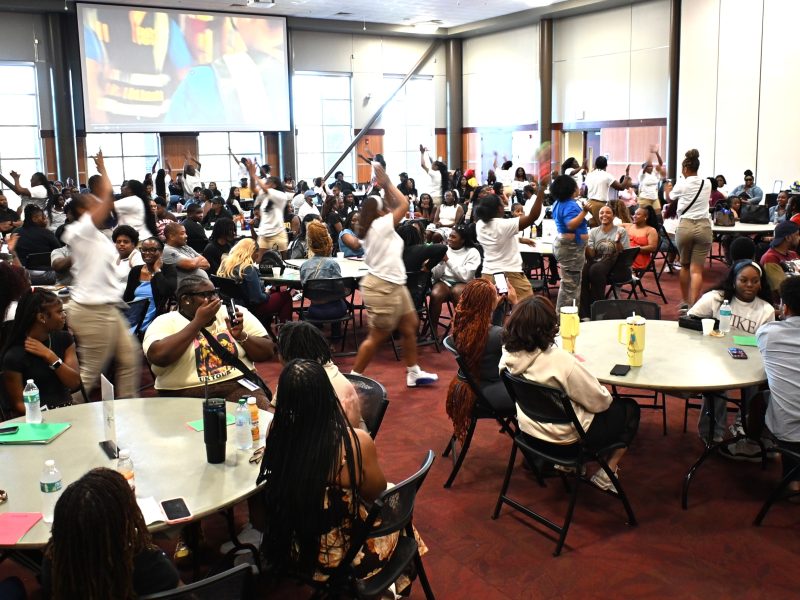
PHOTOS: Albany State New Student Orientation
Photos by Reginald Christian, Albany State University
