
BARRY LEVINE: You always remember that first time
THE OLD ROCKER: Watching three Ali fights in the Big Apple was worth the wait
By Barry Levine
The Old Rocker
You always remember the first.
It might be the first day of high school, first date, first kiss or first time your team won a championship.
One of my favorites was the first time I was supposed to see a televised boxing match. The emphasis here is on supposed.
It was Rocky Marciano’s first heavyweight title defense against Jersey Joe Walcott on May 16, 1953. Marciano had won the championship by knocking out Walcott in the 13th round in September 1952.
I was 8 years old and anxiously awaiting the big fight.
After days, maybe weeks, of pleading with my parents to stay up past my normal bedtime to see the fight, they acquiesced.
While the ring emcee was announcing the fighters, I went into the kitchen to get a big bowl of ice cream, with sprinkles, naturally,
When I returned to the den with my ice cream, I quickly learned the fight was over. Marciano had knocked out Walcott in 2:25 of the first round.
I kept saying to my parents that the fight can’t be over because it just started.
Well it was over.
I started crying and my parents started laughing. And, remember, those were the days before instant replay.
When they finally convinced me the fight WAS over, I stomped up the steps to my bedroom.
That was my introduction to boxing.
Marciano finished his career with a 49-0 record, the only heavyweight champion to retire undefeated.
I continued to watch boxing in TV with Pabst Blue Ribbon Boxing on Wednesday nights and the Gillette Friday Night fights. Jack Drees was the commentator for the Wednesday fights and Jimmy Powers, who served as sports editor of the New York Daily News from 1936 to 1959, worked in the same capacity on Fridays.
The sport was different during the 1950s as boxers fought on a regular basis, not once or twice a year as today’s fighters.
This gave viewers the opportunity to see all the great fighters of the day including Sugar Ray Robinson, Archie Moore, Bobo Olson, Carmen Basilio, Kid Gavilan, Gene Fullmer, Willie Pep, Sandy Sadler, Johnny Saxton and Tony DeMarco. All were champions or fought for championships.
I saw my first fight in-person when our family was vacationing in Miami Beach In December 1957.
My father managed to get quality seats for the middleweight fight between Joey Giardello and Ralph “Tiger” Jones. Giardello, who bloodied Jones’ nose in the 10th round, won a close, but unanimous. decision. The fight was part of the Gillette Friday Night series.
After the fight, my father took me to where Powers had been broadcasting the fight and I shook hands with him.
My father asked Powers if he had any advice for me and the announcer quickly responded, “Study hard and get good grades,”
Too bad I didn’t listen to him.
The fight really whetted my appetite for the “sweet science.”
The Giardello-Jones fight was the last I would see in-person for nearly 14 years.
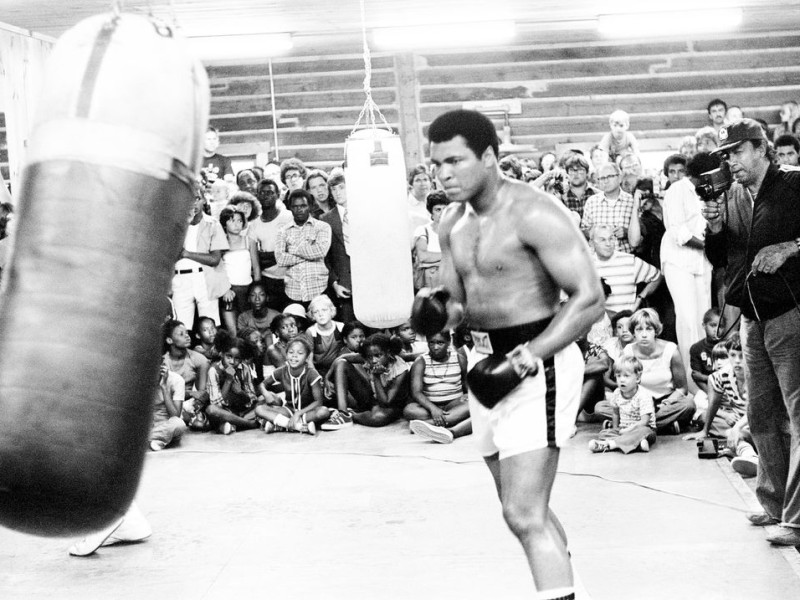
The wait was worth it as I covered three of Muhammad Ali’s fights for the New Jersey newspaper for which I worked.
The next bout was on March 8, 1971, at Madison Square Garden when Ali, boasting a 31-0 record, was attempting to defeat heavyweight champion Smokin’ Joe Frazier, 26-0. This marked the first time two undefeated fighters met for the heavyweight crown.
The bout justifiably was billed as “The Fight of the Century.”
Frazier knocked Ali to the canvas 10 seconds into the 15th and final round with a vicious left hook en route to posting a 9-6, 11-4, 9-6 unanimous decision based on rounds.
Ali was not in the best boxing shape and tired early in the fight as he was showing the rust following a three-year banishment after being stripped of the heavyweight crown after refusing induction into the military, claiming he was a conscious objector.
Ali and Frazier met for a second time at Madison Square Garden on Jan. 28, 1974, with Ali, in much better boxing shape, whipped Frazier, 7-4-1, 7-5 and 7-4-1 in the 12 rounder.
Seated in the auxiliary press section, I was surprised the post-fight press conference was comparatively calm.
What amazed me with both fights was the circus-like atmosphere that permeated The Garden. It looked like a fashion show as women – and men, too – wore the most unbelievable ensembles.
My third Ali fight was against Ken Norton at Yankee Stadium on Sept. 28, 1976. The two had split their first two meeting with Norton winning a decision in March 1973 and Ali capturing the rematch in September of that year via a decision.
I was seated in the baseball press box in the mezzanine level behind home plate and the ring was situated in the center field area, an estimated 260 feet away.
My assignment for the night was to interview Ali after the fight.
Realizing after the 14th round that the outcome would be determined by who won the 15th and final round, I left the press before the start of the round and went to the bottom of Yankee Stadium where Ali’s dressing room was located.
I perched myself directly in from of Ali’s dressing room door.
After the controversial decision was announced with Ali winning by scores of 144-142, 143-142 and 143-142, the crowd in front of his dressing room was wall to wall.
Ali and members of his entourage eventually made their way to the dressing room.
They yelled at me to move so they could enter.
I refused.
Finally, Ali and company got into his locker room with five writers following him.
I was one of the quintet. My plan had worked.
Ali shortly sat down at a rectangular wooden table in the middle of the room and began speaking.
He was totally exhausted from the fight. I was sitting across from him at the table and his statements were barely audible.
It’s hard to believe that the fight took place nearly 40 years ago.
I still watch boxing on TV and was looking forward to seeing last month’s welterweight championship fight between Keith Thurman and challenger Shawn Porter. Thurman won a unanimous decision to retain his title.
I was watching a preliminary fight when I nodded off while sitting in my favorite La-Z-Boy chair. The next thing I remember hearing was the New York weather report for the next day.
Never saw one second of the Thurman-Porter fight.
At least this time it wasn’t because I was getting a bowl of ice cream.
This week in rock history: — “Tossin’ and Turnin’” by Bobby Lewis, 28, reached the top of the charts on July 10, 1961, for the first of a seven-week run. … The novelty song “Alley-Oop” jumped to No. 1 on July 11, 1960. It was credited to a then fictitious group called The Hollywood Argyles. The song was actually performed by Gary Paxton who made up the group’s name and then had to put a band together when the song became a hit. … Elvis Presley, 19, quit his day job as a truck driver for the Crown Electric Co. on July 12, 1954, and signed a recording contract with Sun Records.
Paul Anka’s “Lonely Boy” was the No. 1 song on the Hot 100 on July 13, 1959. He also performed the song in the movie “Girls Town,” in which he starred with Mamie Van Doren and Mel Torme. … Bobby Vinton’s “Roses Are Red” skyrocketed to No. 1 on the charts on July 14, 1962. It was a song that Vinton found in a pile of demo discs that were marked “reject.” The song became a million-seller. … The Coasters recorded “Poison Ivy” in New York on July 16, 1959. The song became their sixth consecutive Top 10 hit.
Barry Levine is an entertainment writer for The Albany Herald. He can be reached at [email protected].

Related Articles

Southwest Georgia artists recognized at packed opening of exhibition
The annual juried exhibition, one of the region’s largest showcases of visual art, features approximately 46 artists and nearly 90 works spanning painting, sculpture, ceramics, photography and mixed media.

Albany Area Arts Council to host reception for ‘A Room of Her Own’ exhibit
A reception for “A Room of Her Own,” an exhibit celebrating female empowerment, is scheduled at the Albany Area Arts Council.
Albany museum’s fall exhibits enter final weeks
ALBANY ─ As 2024 reaches its final weeks, so do the fall exhibitions at the Albany Museum of Art. Jan. 4
