
BARRY LEVINE: Bouton’s ‘Ball Four’ got him blackballed by Yankees
By Barry Levine
[email protected]
Jim Bouton, who helped the New York Yankees capture the 1963 American League pennant by posting a 21-7 record with a 2.53 earned-run average, died earlier this summer at age 80 from problems associated with dementia.
Bouton, who spent 10 years in the majors pitching for the Yankees, Seattle Pilots (now Mariners), Houston Astros and Atlanta Braves, is much more famous for his skill as an author than his ability to throw a baseball.
He authored “Ball Four,” a book that served as a diary of his 1969 season with the Pilots and Astros. Bouton also included the off-the-field antics of his Yankee teammates, and “Ball Four” is widely considered the pioneer publication of sports expose’s. It shattered the players’ philosophy of “what goes on in the clubhouse remains in the clubhouse.”
Bouton’s famous Yankee teammates included Mickey Mantle, Whitey Ford, Elston Howard and Roger Maris.
The Yankees and Major League Baseball were none too pleased with Bouton’s autobiography.
Commissioner Bowie Kuhn, a New York attorney before he became baseball’s leader, was so incensed with “Ball Four” that he tried, in vain, to get the pitcher to sign a letter stating the book was fiction.
Although he later had reporter’s credentials, the Yankees blocked Bouton from the field and clubhouse.
I covered the Yankees during spring training that year for my New Jersey newspaper and witnessed Bouton getting the cold shoulder. The usually mild-mannered Howard, the American League’s Most Valuable Player in 1963, was so incensed that he had to be physically restrained from attacking Bouton.
Bouton was estranged from the Yankees until 1988 when his daughter wrote team owner George Steinbrenner a letter strongly urging that her father get an invitation to Old Timers’ Day festivities. He got the invitation, and it went without incident.
Bouton finished his career with a 62-63 record and a 3.57 earned-run average. After pitching for Western Michigan University, he signed a $30,000 contract with the Yankees in 1959.
The book sold millions of copies and made Bouton big bucks. But, at what price?
If I were a member of the Yankees 50 years ago, I would not have been happy if I had appeared in Bouton’s book without my knowledge and permission. When I was covering the Yankees, a woman who lived near me was fooling around with a married player. I never wrote about it. Never would. I always felt what a player did off the field was his business, not mine, even if I was aware of it.
Bouton obviously had a different opinion.
He made his money. But was it worth the damage he caused some players?
Not in my book.
Baseball Players and Dementia
Jim Bouton was not the only New York player to be affected by dementia. The family of Tom Seaver has announced that he no longer will make public appearances because of his battle with dementia. Pitching primarily for the New York Mets, Seaver won 311 games during his career.
Bud Harrelson, the Mets’ shortstop when they upset the Baltimore Orioles in the 1969 World Series, also is suffering from the same mental disease. Harrelson, who also managed the Mets, was one of the classiest men ever to don a uniform. After the Mets received their World Series rings, Harrelson opted to give his to his father as a way of thanking him for everything he did for him.
Now that’s class.
1970 No. 1 hits
While Bouton made his money on his book, rock singers made their bucks on singles. Here’s a list of songs that topped the charts in 1970:
♦ “Raindrops Keep Fallin’ on My Head,” B.J. Thomas
♦ “I Want You Back,” Jackson Five
♦ “Venus,” Shocking Blue
♦ “Thank You (Falettin Me Be Mice Elf Again),” Sly and the Family Stone
♦ “Bridge over Troubled Water,” Simon & Garfunkel
♦ “Let It Be,” The Beatles
♦ “ABC,” Jackson Five
♦ “American Woman,” Guess Who
♦ “Everything Is Beautiful,” Ray Stevens (of Albany)
♦ “The Long and Winding Road,” The Beatles
♦ “The Love You Save,” Jackson Five
♦ “Mama Told Me Not to Come,” Three Dog Night
♦ “Close To You,” Carpenters
♦ “Make It With You,” Bread
♦ “War,” Edwin Starr
♦ “Ain’t No Mountain High Enough,” Diana Ross
♦ “Cracklin’ Rosie,” Neil Diamond
♦ “I’ll Be There,” Jackson Five
♦ “I Think I Love You,” The Partridge Family
♦ “The Tears of a Clown,” Smokey Robinson and the Miracles
Here are some interesting tidbits about the 21 chart toppers:
♦ The Jackson Five had four No. 1 hits, controlling the top spot for 10 weeks. “I’ll Be There” was No. 1 for five weeks. The Beatles were the only other group to have more than one No. 1 hit, placing two at the top.
♦ After charting songs for nearly 10 years, Albany native Ray Stevens finally got his first No. 1 hit with “Everything is Beautiful.” He got his second and last chart topper four years later with “The Streak.”
♦ The Miracles placed 25 songs in the Top 40 from 1960 to 1970 without having a No.1. hit. That void ended late in 1970 when “Tears of a Clown” reached the top for two weeks. The closest the Miracles had come to No.1 was when “Shop Around’ reached No. 2.
Related Articles

Southwest Georgia artists recognized at packed opening of exhibition
The annual juried exhibition, one of the region’s largest showcases of visual art, features approximately 46 artists and nearly 90 works spanning painting, sculpture, ceramics, photography and mixed media.
Powerful performances drive Theatre Albany’s ‘The Color Purple’
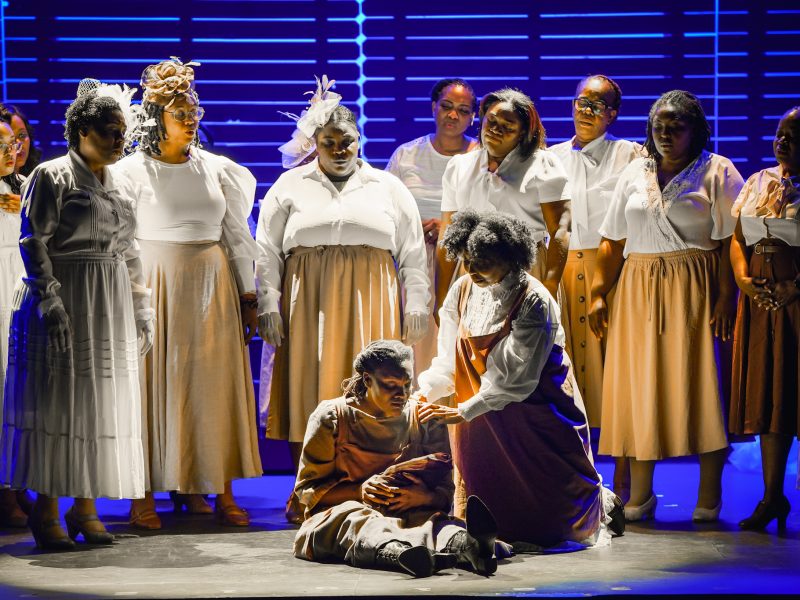
From the street, strands of purple ribbon wind around the white columns of the historic theater, hinting at the story waiting beyond its doors. Inside the foyer, a carefully curated slideshow flickers across a large screen, cycling through the faces of the cast. Some are seasoned performers. Others are stepping onto a stage for the very first time. Teachers stand alongside former students. Parents perform beside their children. People who worship in different churches, work different jobs and come from different corners of Southwest Georgia gather beneath the same lights to tell the same story.

Annual exhibition showcases southwest Georgia talent, community connections
Now in its 26th year, the exhibition features work by artists from across Southwest Georgia and offers residents an opportunity to engage directly with the area’s creative community.
