
Powerful performances drive Theatre Albany’s ‘The Color Purple’
From the street, strands of purple ribbon wind around the white columns of the historic theater, hinting at the story waiting beyond its doors. Inside the foyer, a carefully curated slideshow flickers across a large screen, cycling through the faces of the cast. Some are seasoned performers. Others are stepping onto a stage for the very first time. Teachers stand alongside former students. Parents perform beside their children. People who worship in different churches, work different jobs and come from different corners of Southwest Georgia gather beneath the same lights to tell the same story.

ALBANY — Before the curtain rises, before a single note is sung and before Celie utters her first words, there is already a story unfolding inside Theatre Albany.
From the street, strands of purple ribbon wind around the white columns of the historic theater, hinting at the story waiting beyond its doors. Inside the foyer, a carefully curated slideshow flickers across a large screen, cycling through the faces of the cast. Some are seasoned performers. Others are stepping onto a stage for the very first time. Teachers stand alongside former students. Parents perform beside their children. People who worship in different churches, work different jobs and come from different corners of southwest Georgia gather beneath the same lights to tell the same story.
For a moment, the divisions that often define public life — race, politics, income, age and background — seem less important than the shared act of creation.
For director and Theatre Albany Board member Ta’Varis Wilson, that may be the most important story being told.
“These are people you see at church, at football games or in the grocery store,” Wilson said. “They’re all on the same stage together. Some went to high school together. Some went to college together. We even have families performing together.”
Wilson said several cast members are appearing in their first Theatre Albany production, while others are sharing the stage with people who once taught them in elementary school.
“Those lines are being blended together, and it’s just beautiful,” he said.


The production’s nearly 30-member cast includes performers from Albany, Tifton, Moultrie and surrounding communities. Some drove to the theater nearly every day during the show’s intensive six-week rehearsal schedule.
“We have members of our cast who are driving from Moultrie and Tifton every day,” Wilson said. “It’s something about this story that makes them come to rehearsal every day. They want to tell this story.”
That commitment speaks not only to the enduring power of Alice Walker’s Pulitzer Prize-winning novel but also to the remarkable talent assembled on Theatre Albany’s stage.
When auditions concluded earlier this spring, Wilson found himself expanding the cast beyond what he initially envisioned.
“There was so much wonderful talent,” he said. “They should share the stage.”
Many are first-time performers. Others are experienced actors. Together, they form an ensemble capable of carrying one of the most celebrated and challenging works in modern American literature.
More than 40 years after its publication, “The Color Purple” continues to challenge audiences, spark debate and ask difficult questions about race, gender, poverty, education and human dignity.
“We want to embrace the full community,” Wilson said. “It’s a story that transcends location. It’s about love.”
In a city where conversations often focus on struggling schools, economic uncertainty, population loss, political division and concerns about public safety, Wilson sees something different happening inside Albany’s oldest cultural institution.
He sees people coming together.
That idea sits at the heart of “The Color Purple.” Long before scholars coined the term “intersectionality,” Walker’s novel explored how race, gender, poverty and education overlap to shape a person’s life. Celie’s journey is not defined by a single hardship but by the cumulative weight of many barriers.
Walker centered a voice that American literature had often ignored: a poor, rural black woman whose experiences were rarely considered worthy of public attention. The novel, published in 1982, became a literary landmark when Walker became the first African American woman to win the Pulitzer Prize for Fiction the following year. Yet its success was accompanied by controversy.
Critics challenged its depictions of domestic violence, sexuality and religion. Some black scholars argued that its portrayal of black men reinforced harmful stereotypes. School districts across the country removed it from libraries or attempted to ban it from classrooms.
Yet the controversy itself reveals why the work remains important. Celie is not simply black. She is not simply female. She is not simply poor.
She exists at the intersection of race, gender, class, education and geography, experiencing each of those realities simultaneously. The obstacles she faces cannot be neatly separated because they compound one another.
For Wilson, one of the story’s most enduring themes is the connection between literacy and empowerment.
“What’s fascinating about ‘The Color Purple’ is that it exists in so many forms,” he said. “It started as a book, then became a film and later a Broadway musical. I love how it demonstrates the different ways literacy can be accessed.”
Wilson points to Celie’s evolving ability to read and understand the letters from her sister Nettie as one of the story’s defining moments.
“You see that reflected in Celie’s story,” the director said. “She initially struggles with reading, but eventually learns through the letters from her sister. The power of literacy and what it can do for individuals and communities is incredible.”
For Wilson, those themes are less academic than personal.
Originally from Augusta, he earned a degree in speech and theater from Albany State University before pursuing graduate studies and building a professional acting career throughout the Southeast. He worked in Virginia, Atlanta and Columbus before returning to Albany, where he now serves as a professor of theater at Albany State.
“When I came back, I wanted to do more community outreach, both for myself and for my students,” he said.
That decision reflects one of the central ideas embedded within Walker’s novel. Education is not merely a pathway out. It can also be a pathway back.
The same literacy that empowers Celie to discover her own voice becomes, in Wilson’s life, a means of investing in the next generation. Knowledge acquired elsewhere can be brought home. Experience gained elsewhere can strengthen local communities.
The connection between education, storytelling and civic engagement is woven throughout Theatre Albany itself.
Founded in 1932, the organization is one of Albany’s longest-standing cultural institutions. Since 1964, it has operated from the historic Davis House, providing a space where people from different backgrounds can gather around a shared story.
Wilson joined the board in 2019, just before the COVID-19 pandemic. While many community theaters across the country struggled financially, Theatre Albany continued operating.
“It was rough,” Wilson said. “But we made it through, and we’ve been growing ever since.”
The production also arrives during a period of loss for the theater community.
Wilson noted that Theatre Albany recently unexpectedly lost a cast member, as well as long-time supporters and former board presidents Randy Henry and Nancy McClendon.
“This show does mean a lot because it gives us hope and triumph,” Wilson said. “The triumph of what hope is and what love is.”
The lesson, he believes, remains as relevant today as it was four decades ago.
“Depending on where you are in life, it can feel as though your worth is being determined by so many outside factors,” Wilson said. “When you’re content in the love within yourself and how you navigate the world, it’s OK. It’s OK.”
In a city wrestling with questions about where it is headed, Theatre Albany’s production of “The Color Purple” offers a reminder of what can happen when people choose to build something together rather than argue over what divides them.
And in a city that sometimes struggles to imagine its future, hope may be the most important thing the talented cast of Theatre Albany brings to the stage.
Opening weekend performances for the production are sold out. Tickets remain available for performances June 12-14 but are selling quickly. Tickets and additional information are available at Theatre Albany.
Related Articles

District 151 challengers Wolfe, Lockhart offer plans for schools, rural jobs, health care
Two challengers seeking to unseat state Rep. Mike Cheokas are proposing different approaches to Southwest Georgia’s needs, with Democrat Ethan Wolfe emphasizing changes to state funding and health policy and independent Travis Lockhart focusing on partnerships among local governments, schools and employers.
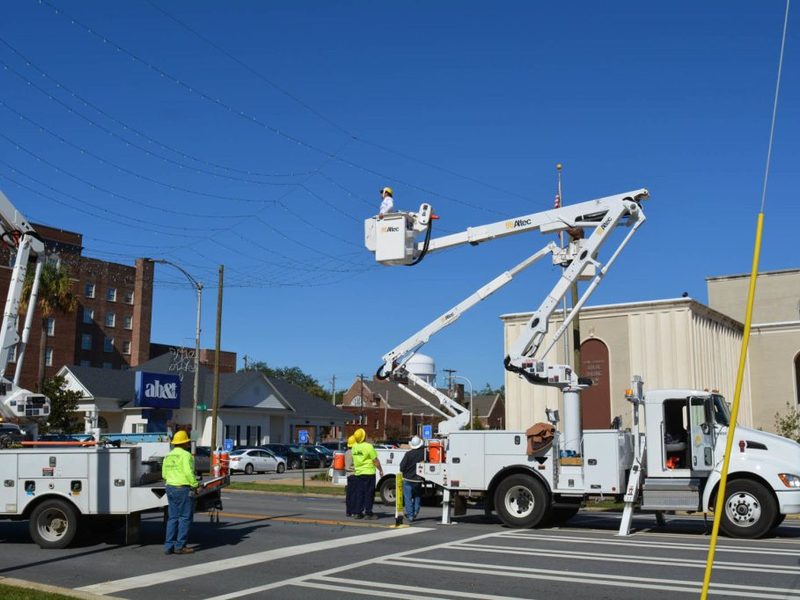
Albany considers battery storage system to address electricity surplus
“For me, this is all about ratepayers. Will this keep our rates low? That’s my biggest concern on a project like this.”

Lee County denies mother’s home day care plan despite staff support, corrections to objections
A day after Lee County commissioners voted down her plan to care for five young children in her home, Sharemer Jones returned to the county planning office with her infant daughter to ask how to appeal.
