
BARRY LEVINE: The triumph and tragedy of Marvin Gaye

By Barry Levine
[email protected]
Marvin Gaye’s hits that made the Top 5:
♦ 1964: “How Sweet It Is To Be Loved By You”
♦ 1967: “Your Precious Love”
♦ 1968: “I Heard It Through The Grapevine”
♦ 1968: “Too Busy Thinking About My Baby”
♦ 1971: “What’s Going On”
♦ 1971: “Mercy Mercy Me”
♦ 1971: “Let’s Get It On”
♦ 1977: “Got To Give It Up”
♦ denotes No. 1 hit
David Maschke has loved Marvin Gaye’s music since he first heard his songs more than a half-century ago. Getting Maschke to select his three favorite Gaye songs was more difficult for the Albany architect than designing a unique building.
After taking two days to finalize his decision, he picked “Pride and Joy,” “Inner City Blues” and “I Heard It Through The Grapevine.”
“Pride and Joy” peaked at No. 10 in 1963, “I Heard It Through the Grapevine” at No. 1 in 1968 and “Inner City Blues” at No. 9 in 1971.
Maschke admitted that his favorite Gaye songs could change depending on many different factors.
The 64-year-old said that he had “Pride and Joy” on his list because it keeps Carolyn, his wife of 40 years, on his mind. They will celebrate their 41st anniversary on Oct. 29.
Maschke said he really liked the song’s third verse, which includes the lyrics: And a love like mine, yeah baby, Is something nobody can ever destroy. You pick me up when I’m down And when we go out, pretty baby, You shake up the whole town. And that’s why I believe you’re my pride and joy.
A 12-year member of the Dougherty County Board of Education, Maschke has “Blues” on his list because of a client who cheated him out of a lot of money for services rendered.
My selections are a trio of his early chart songs: “Hitch Hike,” his first chart song in 1963, “Pride And Joy” and “Can I Get A Witness,” also in 1963. Add “You’re a Wonderful One” in 1964.
OK, OK, that’s four, not three, so you figure the Old Rocker is senile and can’t count. Well, writing this column does have its privileges, and if I say those four Gaye songs are my three, then they are my three.
What makes Maschke’s choices and mine so different is that it shows just how diverse Gaye’s songs were. Gaye is the second-most successful single artist in Motown history, trailing only Stevie Wonder.
— Wonder had a staggering 47 Top 40 hits, four more than Gaye.
— Wonder had 27 Top 10 hits, 11 more than Gaye.
— Wonder had nine No. 1 hits, six more than Gaye.
Wonder’s chart toppers are “Fingertips” in 1963, “Superstition” in 1972, “You Are the Sunshine of My Life” in 1973, “You Haven’t Done Nothin’” in 1974, “I Wish” in 1976, “Sir Duke” in 1977, “Ebony and Ivory” with Paul McCartney in 1982, “I Just Called To Say I Love You” in 1984 and “Part-Time Lover” in 1985.
In fairness to Gaye’s career, it was short-circuited when he was murdered by his father.
At the apex of his career, Gaye was one of Motown’s superstars — the soulful voice behind his variety of hits. As did labelmate Wonder, Gaye outgrew the crowd-pleasing sound that made Motown famous.
During the course of his recording career, he moved successfully from upbeat pop to “message” music to satin soul, combining elements of Smokey Robinson, Bob Dylan and Barry White.
His life came to a tragic end on April 2, 1984, when he was shot and killed by his father one day shy of his 45th birthday.
If the physical cause of Marvin Gaye’s death was straightforward —”Gunshot wound to chest perforating heart, lung and liver,” according to the Los Angeles County Coroner, then the events that led to the shooting are tangled.
One factor was a longstanding conflict with his father dating back to childhood. Marvin Gay Sr., (the “e” was added by his son for his stage name) was a preacher in the Hebrew Pentecostal Church and a proponent of a strict moral code. He was reportedly brutal with his four children. He was also said to be a hard-drinking cross-dresser who embodied a rather complicated model of morality. Marvin Sr. also was envious of his son’s tremendous success, and Marvin Jr. clearly harbored unresolved feelings toward his father.
Those feelings surfaced for the final time in the Los Angeles home of Marvin Gay Sr., and his wife Alberta. Their son had moved into his parents’ home in late 1983 during a low point of his life due to his alleged struggle with depression, debt and cocaine abuse.
One year removed from his first Grammy win and from a triumphant return to the pop charts with “Sexual Healing,” Marvin Gaye reportedly was in a bad state physically, psychologically and financially.
After an argument between father and son escalated into a physical fight on the morning of April 2, 1984, Alberta supposedly was trying to calm her son in his bedroom when Marvin Sr. took a revolver given to him by Marvin Jr. and shot him three times in the chest. After being taken to the Los Angeles County Jail, Gay was held on a $100,000 bail.
The judge agreed to let Gay enter a plea bargain. Gay pleaded no contest to a charge of voluntary manslaughter on Sept. 20, 1984. During the sentencing hearing two months later, Gay was allowed to speak. A tearful Gay, 70, told the court: “If I could bring him back, I would. I was afraid of him. I thought I was going to get hurt. I didn’t know what was going to happen. I’m really sorry for everything that happened. I loved him. I wish he could step through this door right now. I’m paying the price now.”
Following his statement, Gay was given a six-year suspended sentence and five years of probation for the shooting. During this time, Alberta Gay filed for divorce after 49 years of marriage. He died of pneumonia on Oct. 10, 1998, nine days after his 84th birthday.
Top 5 Hits of Sept. 29, 1958:
1) “It’s All In The Game,” Tommy Edwards
2) “Volare,” Domenico Modugno
3) “Bird Dog,” The Everly Brothers
4) “Rock-in Robin,” Bobby Day
5) “Little Star,” The Elegants
Related Articles

Southwest Georgia artists recognized at packed opening of exhibition
The annual juried exhibition, one of the region’s largest showcases of visual art, features approximately 46 artists and nearly 90 works spanning painting, sculpture, ceramics, photography and mixed media.
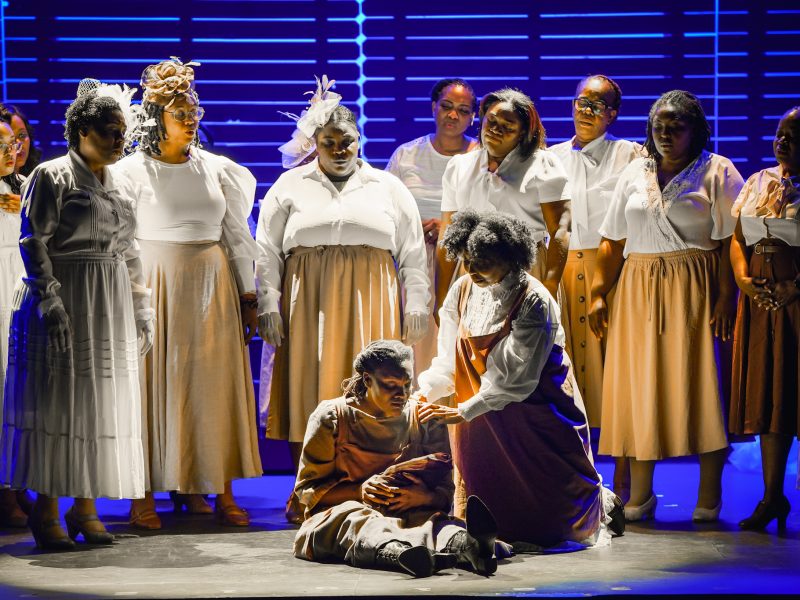
Powerful performances drive Theatre Albany’s ‘The Color Purple’
From the street, strands of purple ribbon wind around the white columns of the historic theater, hinting at the story waiting beyond its doors. Inside the foyer, a carefully curated slideshow flickers across a large screen, cycling through the faces of the cast. Some are seasoned performers. Others are stepping onto a stage for the very first time. Teachers stand alongside former students. Parents perform beside their children. People who worship in different churches, work different jobs and come from different corners of Southwest Georgia gather beneath the same lights to tell the same story.

Annual exhibition showcases southwest Georgia talent, community connections
Now in its 26th year, the exhibition features work by artists from across Southwest Georgia and offers residents an opportunity to engage directly with the area’s creative community.
