
Exhibit offers fans opportunity to ‘visit’ Downton Abbey
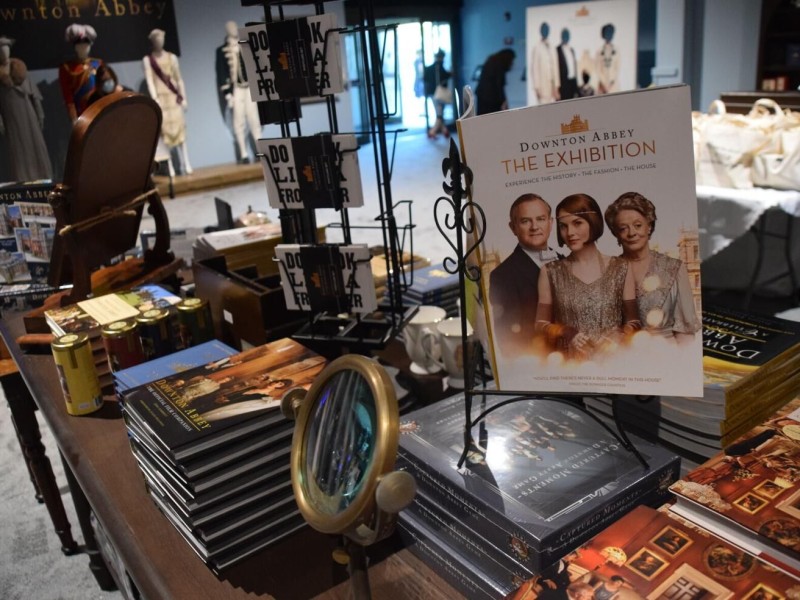
Special Photo
By Curt Yeomans
[email protected]
As visitors walk into “Downton Abbey: The Exhibition,” one of the first things they encounter is a familiar face and voice.
Mr. Carson, the butler from the British television show’s titular house, welcomes fans to the exhibit as if they are guests of the Crawley family and stepping into the house itself. It’s the first glimpse at how immersive the exhibit, which takes at least an hour to an hour and a half to get through, will end up being.
“You are cordially invited to explore the world of Downton Abbey, both the upstairs and below,” Carson tells the visitors.
“Downtown Abbey: The Exhibition” opened Sept. 25 at the Perimeter Pointe shopping center on Mount Vernon Highway in Sandy Springs. The exhibit, which offers a sneak peek behind the making of the popular television series, will remain open through mid-January 2022.
“Downton Abbey” started as a British television series that showed the lives of both members of the Crawley family as well as their servants in England between the sinking of the Titanic and the mid-1920s. It ran for six seasons, airing from 2011 to 2016 on PBS in America, and spawned a film in 2019.
A second film, “Downton Abbey: A New Era,” is scheduled to be released in March 2022.
The traveling exhibit, which is presented by NBC/Universal and Imagine Exhibitions, is the same one that was recently featured at The Biltmore Estate in Asheville, N.C.
“I personally hope that people, the fans, come here and feel like they’ve been to Downton Abbey and they didn’t have to travel to England,” Imagine Exhibitions CEO Tom Zoller said. “They only have to travel just outside the perimeter, to Perimeter Pointe, and feel like they’ve been there.
“And I think there’s a reconnection to the characters and to the franchise that is powerful. I hope they have a great time and have a smile when they walk out the door.”
The exhibition includes 11 rooms filled with recreations of sets from the show and actual props and outfits worn and used by actors in the show and the first film. There are more than 50 outfits that actors wore on the show included in the exhibit.
“All of the costumes and all of the props that you see in cases are from the show,” Zoller said. “So the dresses and the menswear, and servants’ outfits, and the jewelry and the tiaras are real, and everything you see in the cases is real.”
One of the more famous props from the show that is displayed in the exhibit is the bell wall that was used by the Crawley family to summon servants upstairs to various rooms.
Other examples of props actually used in the show that are in the exhibit include the magazine that footman Thomas Barrow was reading when he found an ad for what claimed to be a cure for homosexuality as well as the pharmacy bag that the character Anna, who was Lady Mary’s maid, received when she had to discretely pick up contraceptives for Mary. There are also several watches and pieces of jewelry that various characters wore.
Zoller pointed out that the exhibition is a one-of-a-kind experience. Although the exterior shots of the abbey — as well as shots of the main hall, dining room and drawing room — use Highclere Castle in England, the kitchen, servants quarters, family bedrooms and other residences were sets created for the TV show and its movies.
“You can’t go to England and see that kitchen,” Zoller said. “It doesn’t exist. Matter of fact, you can’t go in (Highclere) and see that dining room because it’s not set that way.
“You can go to Highclere Castle but it’s not set up (like the TV show and movies). When they come in, they completely change the place to dress it up and make it what we know as Downton Abbey.”
Some of the props show the level of detail the shows crew put into making the series as real as possible, even if the prop was facing away from the camera. These include handwritten letters between Mary and Matthew Crawley and two of the photos used in a scheme by Lady Rose Macclare’s mother in a bid to stop her daughter from marrying Atticus Aldridge.
There is even a copy of Sarah O’Brien’s handwritten resignation letter from when she informed Cora Crawl that she was resigning from her lady’s maid position. The resignation was only referred to on screen but not actually shown since O’Brien’s portrayer, Siobhan Finneran, left the show between the third and fourth seasons.
One set of items that is not actually from the show is the furniture used in the recreations of the various rooms from the house. Set pieces were still needed by the production crew while the cast was still filming the show and movies when the traveling exhibition was first created.
“When we built this, they were still filming so it’s not exactly the same, but areas where we could, we did,” Zoller said. “Otherwise, it was all sourced by the same prop people who sourced the TV series.”
The exhibit also includes video content created specifically for it featuring cast members Jim Carter, who played Mr. Carson; Phyllis Logan, who played Mrs. Hughes; Hugh Bonneville, who played Robert Crawley; and Elizabeth McGovern, who played Cora Crawley. The actors appear as their characters from the show.
Carter created the most new content for the exhibition, including the welcome video at the beginning of the exhibition, a video on dining room etiquette that plays in a recreation of Downton Abbey’s dining room, and a video at the end with Logan, Bonneville and McGovern.
Logan also filmed a video as Mrs. Hughes that plays midway through the exhibit in which she greets visitors after they walk through the abbey’s “Green Door,” which separated the servants area from the Crawley family’s living areas.
There are several sensory and interactive components to the exhibit. As visitors are walking through, some of the displays have drawers that can be pulled out to see additional props or information about the show and the era in which it took place.
There are also stations where visitors can pick up a speaker and listen to a short video talking about the era in which the show is set.
“You’ll see lots of things to explore, both from the film and TV show, as well as things that relate to the era,” Zoller said. “Remember ‘Downton Abbey’ took place between 1912 and 1926. A lot happened during that time and so we touch on some of the historical things that happened as well.”
Other interactive components of the exhibit include a station at which visitors can apply for a job at Downton Abbey and a room where video projectors give the allusion of sitting in the abbey’s drawing room with clips from the show of characters talking the in the room playing.
“My goal was to take you to Downton Abbey and then make sure you had time with those characters,” Zoller said.
Zoller said the exhibit is not intended to be a promotion for “Downton Abbey: A New Era,” but he admitted the exhibit could benefit from the upcoming film.
“Our job is to be a great experience, but of course the movie coming out in March will certainly be reminding people of (the series) and we will certainly be reminding them of the movie and back and forth,” he said.
“We were in Boston when the (first) film came out and for sure it was a great boost to sales. People loved it because it’s top of mind, right? So it helps, but the film and the exhibition are not one for the other or vice versa.”
Related Articles

Southwest Georgia artists recognized at packed opening of exhibition
The annual juried exhibition, one of the region’s largest showcases of visual art, features approximately 46 artists and nearly 90 works spanning painting, sculpture, ceramics, photography and mixed media.
Powerful performances drive Theatre Albany’s ‘The Color Purple’
From the street, strands of purple ribbon wind around the white columns of the historic theater, hinting at the story waiting beyond its doors. Inside the foyer, a carefully curated slideshow flickers across a large screen, cycling through the faces of the cast. Some are seasoned performers. Others are stepping onto a stage for the very first time. Teachers stand alongside former students. Parents perform beside their children. People who worship in different churches, work different jobs and come from different corners of Southwest Georgia gather beneath the same lights to tell the same story.

Annual exhibition showcases southwest Georgia talent, community connections
Now in its 26th year, the exhibition features work by artists from across Southwest Georgia and offers residents an opportunity to engage directly with the area’s creative community.
