
Appeals Court judges take their show on the road
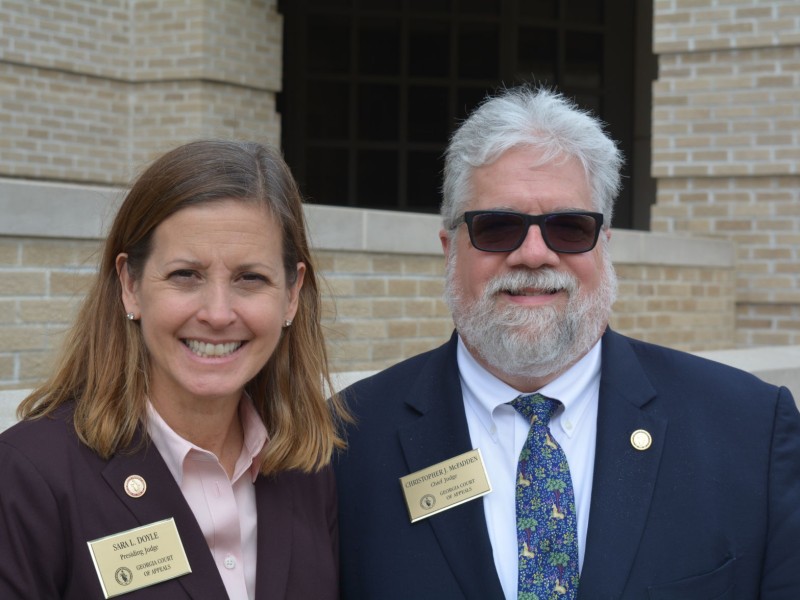
Staff Photo: Carlton Fletcher
By Carlton Fletcher
carlton.fletcher
@albanyherald.com
ALBANY — The opportunity to take their show on the road is a part of their duties that Georgia Court of Appeals Chief Judge Christopher McFadden and Presiding Judge Sara Doyle say they find rewarding.
The state Appeals Court judges, along with the third member of their appointed court panel, former Dougherty County District Attorney and current state Appellate Court Judge Ken Hodges, heard oral arguments on three cases this week at Albany State University. Such sessions are much more than a PR ploy, the judges say.
“Georgia is, I believe, the largest state geographically east of the Mississippi River,” McFadden said during a conversation before the ASU hearings. “And, thus, we are one of the largest states with a single internal appellate court. So cases from all 159 of Georgia’s counties come before us. It is, therefore, appropriate that we go before the Bar Associations and get in front of the communities in places like Valdosta, Savannah, Rome and Albany.”
Such appearances help alleviate the “mystery” of the court, Doyle added.
“There is sort of an air of mystery about what this court does,” the Presiding Judge said. “These opportunities give the communities in the state an opportunity to see us, see how we make our decisions. I think it’s even more important for young people to have this kind of opportunity.”
McFadden, who has been a part of the Appeals Court for nine years, calls his ascendancy to the Chief Judge post “the culmination of all my life’s ambitions.” So much so, he’s even decided to decline his recent nomination for appointment to the seat on the Georgia Supreme Court vacated by Justice Robert Benham.
“I’ll just say that I’m honored to be nominated and take my name from consideration,” McFadden said. “I love what I’m doing now. My father was a judge — I wear his robe in court — and while I did get my undergraduate degree in Philosophy and worked as an executive recruiter before I started law school, I think this was always in the back of my mind.
“And when I started practicing law, my ambition grew. I put in for just about every appointment that became available for a 10-year period, and even though I was partially responsible for many appellate practices, I was never on anyone’s short list.”
McFadden eventually ran for a vacant seat on the Court of Appeals and was elected to serve on the 15-member court.
Doyle, meanwhile, had no such ambition. She initially appeared destined to be “an English teacher who worked with the dance and cheerleading teams.” But life altered her plans.
“I did not grow up in a household of lawyers,” she said. “But many of my friends were applying to law school, and I just didn’t have a real interest in business. So I decided to apply for law school as well. Once I got in, I fell in love with the law.
“I never thought I’d be a judge, though. But I’d done a wide variety of things as a litigator, and the things I enjoyed most were among the things judges do. Another woman about my age got an appointment as a State Court judge, and when a member of the Appeals Court stepped down I spent a day researching what the court does. I had limited knowledge — I’d had maybe 14 cases before the court — of what the court did, but the more I read , the more intrigued I became.”
Doyle, too, was elected to the court.
As Chief Judge, McFadden has the responsibility of “court cat-herder.” He is in charge of assigning the five three-judge panels that consider the 2,200 direct appeals that are filed each year. Each appeal is considered by the panels, and any case that leads to a split decision among the judges on the panel is subject to review by the entire 15-judge Appeals Court.
Plus, the judges work under strict deadlines. If they don’t docket a case by a predetermined time, the original ruling by lower courts is automatically affirmed by law.
“We have those constitutional deadlines, so we don’t have the luxury of letting cases linger,” Doyle said. “Budgeting time becomes one of the key elements of the job. But I believe most of us consider those deadlines a benefit to ourselves and to the people involved in litigation. Put it this way: (Missing the deadline for docketing a case) has never happened in the history of the court.”
Which, McFadden notes, offers its own kind of motivation.
“Everyone is determined not to be the first,” the Chief Judge said.
The Georgia Appeals Court is currently one judge short of its 15-judge makeup. Judge Herb Phipps is serving as a substitute while Gov. Brian Kemp considers a short list of nominees to fill the post held by Judge Stephen Goss of Albany. Goss took his life last year, and Kemp will appoint his replacement.
“Judge Phipps is certainly an excellent person filling in in that slot,” McFadden said. “I served on a panel with Judge Goss, and while neither he nor I is the kind to carry a conversation among a group of people, I really looked forward to being his friend for many years. Everyone respected the work he did nationwide with the accountability courts, and it was because of his work with the National Judicial College that that group entered into a partnership with us.
“He is greatly missed.”
Doyle, too, said she was touched by Goss.
“I didn’t know him well, but when the Judicial Council met he’d come around and pass out candy to everyone,” she said. “When he learned I avoided sugar, he’d make a point to bring me sugar-free gum. The work he did nationally with the accountability courts was very important. I was super shocked when I learned of his passing. He was a very kind man.”
As they talk of the cases they’ve heard during their time as judges, Doyle remembers in particular a case in which a woman was babysitting her daughter’s dog when the woman was found deceased. Her daughter’s home was located adjacent to Savannah marshland, and there was evidence that an alligator had taken a bite out of the deceased woman.
“The question was whether the condominium association had liability for the alligator being on the premises,” Doyle said. “That’s a case that went to the Supreme Court for a final ruling. Chief Justice (Harold) Melton announced that there should have been a reasonable expectation for alligators to be in that area, and he confirmed that there was no liability.”
McFadden remembers a ruling he made on an environmental case involving the terminology “wrested vegetation” written into a state law.
“Sometimes the language the General Assembly uses is not perfect, and this was one of those cases,” he said. “It involved how close a developer could build to water. I read that the statute, as written, provided limitations. The Supreme Court later interpreted the law differently and said the statute didn’t apply, and they reversed the ruling.”
As the judges became more comfortable with the conversation, they let down their reserve a bit and let The Herald in on one of their guilty pleasures: the Atlanta Bar Association’s “Bard Show,” which has been held since 1999. In it, lawyers write, produce, sing, act and direct a full-blown musical review.
“Sara and I have been in it pretty regularly,” McFadden said. “I think it’s safe to say we’re both ‘single-threats,’ talentwise. Sara is a marvelous dancer, and I’m a pretty good amateur actor. Other than that … no.”
Related Articles

Southwest Georgia artists recognized at packed opening of exhibition
The annual juried exhibition, one of the region’s largest showcases of visual art, features approximately 46 artists and nearly 90 works spanning painting, sculpture, ceramics, photography and mixed media.
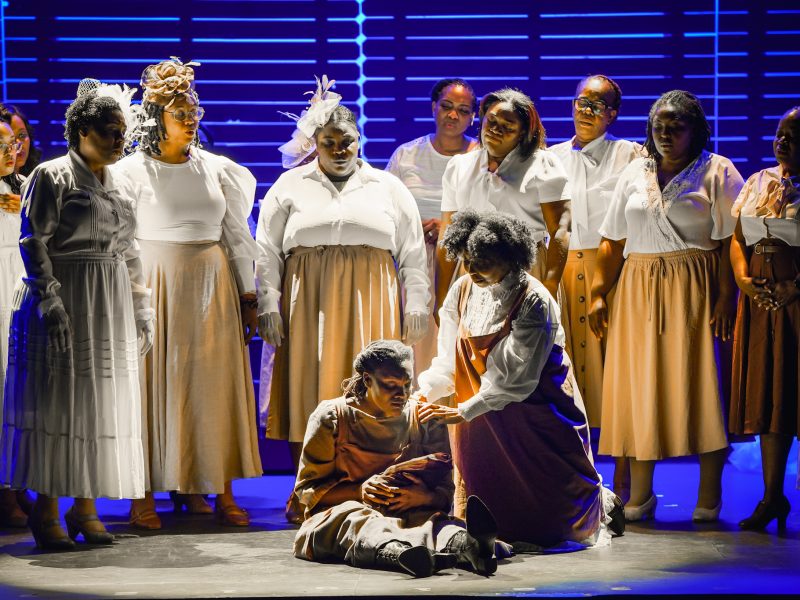
Powerful performances drive Theatre Albany’s ‘The Color Purple’
From the street, strands of purple ribbon wind around the white columns of the historic theater, hinting at the story waiting beyond its doors. Inside the foyer, a carefully curated slideshow flickers across a large screen, cycling through the faces of the cast. Some are seasoned performers. Others are stepping onto a stage for the very first time. Teachers stand alongside former students. Parents perform beside their children. People who worship in different churches, work different jobs and come from different corners of Southwest Georgia gather beneath the same lights to tell the same story.

The Worst Job in the Marines: Telling Parents Their Child Was Dead. It Was Also an Honor
Telling a family their child died in combat is something no one wants to do, but someone has to. Christopher Murphy described his service as a Casualty Assistance Calls Office as miserable but vital.

