
BARRY LEVINE: Court procedurals, game shows TV taples
THE OLD ROCKER: ‘Perry Mason’ groundbreaking series in courtroom genre
By Barry Levine
Editor’s Note: Second of a two –part series on the evolution of TV genres.
Television has been inundated with police procedure shows during the past seven decades, but that is not the case with legal shows.
“Perry Mason” was the first major legal show, airing from 1957 to 1966.
Raymond Burr played the title character, a fictional Los Angeles criminal defense lawyer who originally appeared in books by Erle Stanley Gardner.
The first weekly one-hour series filmed for television, “Perry Mason” was one of TV’s longest-running and most successful legal series. Co-starring on the show were Barbara Hale as Mason’s secretary, Della Street, William Hopper as Paul Drake, Mason’s private investigator, and William Talman as District Attorney Hamilton Burger.
Two other one-hour legal dramas had major impacts.
Steven Bochco and Terry Louise Fisher created “L.A. Law,” which aired 1986-1994. The show had a large cast of regulars and focused on off-the-wall humor and also reflected the social and cultural ideologies of the 1980s and early 1990s. Many of the cases featured hot issues such as capital punishment, abortion, racism, gay rights, homophobia, AIDS and domestic violence. The show captured 15 Emmy Awards, four of which were for Outstanding Drama Series.
Running from 1986-1995, “Matlock” starred Andy Griffith as Ben Matlock, a frugal, hot dog-eating Atlanta legal attorney.
Co-starring on the show at various times were Kene Holliday as Tyler Hudson and Clarence Gilyard Jr., as Conrad McMasters, Matlock’s private investigators; Julie Sommars as Julie March, a district attorney who became Matlock’s close friend; Daniel Roebuck as Cliff Lewis, Ben’s last partner and private investigator; and Warren Frost as Billy Lewis, Matlock’s childhood friend and Cliff Lewis’ father.
Among the other legal procedure shows were “The Defenders” (1961-65), Owen Marshall: Counsellor at Law (1971-74), “Night Court” (1984-92), “Jake & The Fatman” (1987-92), “Jag” (1995-2005), “Ally McBeal” (1997-2002), “The Practice” (1997-2004), “Judging Amy” (1999-2005) and “Boston Legal” (2004-08).
While there were a limited number of quality legal procedure shows, quiz shows have long had a major role in TV programming.
The year 1950 was important for quiz programming as three different types of shows – “What’s My Line,” “Beat the Clock” and “You Bet Your Life” — made their debuts.
“What’s My Line” was a panel game show that was broadcast 1950-1967.
The game required celebrity panelists to question a contestant in order to determine his or her occupation. Panelists also had to identify a weekly celebrity “mystery guest.” John Daly served as the show’s moderator with regular panelists Dorothy Kilgallen, Arlene Francis and Bennett Cerf. A celebrity panelist was also a regular feature.
The original “Beat the Clock” aired 1950-1961 with Bud Collyer serving as the host.
The premise of the show was simple: Contestants were required to perform tasks within a certain timeframe, which was counted down on a large 60-second clock. If they succeeded, they were said to have “beaten the clock.” Contestants were chosen from the studio audience and usually were married couples.
The cigar-chomping, mustachioed Groucho Marx of the famous Marx Brothers served as the host for “You Bet Your Life” from its inception in 1950 through its final season in 1961.
Contestant teams usually consisted of one male and one female selected from the studio audience.
Marx was introduced to the first two contestants and engaged in humorous repartee in which he would improvise his responses or employ prepared lines from the show’s writers using pre-show interviews.
Some show tension revolved around whether a contestant would say the “secret word,” a common word revealed to the audience at the beginning of each episode. If one of the contestants said the word, a toy duck resembling Groucho descended from the ceiling to bring a $100 prize, which would then be divided equally between that two-person team.
After the contestants’ introduction and interview, couples were allowed to choose from a list of 20 available categories before the show; then they tried to answer a series of questions within that category.
Some of the questions were:
“Who is buried in Grant’s Tomb?”
“When did the War of 1812 start?”
“How long do you cook a three-minute egg?”
“What color is an orange?”
The decade of the 1950s was one of the most interesting involving quiz shows.
The “$64,000 Question” (1955-58) and “Twenty-One” (1956-58) dominated the evening fare – until the scandals hit and nearly destroyed the quiz show genre. Hal March hosted the “$64,000 Question” and Jack Barry “Twenty-One.”
The scandals revealed contestants secretly were given assistance by the show’s producers to arrange the outcome of an alleged fair competition.
“The $64,000 Question” was the first big-money TV quiz show.
In 1955, Dr. Joyce Brothers, a psychologist, earned fame by becoming the first woman to earn the $64,000 prize winning on her knowledge of boxing. It was revealed later that the show’s producers did not want her to win and deliberately gave her questions perceived to be beyond her knowledge, which she managed to answer correctly. “The $64,000 Question” was one of the game shows ultimately implicated to be rigged.
In 1956, “Twenty One” featured champion Herb Stempel, who had been coached by producer Dan Enright to allow his opponent, Charles Van Doren, a Columbia University professor, to win the game. Stempel took the fall as requested of him.
A year later, Stempel said his run as champion had been choreographed and that he had been ordered to purposely lose his championship to Van Doren.
Quiz show ratings across the networks plummeted and several were cancelled amidst allegations of fixing.
Among the other quiz shows that debuted during the 1950s were “I’ve Got a Secret” (1952-67),”Name that Tune” (1953-59, 74-81), “People Are Funny” (1954-60), “Tic-Tac-Dough” (1953-59, 78-86), “To Tell the Truth” (1956-2010) “The Price is Right” (1956-present), “Who Do You Trust” (1957-63) and “Concentration” (1958-91).
Barry “The Old Rocker” Levine is an entertainment writer for The Albany Herald. He can be reached at [email protected].
Related Articles

‘Sounds Like a Mutiny.’ Secret Recording Exposes Claims of Toxic Leadership After a Marine’s Suicide
This week’s War Horse story follows the systemic failures before and after the death of Cpl. Drew Mobley who was the third in two years at Marine Corps Base Quantico to die by suicide.

Southwest Georgia artists recognized at packed opening of exhibition
The annual juried exhibition, one of the region’s largest showcases of visual art, features approximately 46 artists and nearly 90 works spanning painting, sculpture, ceramics, photography and mixed media.
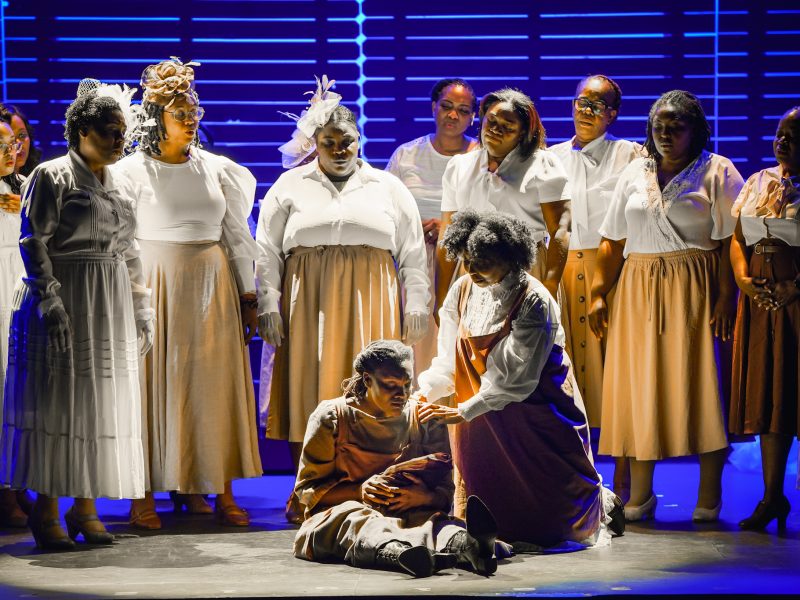
Powerful performances drive Theatre Albany’s ‘The Color Purple’
From the street, strands of purple ribbon wind around the white columns of the historic theater, hinting at the story waiting beyond its doors. Inside the foyer, a carefully curated slideshow flickers across a large screen, cycling through the faces of the cast. Some are seasoned performers. Others are stepping onto a stage for the very first time. Teachers stand alongside former students. Parents perform beside their children. People who worship in different churches, work different jobs and come from different corners of Southwest Georgia gather beneath the same lights to tell the same story.
