
BARRY LEVINE: Irish songs mark St. Paddy’s Day
THE OLD ROCKER: From Danny Boy to Thin Lizzy, Emerald Isle honored

By Barry Levine
“Oh Danny boy, the pipes, the pipes are calling, From glen to glen, and down the mountainside. The summer’s gone, and all the flowers are dying. ‘Tis you, ‘tis you must go and I must bide.”
Danny Boy by Frederic Weatherly, 1913
For those of you who will make the 250-mile, four-hour trek to Savannah on Saturday for the state’s – and one of the country’s — biggest St. Patrick’s Day celebrations, you will hear some of the finest music about “The Emerald Isle.”
Here are some of the most popular Irish songs that probably will be heard during the Savannah festivities:
First published in 1912, “When Irish Eyes Are Smiling” is a lighthearted song written as a tribute to Ireland.
Chauncey Olcott and George Graff Jr. wrote the song’s lyrics for Olcott’s production of “The Isle O’ Dreams” at the Grand Opera House in New York in 1913.
The play survived 32 performances, while “When Irish Eyes are Smiling” has been a St. Patrick’s Day staple for more than 100 years.
The song continued to be a familiar standard for generations and has been recorded on more than 200 singles and albums and by many famous singers, including Bing Crosby, Connie Francis and Roger Whittaker.
One of the most popular Irish songs, “Danny Boy” is a ballad set to an ancient Irish melody. The words were written by English songwriter and attorney Frederic Weatherly and usually set to the Irish tune of the “Londonderry Air.” It was published in 1913.
The song is popular for funerals, but its suitability as a funeral song is sometimes questioned.
“Danny Boy” has been covered by singers including Mario Lanza, Bing Crosby, Andy Williams, Johnny Cash, Sam Cooke, Elvis Presley, Jackie Wilson, Harry Belafonte and Tom Jones.
“Too-Ra-Loo-Ra-Loo-Ral (That’s an Irish Lullaby)” is a classic Irish-American song written in 1913 by James Royce Shannon for the musical “Shameen Dhu.”
The original recording of the song, by Chauncey Olcott, peaked at No. 1 on the music charts.
The song returned to prominence because of Bing Crosby’s rendition in the 1944 Oscar-winning movie “Going My Way.” Crosby starred in the film as Father Chuck O’Malley, Barry Fitzgerald as Father Fitzgibbon and Frank McHugh as Father Timothy O‘Dowd. Crosby and Fitzgerald won Oscars for Best Actor and Best Supporting Actor, respectively.
Crosby’s single of “Too-Ra-Loo-Ra-Loo-Ral (That’s an Irish Lullaby)” sold more than 1 million copies and peaked at No. 4.
Written by J.M. Crofts, “The Irish Rover” is an Irish folk song about a magnificent, though improbable, sailing ship that crashed while going from Ireland to the Americas. It has been recorded by numerous artists, some of whom have made changes to the lyrics.
The song describes a gigantic 27-masted ship with a colorful crew and varied types of cargo. The verses grow more extravagant about the wonders of the great ship. The seven-year voyage came to a disastrous end after losing its way in the fog, striking a rock, and spinning nine times around before sinking with most of the crew and the captain’s old dog aboard – everyone except the singer, who in the last line of the song is revealed to be the lone survivor of The Irish Rover’s ill-fated voyage, so there is no one alive to contradict the tale.
An old Irish war song, “Whiskey in the Jar” was first recorded by the Dubliners and has been covered by multiple artists. The song’s lyrics are still popular today and many people enjoy listening to the original version as well as remakes of this song.
The song is the tale of a highwayman who, after robbing a military or government official, is betrayed by a woman. It is unclear whether she is his wife or sweetheart.
“Finnegan’s Wake” is a ballad that arose during the 1850s in the music-hall tradition of comical Irish songs.
The song was a staple of the Irish folk-music group the Dubliners, who played it on many occasions and included it on several albums, and is especially well-known to fans of the Clancy Brothers, who have performed and recorded it with Tommy Makem.
In the ballad, Tim Finnegan was born “with a love for the liquor,” falls from a ladder, breaks his skull, and is thought to be dead. The mourners at his wake became rowdy and spilled whiskey over Finnegan’s corpse, causing him to come back to life and join in the celebration.
Whiskey caused both Finnegan’s fall and his resurrection.
“Molly Malone” tells the fictional tale of a fishmonger who plied her trade on the streets of Dublin, but who died young of a fever.
In the late 20th century, a legend grew that there was a historical Molly, who lived in the 17th century. She is typically represented as a hawker by day and part-time prostitute by night.
In contrast she has also been portrayed as one of the few chaste female street-hawkers of her day. However, there is no evidence that the song is based on a real woman of the 17th century or at any other time. The name “Molly” originated as a familiar version of the names Mary and Margaret. While many such “Molly” Malones were born in Dublin throughout the centuries, no evidence connects any to the events in the song.
The song was not recorded before 1876, when it was published in Boston. The song’s placement in the section of the book entitled “Songs from English and German Universities” suggests a British origin.
“The Luck of the Irish” was written by former Beatle John Lennon and Yoko Ono, his wife, and was released in June 1972. The song used a folk-like melody. Lennon and Ono believed that the simplicity of a folk melody would encourage audience participation and help engage the audience in their protest.
In the verses, Lennon sings of the difficult history between England and Ireland and of the contemporary political problems in Northern Ireland resulting from the history of British colonialism. The title of the song is ironic, as Lennon sings that the luck of the Irish has been bad, and “if you had the luck of the Irish, you’d wish you was (sic) English instead.” The melody also provides an ironic contrast to the Lennon accusations of British atrocities, including rape, torture and genocide.
“The Boys are Back in Town” was recorded by Thin Lizzy, an Irish rock band. The song talks about a group of friends returning home and having a good time with each other.
“The Boys Are Back in Town” was originally released in 1976 on the Thin Lizzy album “Jailbreak.”
“Zombie” by the Irish rock band The Cranberries is a protest song written about the 1993 IRA bombing in Warrington, and in memory of two young victims, Johnathan Ball and Tim Parry. It was released in September 1994 as the lead single from their studio album, “No Need to Argue.” The song was written by the band’s lead singer Dolores O’Riordan, and reached No. 1 on the charts in Australia, Belgium, France, Denmark and Germany.
“Galway Girl” is a modern Irish love song performed by Steve Earle and Sharon Shannon. This song became the most popular Irish song during the past 20 years. “The Galway Girl” was featured on Earle’s 2000 album “Transcendental Blues.” “The Galway Girl” tells the semi-autobiographical story of Earle’s reaction to a beautiful black-haired, blue-eyed girl he met in Galway, Ireland.
This song has been covered more than 150 times.
Barry “The Old Rocker” Levine is an entertainment writer for The Albany Herald. He can be reached at [email protected].
Related Articles

‘Sounds Like a Mutiny.’ Secret Recording Exposes Claims of Toxic Leadership After a Marine’s Suicide
This week’s War Horse story follows the systemic failures before and after the death of Cpl. Drew Mobley who was the third in two years at Marine Corps Base Quantico to die by suicide.

Southwest Georgia artists recognized at packed opening of exhibition
The annual juried exhibition, one of the region’s largest showcases of visual art, features approximately 46 artists and nearly 90 works spanning painting, sculpture, ceramics, photography and mixed media.
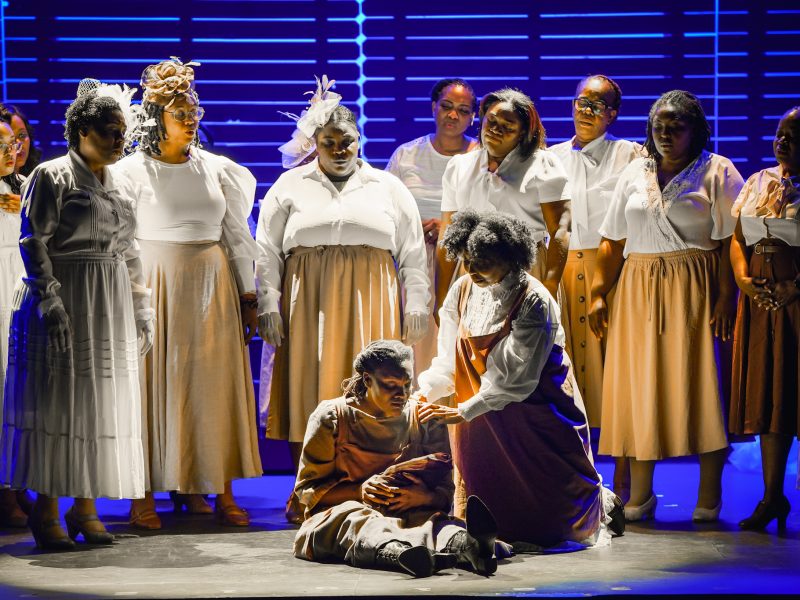
Powerful performances drive Theatre Albany’s ‘The Color Purple’
From the street, strands of purple ribbon wind around the white columns of the historic theater, hinting at the story waiting beyond its doors. Inside the foyer, a carefully curated slideshow flickers across a large screen, cycling through the faces of the cast. Some are seasoned performers. Others are stepping onto a stage for the very first time. Teachers stand alongside former students. Parents perform beside their children. People who worship in different churches, work different jobs and come from different corners of Southwest Georgia gather beneath the same lights to tell the same story.
