
BARRY LEVINE: Pick six great football flicks
THE OLD ROCKER: Certain films capture the spirit of the gridiron
By Barry Levine
In football parlance, the term “pick six” means an interception that was returned for a touchdown.
In “Old Rocker” parlance, pick six means the top six selections in a particular category, in this case the six best football films of all time.
Here are the Old Rocker’s selections of the best football films. The selections are listed in the order of their release.
“Brian’s Song” – The 1971 ABC-TV Movie of the Week revealed the details of the life of Brian Piccolo, a Wake Forest University football player who was stricken with terminal cancer after joining the Chicago Bears, and his relationship with teammate Gale Sayers. James Caan played the outgoing Piccolo, who died in June 1970, and Billy Dee Williams portrayed the reserved Sayers. What helped make the movie so special was the differing temperaments and racial backgrounds that made the running backs unlikely to become close friends, including becoming the first interracial roommates in the history of the National Football League. The film won an Emmy for Best Dramatic Program during the 1971–72 awards season.
“The Longest Yard” — The film focused on an imprisoned former NFL quarterback Paul “Wrecking” Crewe, played by Burt Reynolds, who recruited a group of prisoners to play a football game against their guards. The 1974 movie was shot on location at Georgia State Prison in Reidsville, and it had the cooperation of then-Gov. Jimmy Carter. Filming was occasionally delayed due to prison uprisings. Crewe scored the winning touchdown in the game as time expired to give the “Mean Machine” a victory over the guards.
“Rudy” – The 1993 film centers on the life of Rudy Ruettiger, whose primary goal was to play football at the University of Notre Dame, despite being undersized at 5-foot-6 and 170 pounds. It was the first movie that Notre Dame’s administration allowed to be shot on campus since “Knute Rockne, All American” in 1940. Played by Sean Astin, Rudy was involved in all of Notre Dame’s practices but never suited up for a game until the final contest of his senior year in 1975. He appeared late in the game on the kickoff team and remained on the field for the next play to sack the Georgia Tech quarterback Rudy Allen.
“Remember The Titans” – The movie is based on the true story of Herman Boone, an African-American football coach portrayed by Denzel Washington, and his attempt to integrate the T. C. Williams High School football team in Alexandria, Va., in 1971. Will Patton played Bill Yost, Boone’s white assistant who was bypassed for the head coaching job. The 2000 film followed the team through the season and winning the state championship. It also closely followed how black and white players changed their attitudes toward each other as the season progressed.
“We Are Marshall” – The 2006 film depicts the aftermath of the November 1970 airplane crash that killed 37 Marshall University football players, five coaches, two athletic trainers, the athletic director, 25 boosters and a crew of five after the Thundering Herd’s loss to East Carolina. The movie centered on the rebuilding of the program and the healing that the community underwent. Matthew McConaughey starred as head coach Jack Lengyel, with Matthew Fox as assistant coach William “Red” Dawson. Then-Gov. Sonny Perdue of Georgia had a cameo role as an East Carolina University football coach. Marshall’s first post-crash triumph was a 15–13 win against Xavier University in the team’s first home game of the season.
“The Blind Side” — The story featured Michael Oher, an African-American offensive lineman who was drafted by the NFL’s Baltimore Ravens in 2008. He was with the Ravens when they won the Super Bowl three years later. The 2009 film followed Oher from his impoverished upbringing, through his years at Wingate Christian School in Memphis, his adoption by Sean and Leigh Anne Tuohy, a wealthy white family, to his position as one of the most highly coveted prospects in college football and finally becoming the Ravens’ first-round pick. Quinton Aaron starred as Oher, Sandra Bullock as Leigh Anne Tuohy and Tim McGraw as Sean Tuohy. Bullock won that year’s best actress Oscar and Golden Globe for her portrayal. The movie also received an Oscar nomination for best picture.
This week in rock history
The Monkees’ debut album, “The Monkees,” started a 13-week run at the top of the album chart on Nov. 12, 1966, selling more than 3 million copies in three months. James Brown’s “I Got You” entered both the Pop and R&B charts on Nov. 13, 1965, where it reached No. 3 and No. 1, respectively. Ray Charles’ version of Hoagy Carmichael’s 1930s standard “Georgia on My Mind” became the first of the Albany native’s three No. 1 hits on Nov. 14, 1960. After topping the chart with “Come Softly To Me,” The Fleetwoods had their second No. 1 song with “Mr. Blue” on Nov. 16, 1959. The Four Seasons’ “Big Girls Don’t Cry” reached the top spot on the singles chart on Nov. 17, 1962, as their first hit, “Sherry,” did earlier in the year. Songwriter Bob Crewe said that he was inspired to write the song after he heard actor John Payne use the phrase “big girls don’t cry” in a 1956 movie “Slightly Scarlet.” Glen Campbell, a former session musician who appeared on recordings by Frank Sinatra, Nat “King” Cole and the Beach Boys, received Gold records for “By the Time I Get to Phoenix” and “Gentle on My Mind” on Nov. 18, 1968.
Barry “The Old Rocker” Levine is an entertainment writer for The Albany Herald. He can be reached at [email protected].
Related Articles
‘Sounds Like a Mutiny.’ Secret Recording Exposes Claims of Toxic Leadership After a Marine’s Suicide
This week’s War Horse story follows the systemic failures before and after the death of Cpl. Drew Mobley who was the third in two years at Marine Corps Base Quantico to die by suicide.

Southwest Georgia artists recognized at packed opening of exhibition
The annual juried exhibition, one of the region’s largest showcases of visual art, features approximately 46 artists and nearly 90 works spanning painting, sculpture, ceramics, photography and mixed media.
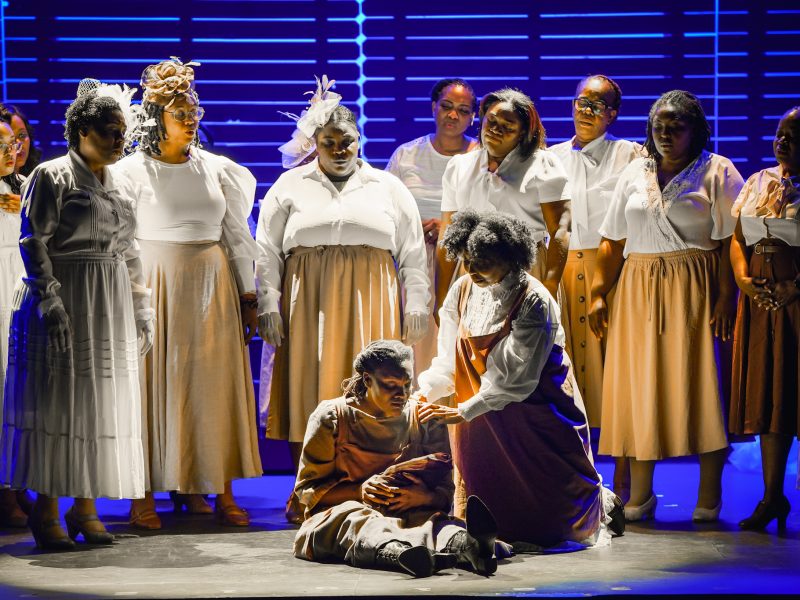
Powerful performances drive Theatre Albany’s ‘The Color Purple’
From the street, strands of purple ribbon wind around the white columns of the historic theater, hinting at the story waiting beyond its doors. Inside the foyer, a carefully curated slideshow flickers across a large screen, cycling through the faces of the cast. Some are seasoned performers. Others are stepping onto a stage for the very first time. Teachers stand alongside former students. Parents perform beside their children. People who worship in different churches, work different jobs and come from different corners of Southwest Georgia gather beneath the same lights to tell the same story.
