
Clennon King: Lynching Memorial unfairly gives Dougherty County a bad name
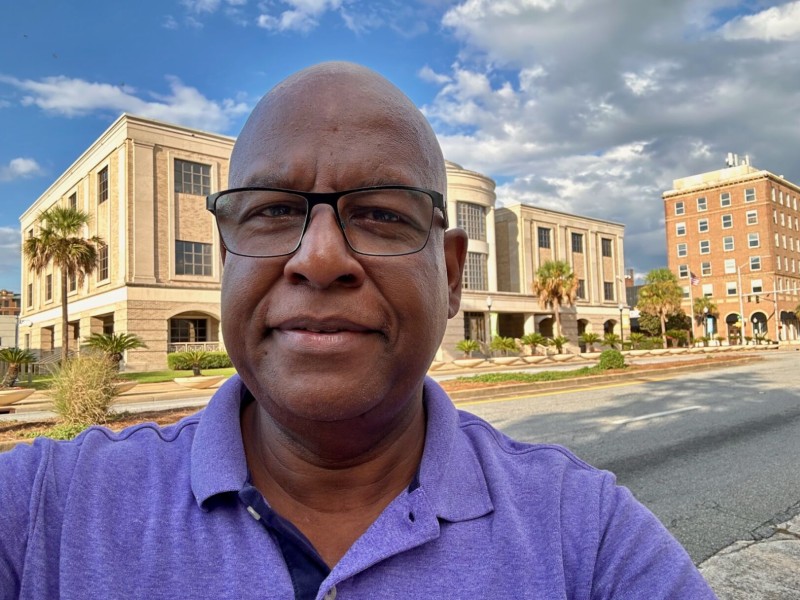
Special Photo: Clennon King
Staff Reports
[email protected]
ALBANY — A black Georgia-based historian has asked a nationally recognized lynching memorial to remove his county’s name from the site, due to false, unsupported claims.
Historian and documentary filmmaker Clennon L. King made the request of The Equal Justice Initiative after its National Memorial for Peace and Justice erroneously listed Dougherty County as the place where two black men were lynched in 1906 and 1920.
“The bodies of both victims were in fact found in neighboring counties, and not Dougherty at all,” said King, an award-winning documentary filmmaker who earlier this year produced a five-minute film, noting no lynching had ever taken place in Dougherty County.
Multiple records confirm the lynchings did not occur in the southwest Georgia county, whose county seat is Albany, a claim King said is supported by the published works of historian W.E.B. Du Bois, Albany State University founder Joseph W. Holley and the Atlanta Journal and Constitution.
“No one’s denying lynchings took place in the region, but it’s irresponsible to mislead the public and give a place a bad name, because researchers chose to broadstroke, connecting dots that simply weren’t there,” King said.
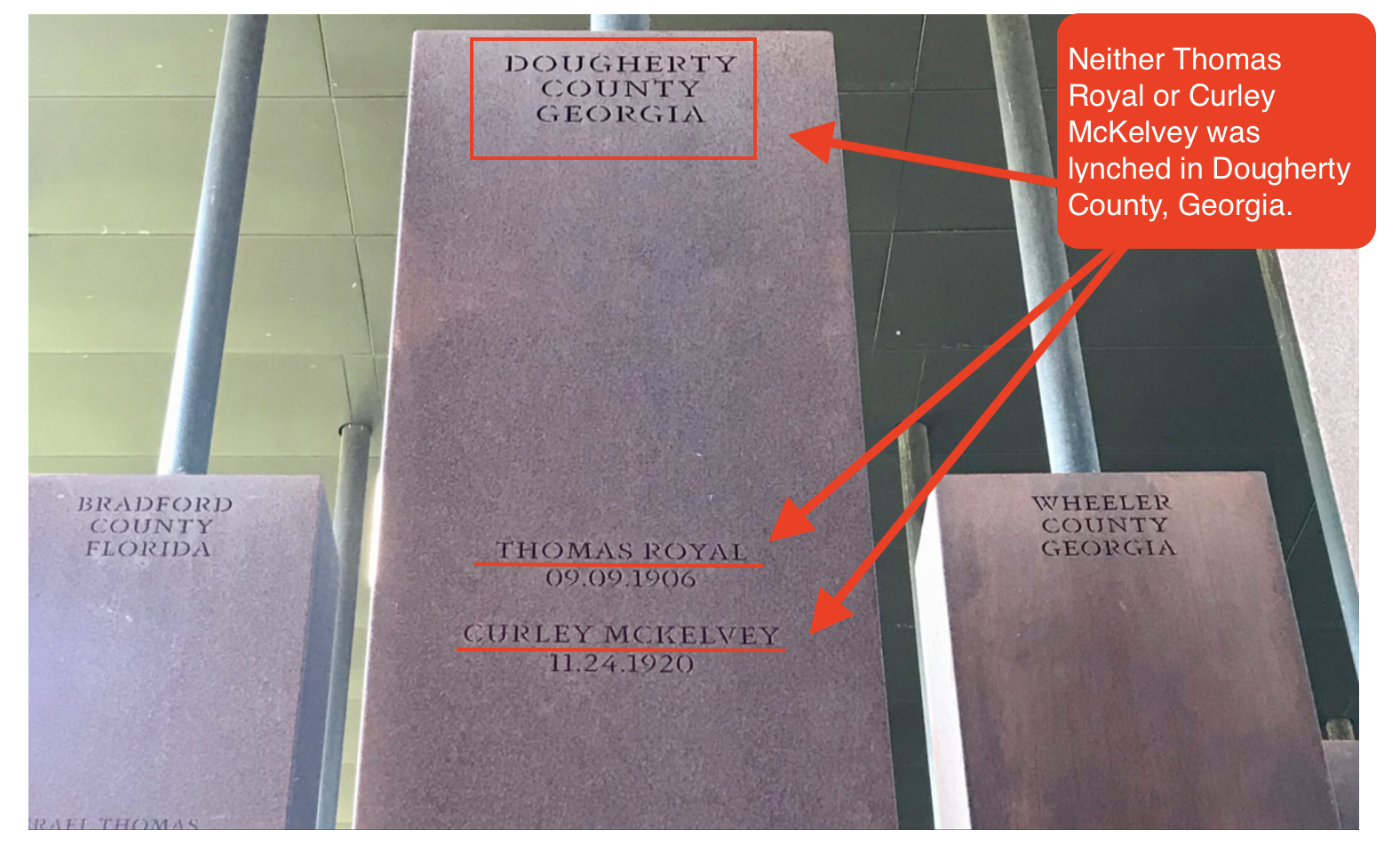
Revelation of the error first came to King’s attention after a January 2020 visit to the renowned EJI memorial, where hundreds of steel columns, suspended from the ceiling and laying in a nearby field, host the names of lynching victims by county, nationwide.
Appearing under “Dougherty County, Georgia” are the names of “Thomas Royal 09.09.1906” and “Curley McKelvey 11.24.1920.”
After researching the matter, King emailed the nonprofit this past August, requesting it provide evidence to support its display of two identical columns bearing Dougherty County’s name in association with Royal’s and McKelvey’s lynching deaths.
King received a news brief and article from EJI senior racial violence researcher Jacob Hoerger, neither of which, he said, supported the deaths taking place within the corporate limits of Dougherty County.
In a follow-up email and letter, King asked Hoerger and his boss, EJI director Bryan Stevenson, to remove any reference to Dougherty County from the lynching memorial, supplementing his request with additional news articles, maps, property deeds and tax records that verify, he said, that Royal was found in Worth County and McKelvey was found in Mitchell County.
“Unfortunately, EJI’s claim flies in the face of an established reputation Dougherty County had for serving as a safe haven and refuge for black people during Reconstruction and Jim Crow,” King said.
To underscore this, he pointed to the 1903 work, “The Souls of Black Folk,” in which Du Bois expressly notes “blacks outnumber the whites four or five to one” in Dougherty County, interpreting the imbalance as “huddling for self-protection.”
In a Sunday, February 25, 1917 article on statewide lynchings, The Atlanta Journal and Constitution reported, “Dougherty county [sic] has never had a lynching at any time in the past.”
And in his 1948 memoir “You Can’t Build a Chimney From The Top,” Albany State University founder Joseph W. Holley wrote, “It should be noted there has never been a lynching in this county (Dougherty).”
To date, King said neither Stevenson nor Hoerger, a Harvard-trained PhD, have issued a response.
King wrote and produced a five-minute documentary entitled, “How Albany Became Georgia’s Blackest Major City,” noting the county’s role as a safehouse for blacks.
King’s published print work and photography have appeared in multiple publications, including The Atlanta Journal and Constitution, Boston Magazine, (Martha’s) Vineyard Gazette, The Washington Post, The Boston Globe and NBC.com.
He is developing a 20-address virtual black heritage trail for Dougherty County, having completed two years ago a 27-address digital heritage trail in Boston around the love story of Martin and Coretta King.
His award-winning documentaries have been screened by Harvard University, Dartmouth College and the National Park Service in New York City. They include the feature-length “Passage at St. Augustine,” which earned the Henry Hampton Award of Excellence in Documentary Filmmaking at the Roxbury International Film Festival in 2015.
King’s hourlong “Fair Game: Surviving A 1960 Georgia Lynching” prompted a south Georgia district attorney’s office to re-open a 60-year-old Jim Crow era rape and murder case in 2019.
And his eight-minute documentary short “The Boston Photograph” received heavy rotation on the film festival circuit in 2022, securing three awards.
Before entering documentary filmmaking, King spent the bulk of his career as a TV news journalist, during which his reporting earned both a regional and national Edward R. Murrow award and Emmy nomination. His stops included WSB Atlanta, WGBH Boston, KXAS Dallas, WSVN Miami, WTLV/WJXX Jacksonville and WALA Mobile.
King is a native of Albany and Dougherty County, home to his documentary filmmaking practice.
Author

Related Articles

Southwest Georgia artists recognized at packed opening of exhibition
The annual juried exhibition, one of the region’s largest showcases of visual art, features approximately 46 artists and nearly 90 works spanning painting, sculpture, ceramics, photography and mixed media.
Powerful performances drive Theatre Albany’s ‘The Color Purple’
From the street, strands of purple ribbon wind around the white columns of the historic theater, hinting at the story waiting beyond its doors. Inside the foyer, a carefully curated slideshow flickers across a large screen, cycling through the faces of the cast. Some are seasoned performers. Others are stepping onto a stage for the very first time. Teachers stand alongside former students. Parents perform beside their children. People who worship in different churches, work different jobs and come from different corners of Southwest Georgia gather beneath the same lights to tell the same story.
The Worst Job in the Marines: Telling Parents Their Child Was Dead. It Was Also an Honor
Telling a family their child died in combat is something no one wants to do, but someone has to. Christopher Murphy described his service as a Casualty Assistance Calls Office as miserable but vital.

