
CREEDE HINSHAW: Church concern: Managing God and mammon
By Creede Hinshaw
[email protected]
It’s not often a prominent weekly newsmagazine devotes ink to how a church should invest its money. But the weekly Economist newsmagazine’s recent issue (Jan. 28, page 68) carried an article entitled “God and mammon: Christian Finance.”
The unattributed article asked: “Is it possible to manage money successfully and be a virtuous Christian?” I have enough trouble managing the money in my wallet and can use all the help I can get, but that was not the focus of the Economist article. The article examined whether a Christian institution (church, church agency, parachurch organization) could invest its money wisely, ethically and profitably.
Many of the congregations I served over the years never had to ask this question because, having had checkbooks resembling the seven starving cows in Pharoah’s dream, they had no money to invest. They could only dream of crafting an investment strategy.
But larger congregations have multiple checking and savings accounts, endowed accounts and large bequests. And denominations have lots of money in multiple accounts, a phenomenon Jesus could never have envisioned. One can debate whether the church should be proud of itself or ashamed of itself for holding on to so much money; one estimate suggests Protestants and Catholics together might have $21 trillion to invest. From past experience, I can say it was always much easier to be the pastor of a church with a flush bank account than its opposite, even though the money brought on a whole new set of problems.
What should churches — or church agencies — do with the mammon sitting in various accounts? The Economist, turning a clever phrase, identified this question as a “moral minefield” that affects in “the here-and-now, not just the hereafter.”
The five-paragraph Economist article could barely scratch the surface of this knotty problem. Nor could a recent Wall Street Journal article (Feb. 6) do better in an article headlined “Why It’s so Hard to be an ESG Investor.”
The reality is that every church with interest-bearing money has an investment strategy, even if the unstated strategy is to earn as much money as possible, no holds barred. Most churches and agencies, however, have established stringent guidelines. My United Methodist Church, for instance, forbids churches to invest in certain businesses, including alcohol, tobacco and armaments.
The Economist cited my church’s own pension agency, then went on to cite a Catholic investment document and an evangelical Christian investment approach. Although each of these came at the management of their money differently, each of them had gone through a prayerful, conscientious process of deciding how to invest and what investments to avoid.
It is likely that the ordinary churchgoer has never considered how his/her congregation or denomination might invest their funds, but those entrusted with this management must do so intentionally and deliberately. There are businesses I won’t invest in (gambling, firearms, others). I suspect you have your lists, too. The church, too, has an imperative to invest morally, ethically and wisely.
Author
Related Articles

‘Sounds Like a Mutiny.’ Secret Recording Exposes Claims of Toxic Leadership After a Marine’s Suicide
This week’s War Horse story follows the systemic failures before and after the death of Cpl. Drew Mobley who was the third in two years at Marine Corps Base Quantico to die by suicide.

Southwest Georgia artists recognized at packed opening of exhibition
The annual juried exhibition, one of the region’s largest showcases of visual art, features approximately 46 artists and nearly 90 works spanning painting, sculpture, ceramics, photography and mixed media.
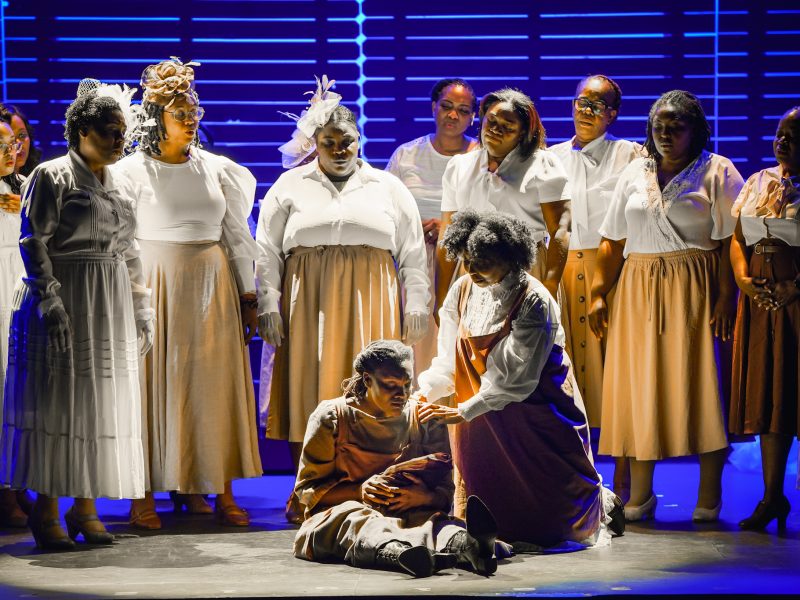
Powerful performances drive Theatre Albany’s ‘The Color Purple’
From the street, strands of purple ribbon wind around the white columns of the historic theater, hinting at the story waiting beyond its doors. Inside the foyer, a carefully curated slideshow flickers across a large screen, cycling through the faces of the cast. Some are seasoned performers. Others are stepping onto a stage for the very first time. Teachers stand alongside former students. Parents perform beside their children. People who worship in different churches, work different jobs and come from different corners of Southwest Georgia gather beneath the same lights to tell the same story.
