
Instant gratification for pickle lovers
TasteFood: Quick Summer Pickles
By Lynda Balslev
TasteFood
When summer yields more vegetables than you can shake a stick at, it’s time to quick pickle. Quick pickling is one of the easiest ways to preserve a bounty of vegetables and a simple method to keep your veggies on hand for munching. The method differs from canning, in that the veggies simply brine in jars in the refrigerator for a day or up to a month before eating. This is pickling meant for instant gratification, which is what I am all about when it comes to pickles.
My family and I adore pickles, and if there are any in our house, there is no chance they will last more than a week before they’re gobbled up. Quick pickling is the perfect way to give us our fix.
Luckily, when it comes to pickles, we are not dependent on the season and the need to preserve healthy produce into the winter. The entire year is a bounty. Summer’s garden harvest gives way to autumn and winter vegetables, such as peppers, squash, cruciferous and root vegetables, providing a continual rotation of fresh veggies changing up in time before you tire of the season’s current yield.
For the pickle brine, I use an equal part vinegar to water and prefer it not too sweet. I often use apple cider vinegar, which is mellow, slightly fruity, and seems to get along with every vegetable. White vinegar, rice vinegar, even balsamic vinegar (think strawberries — yes you can pickle fruit, too!) are also worth experimenting with. Add herbs and aromatics to your taste, such as garlic, thyme, dill, oregano, rosemary, ginger and bay leaves.
For seasonings, use peppercorns, mustard seeds, fennel seeds, coriander seeds, cumin seeds, even allspice, and be sure to toast the seeds first to enhance their flavor. For a kick of heat, add jalapeno peppers to the vegetables or chili flakes to the brine. The sky is pretty much the limit, and with the speed and flexibility of quick pickling, you can tweak to your taste.
Quick Summer Pickles
Active Time: 30 minutes
Total Time: 24 hours
Yield: makes 2 quarts
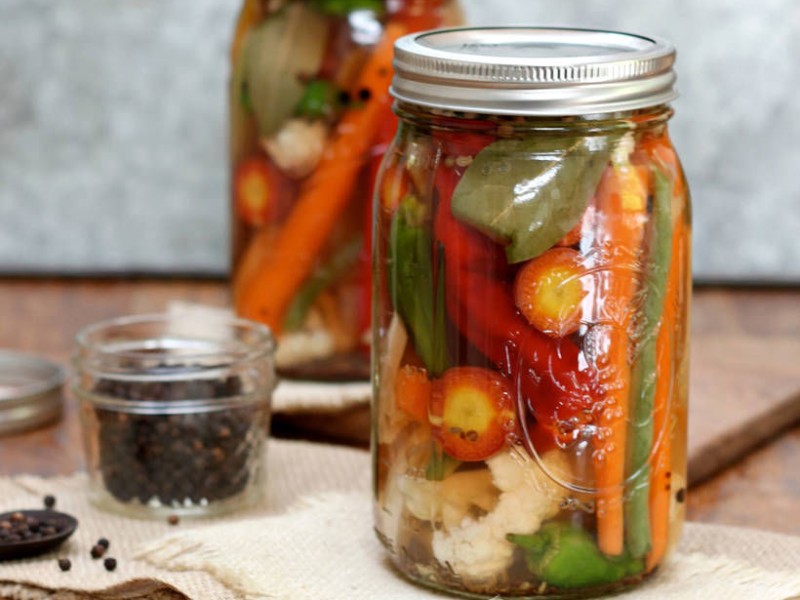
Note: Don’t be afraid to mix up your pickles with a variety of veggies in each jar. Not only are they diverse to eat, they also look very pretty when they fill the jar. Great candidates for pickling are cauliflower florets, peeled carrots, green beans, Kirby cucumbers, zucchini, okra … the list goes on.
For this recipe, you will need 2 (1-quart) mason jars or 4 (1-pint) jars. Run the jars through the dishwasher or wash by hand with hot soapy water and dry thoroughly before use.
Veggies:
2 pounds (any) vegetables, washed and dried, cut into spears, wedges, thick slices or bite-size pieces
Brine:
2 teaspoons black peppercorns
1 teaspoon coriander seeds
1 teaspoon brown mustard seeds
1 teaspoon fennel seeds
2 cups water
2 cups apple cider vinegar, or other vinegar to your taste
1/4 cup kosher salt
1/4 cup sugar
4 garlic cloves, smashed but intact
2 bay leaves
Tightly pack the vegetables into the jars.
Toast the peppercorns, coriander seeds, mustard seeds and fennel seeds in a large saucepan over medium heat until fragrant, about 1 minute. Add the remaining brine ingredients and bring to a boil, stirring to dissolve the salt and sugar. Remove from the heat and pour the brine over the vegetables.
Cover the jars and cool to room temperature. Transfer the jars to the refrigerator and chill for at least 24 hours (or store for up to 1 month) before using. The flavors will develop with time.
Lynda Balslev is the co-author of “Almonds: Recipes, History, Culture” (Gibbs Smith, 2014). Contact her at TasteFood, c/o Andrews McMeel Syndication, 1130 Walnut St., Kansas City, Mo. 64106, or send email to [email protected]. Or visit the TasteFood blog at tastefoodblog.com.
Related Articles

‘Sounds Like a Mutiny.’ Secret Recording Exposes Claims of Toxic Leadership After a Marine’s Suicide
This week’s War Horse story follows the systemic failures before and after the death of Cpl. Drew Mobley who was the third in two years at Marine Corps Base Quantico to die by suicide.
Southwest Georgia artists recognized at packed opening of exhibition
The annual juried exhibition, one of the region’s largest showcases of visual art, features approximately 46 artists and nearly 90 works spanning painting, sculpture, ceramics, photography and mixed media.

Powerful performances drive Theatre Albany’s ‘The Color Purple’
From the street, strands of purple ribbon wind around the white columns of the historic theater, hinting at the story waiting beyond its doors. Inside the foyer, a carefully curated slideshow flickers across a large screen, cycling through the faces of the cast. Some are seasoned performers. Others are stepping onto a stage for the very first time. Teachers stand alongside former students. Parents perform beside their children. People who worship in different churches, work different jobs and come from different corners of Southwest Georgia gather beneath the same lights to tell the same story.
