
Queen Bee: Jennifer Berry turns sweet hobby into her profession
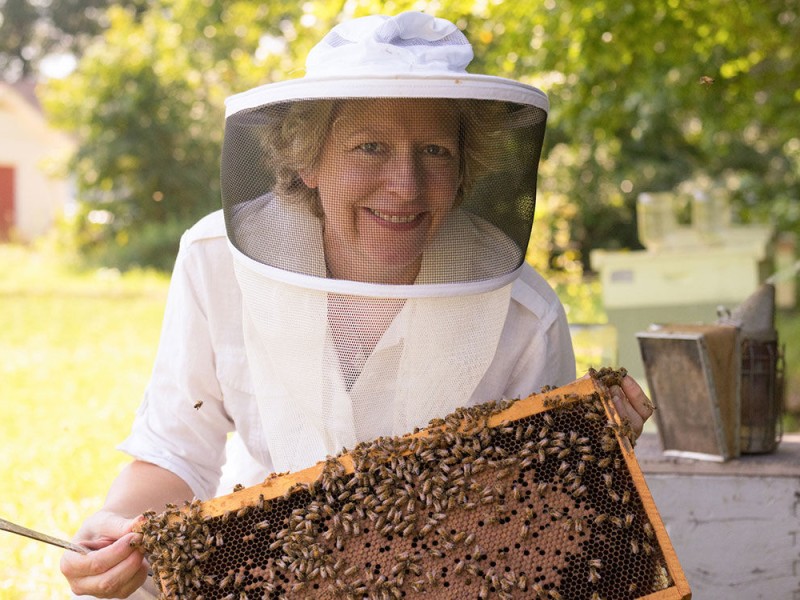
Special Photo: UGA/CAES
By Brandon Ward
UGA/CAES
ATHENS — Jennifer Berry has always been interested in insects. As a child, she would spend time in the woods behind her house, fascinated by the multilegged life that lived among the trees.
In summers, Berry visited her grandparents’ Missouri farm, where her grandfather would take her to a buzzing tree to collect bits of honeycomb. After safely smoking out some of the bees, he would hold Berry up to see the hive and take a couple of small combs for them to enjoy.
“I always wanted more,” she said.
But her grandfather, a steward of the environment, explained how hard the bees worked to create the honeycombs and taught Berry the values of moderation and preservation.
Attending the University of Georgia, Berry took her first beekeeping course with College of Agricultural & Environmental Sciences Professor Keith Delaplane. The rest, as they say, is history.
“I thought, ‘Oh my God, I’m going to do this the rest of my life,” Berry said.
After obtaining her degree, Berry landed a unique position with CAES. The college was constantly fielding requests from Georgia beekeepers for a research coordinator who had an extension appointment. Thus, her job — 50% research and 50% extension — was born.
Now, Berry is an apicultural research professional, lab manager for the UGA Bee Program, an educator — and, most recently, an entrepreneur.
Berry’s research is typically very applied. Throughout her career, she has focused on queen breeding, sub-lethal effects of pesticides on beneficial insects, and pest management techniques for varroa and small-hive beetle control. A varroa mite is a parasitic mite that infests honey bee colonies, feeding on the bees and transmitting viruses, which can lead to the decline and collapse of the colony. They are one of the most damaging honeybee pests in the world.
Part of Berry’s Ph.D. focuses on methods to control varroa mites, the western honeybee’s most devastating pest. The mites’ natural host is the Asian honeybee, but as humans brought European honeybees into Asia, the mite found a weaker host with no natural defenses. Research suggests this host shift happened over about 50-100 years and, in the time since, the mite has spread, collapsing honeybee colonies around the world.
The mites consumed fat body tissue from the bees, decreasing their life span and sometimes altering their behavior. They also transmit many viruses to the bees, infesting and often destroying whole colonies.
“That’s the real killer,” Berry said. “Viruses have always been around, but they have been benign until varroa came into the picture.”
Through her research, Berry wants to offer options for beekeepers to reduce varroa infestation.
The other half of Berry’s role is teaching and promoting good beekeeping practices around Georgia and the world.
Over the years, she has assisted organizations like Farmer to Farmer, during which she would travel to instruct beekeepers from across the United States, Europe and South America. She teaches skills necessary for beekeeping, often correcting bad information.
“We think of bees as somewhat domesticated because we’re taking care of them,” Berry said. “But they’re still wild and they’re going to do their own thing. As much as we think we know about them, they shift the rules all the time.”
It’s not as simple as taking your cat or dog to the vet. Many apiarists look to their local or state clubs for help when their colony suffers. This is where Berry comes in, applying her own research to improve information on pest management.
One project close to her heart is the Georgia Prison Beekeeping Program, which started at Glennville’s Smith State Prison in 2012. The UGA Bee Program began its support shortly thereafter in 2015. The first class saw 15 students certified through the Georgia Master Beekeeping Program. Now, it has expanded to eight prisons, with well over 200 participating and certified inmates.
The students’ passion for beekeeping and learning is gratifying, Berry said.
“So many of these students had to be taught to read to take the exam,” she said. “Once they realized they can pass a junior level UGA exam and make an A, they’re like, ‘Get out of my way.’”
Now that Berry has completed her Ph.D., she’s working with the Georgia Beekeeper Association to expand the program across the Southeast. They’re developing a training manual, resource list, and starter kit that would include a hive and other necessary materials.
Berry’s husband, Mark Davis, a Marine Corps veteran and CAES graduate, enjoys turning raw materials into finished products, whether blacksmithing, soap-making, fermenting, or distilling. One day it occurred to him that he could try making whiskey using the honey from their bee colonies as a sugar source.
“He created this whiskey, and we sampled it and let other people taste it,” Berry said. “They were like, ‘This is fantastic. You need to open a distillery.’”
After early struggles, the pair found a building in downtown Comer, opening the Soldier of the Sea Distillery in early 2023.
A revitalization effort was underway in Comer, and the distillery breathed new life into the town. New restaurants are opening, buildings are being sold and new businesses coming in, and a garden club has been created. Comer recently adopted a new town motto: “Comer is blooming.”
Soldier of the Sea also has a family and dog-friendly pub called The Hive. Berry took inspiration from her travels across Europe, wanting to bring that same sense of camaraderie and community the pub culture in Europe offers.
“That’s what I’ve loved watching at our pub, people meeting people they never would have had the opportunity to meet otherwise” Berry said. “I have a group of friends that we’re having dinner with, and there’s going to be 12 people at my house that I met at the pub. They’re my neighbors, and I never would’ve met them otherwise.”
Like her grandfather, Berry has become a steward to the environment and her community. She cares for honeybees and spreads knowledge to people some in society might have given up on, and she’s helping create a place of togetherness and bringing beauty back to the town she calls home.
Author

Related Articles

From cotton to cloud: In the data center debate, is rural Georgia once again being asked to carry the cost?
Across much of rural Georgia, the abandoned cotton warehouses and shrinking tax bases remain — enduring reminders that industries built to serve distant markets do not necessarily stay rooted in the communities that first sustained them.
My Grandpa Was Killed in World War II. I Met Him Through His Letters Home
Gina Wolf’s grandfather died before she was born. His letters sent to her grandmother from Europe during World War II made it possible to know what kind of man he was.

‘Sounds Like a Mutiny.’ Secret Recording Exposes Claims of Toxic Leadership After a Marine’s Suicide
This week’s War Horse story follows the systemic failures before and after the death of Cpl. Drew Mobley who was the third in two years at Marine Corps Base Quantico to die by suicide.
